Performance Marketing
A First-Party Data Strategy for Ecommerce

The data that powered a decade of digital advertising, third-party cookies and cross-site tracking, is being switched off. What remains, and grows more valuable, is the data your customers give you directly. First-party data is not a privacy workaround; it is the privacy-respecting foundation of modern ecommerce marketing. This guide explains what it is, why it matters, and how to build a strategy around collecting, unifying and activating it.
Quick answer
First-party data is the information customers share directly with you: purchases, email and account activity, site behaviour and preferences. As third-party cookies disappear, it becomes your most valuable marketing asset, because it is accurate, consented and yours. A good strategy collects it with clear value and permission, unifies it into one view of the customer, and activates it across email, ads and personalisation. The brands that invest in first-party data now will measure, target and retain better than those still relying on tracking that is going away.
Key takeaways
- First-party data is what customers share with you directly: accurate, consented, yours.
- It grows more valuable as third-party cookies and cross-site tracking disappear.
- Collect it through genuine value exchange and clear consent.
- Unify scattered signals into one customer view to unlock its power.
- Activate it across email, ads, on-site personalisation and retention.
What first-party data is
First-party data is information you collect directly from your customers and audience, with their knowledge:
It is accurate, consented and unique to you, which is exactly what third-party data never was.
- Purchase history and order value.
- Email engagement and account activity.
- On-site behaviour and product interest.
- Stated preferences, reviews and survey responses.
Why it matters more now
With third-party cookies and cross-site tracking disappearing, the targeting and measurement that relied on them degrade. First-party data is resilient to this because it does not depend on other sites or cookies. It powers better email and retention, stronger ad signals through secure matching, sharper personalisation, and measurement you actually own. It is becoming the core competitive asset in ecommerce marketing.
Collect it with value and consent
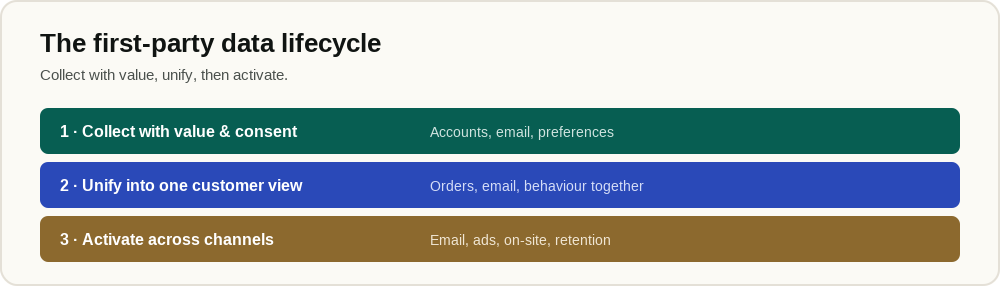
People share data when they get something worthwhile and trust how it is used. Build collection into genuine value exchanges: accounts with real benefits, helpful email, useful preferences, honest incentives. Always with clear consent and transparent use. Data grabbed without value or permission is both low quality and a compliance risk.
Unify it into one customer view
Scattered data is weak data. The strategy's heart is unifying signals, orders, email, site behaviour, into a single view of each customer. That unified profile is what makes good segmentation, personalisation and measurement possible. Without it, you have fragments; with it, you have an asset.
Activate it everywhere
First-party data earns its keep when you use it:
- Email and lifecycle: segment and personalise by behaviour and value.
- Ads: secure matching for better targeting and suppression, plus modelling for acquisition.
- On-site: personalise recommendations and experience.
- Retention: identify and nurture high-value customers.
FAQ
Frequently asked questions
First-party data is collected directly from your own customers with their knowledge. Third-party data is bought or gathered across other sites, often via cookies. First-party is more accurate, consented and resilient as tracking disappears.
Third-party cookies and cross-site tracking are being removed, degrading the targeting and measurement that relied on them. First-party data does not depend on other sites, so it becomes the stable foundation for modern ecommerce marketing.
Offer genuine value in exchange: useful accounts, helpful email, real incentives and preference choices, always with clear consent. People share willingly when they benefit and trust how their data is used.
Bringing scattered signals, orders, email, site behaviour, into one view of each customer. That unified profile is what enables good segmentation, personalisation and measurement. Fragmented data stays weak.
Through privacy-safe secure matching to improve targeting and suppress existing customers, and as input to modelling for acquisition. It strengthens ad signals without relying on third-party cookies.
Similar posts
Measurement
Server-Side Tracking and the Cookieless Future
Server-side tracking collects data via your own server, improving accuracy as cookies and client-side tracking erode. What it solves, what it does not, and consent first.
4 min read
Ecommerce Growth
Ecommerce Retention Marketing: How to Turn First-Time Buyers into Repeat Customers
Learn how ecommerce retention marketing works, which customer journeys to build, and how to measure repeat purchases, retention, and customer value.
14 min read
Ecommerce Growth
Ecommerce Email Marketing Automation: Lifecycle Flows That Support Profitable Growth
Learn how to plan ecommerce email automation, build useful lifecycle flows, measure results, and improve customer experiences without over-messaging.
14 min read
Related services