Ecommerce Growth
Ecommerce Email Marketing Automation: Lifecycle Flows That Support Profitable Growth

Email automation can help an ecommerce business deliver useful messages at the right stage of the customer journey. It can confirm an action, explain how to use a product, recover a relevant shopping journey, introduce complementary products, or reconnect with a customer after a meaningful period of inactivity. But automation is not automatically effective just because it is automated. A flow can send the wrong product recommendation, contact someone who has already purchased, repeat a message from another channel, or offer a discount when a customer needs support instead. Poorly managed automation can damage trust and make performance reports misleading. A strong programme starts with customer needs, clean event data, clear eligibility rules, and a measurement plan. It connects to the wider growth framework: Diagnose → Acquire → Convert → Scale → Compound. Automation can help scale a good customer experience, but it cannot compensate for a broken checkout, poor product fit, unreliable fulfilment, or weak measurement.
Quick answer
It is the use of rules and customer events to send relevant email messages at defined points in the shopping and ownership journey, such as signup, checkout abandonment, post-purchase education, or a suitable repeat-purchase window.
Key takeaways
- Ecommerce email automation sends messages in response to a defined event, customer attribute, or time condition.
- A campaign is typically a one-time message sent to a chosen audience, such as a new collection announcement or seasonal promotion.
- Start with a customer journey map, not a long list of templates.
- The following flows are a practical starting point, not a requirement to activate every journey.
What ecommerce email automation does
Ecommerce email automation sends messages in response to a defined event, customer attribute, or time condition. Examples include a signup, an abandoned checkout, a completed order, a product-use milestone, or a period without a repeat purchase.
Automation is most useful when the trigger has a clear relationship to the message. A shipping update should be triggered by order status. A product-care email should match the product purchased. A replenishment reminder should be relevant to an item that customers plausibly use up or replace.
Campaigns versus flows
A campaign is typically a one-time message sent to a chosen audience, such as a new collection announcement or seasonal promotion.
A flow or journey is a sequence triggered by an event or condition. It may contain delays, branching logic, eligibility checks, and exit rules.
Both can be useful. Campaigns support planned communication; flows support timely, repeatable customer experiences. They need shared frequency rules so customers do not receive several unrelated promotions at once.
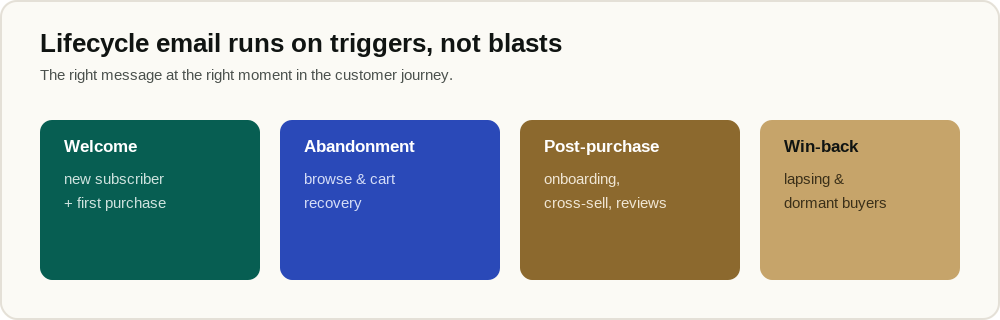
Plan the lifecycle before writing emails
Start with a customer journey map, not a long list of templates.
For each proposed flow, document:
The same event can require different actions depending on context. Someone who abandoned a checkout but then completed an order should not continue receiving checkout reminders. A customer with an unresolved delivery issue may need service support rather than a cross-sell offer.
- Customer need: What question, task, or uncertainty does this message address?
- Trigger: Which event or condition starts the journey?
- Eligibility: Who should receive it, and who should be excluded?
- Timing: When is the message likely to be useful?
- Content: What is the single most helpful next step?
- Exit condition: What event ends the journey or makes later messages irrelevant?
- Success metric: What customer or business outcome should change?
- Guardrails: Which negative signals require a pause or revision?
Core ecommerce email flows
The following flows are a practical starting point, not a requirement to activate every journey. Prioritise the flows that fit the business model, product cycle, customer permissions, and available data.
1. Welcome flow
Purpose: Set expectations and help a new subscriber understand the brand.
Potential sequence:
Do not assume that every subscriber is a first-time buyer. Check order history and suppress content that is no longer relevant. Make consent and preference controls clear.
- Acknowledge the signup and explain what the subscriber can expect.
- Introduce the product range, brand story, or key buying guidance.
- Help the subscriber choose a relevant category or find answers to common questions.
- Present an offer only when it is part of the documented strategy and commercially sensible.
2. Browse-abandonment flow
Purpose: Help a visitor return to a product or category they explored.
This flow may use browsing events and identity matching, subject to consent, platform rules, and applicable law. Keep the message useful and restrained. A reminder can link to the relevant product or provide decision-support information, such as sizing, materials, compatibility, or delivery details.
Do not imply that an item is still available unless inventory data supports the claim. Avoid invasive wording that makes customers uncomfortable about how their activity was observed.
3. Cart or checkout recovery
Purpose: Help a customer complete a shopping journey they did not finish.
First determine which event is reliable: adding an item to a cart, starting checkout, or reaching another documented step. These events represent different levels of intent and may have different data availability.
Useful content can include:
Set exit rules so completed orders stop the recovery sequence. Test links, stock status, price accuracy, and mobile rendering before launch.
- A direct link back to the saved cart or checkout, if supported.
- Clear delivery, returns, payment, or sizing information.
- Access to customer support.
- A promotion only when there is a sound commercial reason to offer one.
4. Post-purchase flow
Purpose: Reduce uncertainty and help customers get value from the product.
Potential content includes order-related information, product education, care instructions, setup guidance, and support routes. Separate operational or transactional communications from promotional messages and apply the appropriate consent and legal requirements.
Product context matters. Apparel, bedding, furniture, electronics, and consumables have different education needs. Avoid sending generic cross-sell content before the customer has received the item or had a reasonable opportunity to use it, unless the message is genuinely relevant.
5. Review and feedback request
Purpose: Invite honest feedback after a customer has had enough time to experience the product.
Choose timing based on delivery and product-use context, not merely the order date. Keep the request straightforward and provide a route to customer support for issues.
Do not condition an incentive on a positive review or selectively solicit reviews only from customers expected to be satisfied. Follow the review platform's rules and applicable consumer-protection requirements.
6. Cross-sell and product discovery
Purpose: Help customers find a complementary or relevant next product.
Use purchase history, product compatibility, customer preferences, and reliable inventory information where available. Recommendations should be genuinely related to the original order.
Suppress items the customer already bought when repeat purchase is not appropriate, and avoid recommending accessories or products that do not fit the customer's selection. Relevance is more valuable than adding more items to every email.
7. Replenishment or repeat-purchase flow
Purpose: Remind customers about products they may need again.
Use observed reorder patterns or reasonable product-use information to estimate timing. Make it easy to adjust preferences or manage a subscription if the business offers one.
Do not apply replenishment logic to durable goods without a credible reason. If the purchase cycle is uncertain, start with a helpful discovery message or test timing before scaling the flow.
8. Win-back flow
Purpose: Re-engage customers who have not returned within a meaningful, category-specific period.
A useful win-back message might highlight relevant new products, helpful content, improved service, or a preference update. A discount can be tested, but it should not be the automatic first step.
Define inactivity based on the product's natural purchase cycle and observed cohort data. A long gap may be normal for furniture and unusual for frequently replenished products.
9. Back-in-stock or price-related alerts
Purpose: Respond to a specific product interest when the item becomes available or a relevant price condition changes.
Only send these messages to eligible customers who requested or otherwise validly consented to the alert where required. Ensure inventory and pricing events are accurate, and stop the journey when the alert is no longer relevant.
10. Customer service and exception communications
Purpose: Resolve problems or keep customers informed about an order or account issue.
These messages should be triggered by reliable operational data and prioritise clarity. Promotional content should not obscure important service information. If a customer has an open complaint or unresolved delivery issue, suppress unrelated sales messaging when appropriate.
Write messages customers find useful
A good lifecycle email has a clear reason to exist. The subject line sets an accurate expectation, the body answers a question or provides a next step, and the call to action matches the customer's situation.
A practical email structure
Avoid misleading urgency, false scarcity, exaggerated claims, and subject lines that imply a personal message when the email is promotional. Use a mobile-friendly layout, accessible text, descriptive links, and meaningful alt text for informative images.
- 01Context: Make clear why the customer is receiving the message.
- 02Value: Answer a question, reduce friction, or show a relevant option.
- 03Action: Provide one primary next step.
- 04Support: Make it easy to get help or update preferences.
- 05Trust: Use accurate claims, clear sender identity, and an appropriate unsubscribe or preference mechanism.
Personalisation should improve relevance
Using a first name is not the same as personalisation. Useful personalisation changes the message based on a valid customer need, such as category interest, product compatibility, or an appropriate replenishment window.
Check fallback logic. If the customer's name, product, image, or recommendation is missing, the email should still read naturally and accurately.
Segmentation, timing, and suppression rules
Flows become safer and more useful when the business defines who qualifies and when communication should stop.
Useful starting segments
Keep the first version simple. Add segments when they change the message, timing, or business decision, not just because the platform supports another filter.
- New subscribers who have not purchased.
- First-time customers.
- Repeat customers.
- Customers who purchased a particular category.
- Customers eligible for a relevant replenishment reminder.
- Customers who requested a back-in-stock notification.
- Customers with recent orders or open service issues.
- Customers inactive beyond a documented, category-informed window.
Build suppression and exit logic
At minimum, review:
Create a contact policy that defines message priority, promotional frequency, quiet periods where appropriate, and which messages are operational versus promotional. Apply current laws, consent requirements, and provider policies to each channel and market.
- Completed purchase after cart or checkout abandonment.
- Unsubscribe, complaint, or consent withdrawal.
- A product going out of stock or becoming incompatible with the recommendation.
- An open service issue that should take priority over promotion.
- Another flow or campaign that would create excessive contact.
- A customer already receiving the same message through another channel.
Measure performance beyond opens
Open rates can be affected by privacy features, image loading, and mailbox behaviour. Use them cautiously and do not treat an open as definitive proof that a person read the message.
Operational metrics
- Delivery and bounce rates.
- Spam complaint and unsubscribe rates.
- Link clicks and click-through behaviour.
- Flow errors, broken links, and invalid personalisation.
- Frequency and suppression-rule performance.
Business outcomes
Attributed revenue is not the same as incremental revenue. Some recipients would have purchased without the email. Where volume and tooling allow, use a suitable holdout group or controlled experiment to estimate the effect of the flow. Document eligibility, observation window, and primary metric before launch.
- Completed purchases and revenue under a clearly stated attribution method.
- Repeat purchase rate over a defined window.
- Contribution after discounts and relevant costs, where available.
- Time to second purchase.
- Refunds, cancellations, returns, or service contacts when relevant.
- Incremental impact compared with a credible holdout, when practical.
Use guardrails
A flow should not be scaled only because it produces attributed orders. Review unsubscribes, complaints, returns, discount costs, customer-service signals, and longer-term cohort behaviour. A short-term gain may not justify a decline in trust or contribution.
Deliverability, consent, and privacy
Email performance depends on whether messages are wanted, properly configured, and delivered reliably.
Before launch:
Technical requirements vary by provider and change over time. Verify the current official documentation rather than relying on an old checklist. Transactional and promotional messages may be treated differently under applicable rules; do not assume one consent model applies to every message.
- Use accurate sender identity and a monitored reply-to address.
- Configure and verify the relevant sending-domain authentication, such as SPF, DKIM, and DMARC, according to your provider's current instructions.
- Maintain clean subscription records and honour opt-outs promptly.
- Avoid purchased or scraped lists and practices that create unwanted messages.
- Monitor bounces, complaints, and delivery trends.
- Use a preference centre where appropriate and explain what subscribers can expect.
- Collect and use personal data transparently and only for appropriate purposes.
- Review the laws and platform policies that apply to each market and message type.
A practical 30-day rollout
Week 1: Audit and prioritise
- Review list sources, consent records, suppression logic, and current email performance.
- Map key customer events and check whether they are tracked reliably.
- Identify the two or three flows most relevant to the product and buying cycle.
- Define each flow's customer need, success metric, and guardrails.
Week 2: Design the journeys
- Map triggers, delays, eligibility, branches, and exit conditions.
- Draft messages around customer questions and useful next steps.
- Review offer economics before adding discounts.
- Confirm that links, product data, consent, and fallback content are available.
Week 3: Test and launch
- Test on mobile and desktop, and across supported email clients where practical.
- Verify personalisation fallbacks, links, product availability, and purchase exits.
- Check sender authentication and suppression behaviour.
- Launch in a controlled way and monitor operational signals closely.
Week 4: Evaluate and improve
A 30-day rollout can establish the foundation and launch initial flows. It may not be long enough to judge repeat-purchase or lifetime-value impact, especially for products with long buying cycles.
- Review delivery, complaints, unsubscribes, engagement, and business outcomes.
- Compare performance with a documented baseline.
- Use a holdout or controlled test when feasible.
- Pause or revise flows that are inaccurate, irrelevant, or generating negative signals.
- Record what changed and schedule the next review.
Common automation mistakes
- 01Automating before validating events. Incorrect triggers create irrelevant messages.
- 02Using one sequence for every product. Customer needs and reorder cycles vary.
- 03Ignoring purchase exits. Customers may keep receiving abandoned-cart reminders after ordering.
- 04Overusing discounts. Offers can reduce contribution or create expectations of future promotions.
- 05Treating attributed revenue as incremental. Use credible tests where feasible.
- 06Over-messaging across channels. Coordinate email, SMS, and campaigns with a shared contact policy.
- 07Ignoring deliverability and consent. A technically functional flow can still be inappropriate or unwanted.
- 08Relying on open rate alone. Privacy features and mailbox behaviour limit its meaning.
- 09Skipping content fallbacks. Missing data can create broken or embarrassing messages.
- 10Failing to maintain the system. Product catalogues, policies, links, and platform features change.
Credible reference points
Verify current requirements and implementation details using official documentation:
These references are starting points for verification. Check the current requirements for the specific email service provider, ecommerce platform, market, and message type before implementation.
---
Editorial note: This draft is intended for review before publication. Verify the site's live internal routes, platform-specific details, email consent requirements, and author information. Add original performance examples only when supported by verified evidence.
- Google Search Central, Article structured data: https://developers.google.com/search/docs/appearance/structured-data/article
- Google Search Central, SEO Starter Guide: https://developers.google.com/search/docs/fundamentals/seo-starter-guide
- Google Workspace Admin Help, email authentication and sender requirements: https://support.google.com/a/
- Mailchimp Help Center, email marketing and automation guidance, where relevant: https://mailchimp.com/help/
- Shopify Help Center, marketing and customer segmentation features, where relevant: https://help.shopify.com/
FAQ
Frequently asked questions
It is the use of rules and customer events to send relevant email messages at defined points in the shopping and ownership journey, such as signup, checkout abandonment, post-purchase education, or a suitable repeat-purchase window.
Start with flows that solve a clear customer need and have reliable triggers. Depending on the business, that may include a welcome flow, checkout recovery, post-purchase education, or a relevant repeat-purchase journey. Do not activate every possible flow at once.
There is no universal ideal number. The sequence should be long enough to serve the customer need and short enough to avoid repetition or fatigue. Test timing and message count against business outcomes and negative signals.
Not automatically. First remove friction by providing a clear return path and helpful information. Test discounts only when the economics justify them, and measure contribution and incremental outcomes where practical.
A campaign is usually a planned one-time message to a selected audience. A flow is triggered by an event, attribute, or condition and may include delays, branching, and exit rules. Both need coordinated frequency and suppression policies.
Monitor delivery and complaint signals, engagement, completed purchases under a stated attribution method, repeat behaviour, contribution where available, and unsubscribe rates. The right primary metric depends on the flow's purpose.
No. Compliance depends on how consent was collected, the type of message, the recipient's market, applicable law, and provider policies. Keep records, honour opt-outs, and verify current requirements before launch.
Similar posts
Ecommerce Growth
Ecommerce Retention Marketing: How to Turn First-Time Buyers into Repeat Customers
Learn how ecommerce retention marketing works, which customer journeys to build, and how to measure repeat purchases, retention, and customer value.
14 min read
Ecommerce Growth
Customer Lifetime Value (LTV) for Ecommerce: How to Measure and Use It
Learn how to calculate ecommerce customer lifetime value, distinguish revenue from contribution, compare LTV with CAC, and use cohorts to guide profitable growth.
11 min read
CRO
Ecommerce Conversion Rate Optimisation: A Practical Framework for More Profitable Sales
Learn how to improve ecommerce conversions with a practical CRO framework covering funnel analysis, product pages, checkout, mobile UX, testing, and revenue quality.
14 min read
Related services
Related work