SEO
Entity SEO: Building a Brand Entity for AI Search

Search and AI systems increasingly think in entities, distinct things like a company, a person or a product, rather than just keywords. When the engine clearly understands who you are and what you are known for, it can confidently surface and cite you. When your identity is fuzzy or inconsistent, it hesitates. Entity SEO is how you remove that doubt. This article explains what an entity is and the practical steps to strengthen yours for both classic and AI search.
Quick answer
Entity SEO is the practice of making your brand, people and products recognisable, consistent "entities" that search and AI systems understand and trust. You build an entity with consistent naming across your site and the web, clear organisation and person markup, an authoritative "about" presence, and corroborating mentions on reputable sources. A strong entity is what makes an engine treat you as a default source for your topic, rather than an occasional one.
Key takeaways
- Entity SEO makes your brand, people and products recognisable and trusted.
- Engines reason in entities; a clear one earns confident citations.
- Build it with consistency, structured data, an about presence and corroboration.
- Own a focused set of topics so the engine knows what you stand for.
- Inconsistency and anonymity are the main things that weaken an entity.
What an entity is
An entity is a uniquely identifiable thing with attributes and relationships: your organisation, its founders and authors, its products and the topics it is known for. Engines build a model of each entity from your site and from the wider web, then use it to decide relevance and trust. The clearer and more consistent that model, the stronger your entity.
Why entities matter for AI
Generative systems prefer sources they can identify and verify. A well-defined entity gives them a confident answer to "who is this and are they credible on this topic". That confidence is what turns you into a source worth citing. A vague or contradictory identity, by contrast, makes you a risky choice the engine avoids.
How to build a strong entity
Be consistent everywhere
Use the same brand name, spelling, logo, descriptions and key people across your site, profiles, directories and publications. Inconsistency splits your identity and weakens recognition.
Mark up who you are
Add organisation and person structured data, link your profiles, and keep an authoritative about page. This gives engines explicit, machine-readable facts about your entity.
Earn corroboration
Entities are strengthened by being referenced consistently on reputable third-party sources, publications, directories, reputable mentions and links. Corroboration from places the engine already trusts is powerful.
Own a clear topic
Publish depth on a focused set of topics so the engine associates your entity with them. Topic clusters, consistent authorship and genuine expertise all reinforce the association.
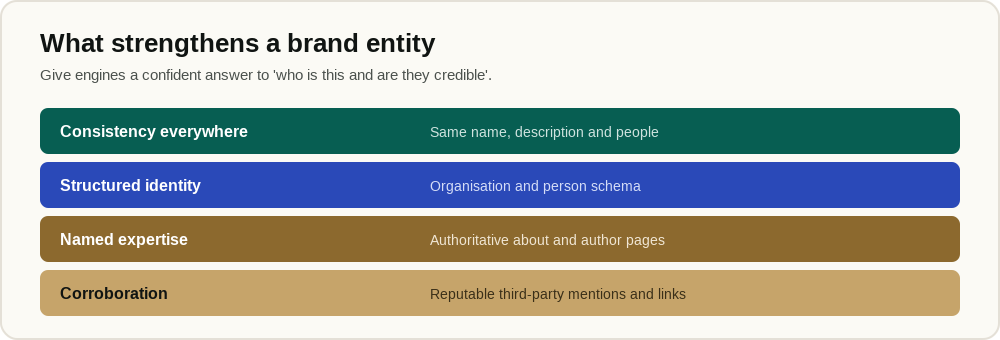
Signals that strengthen an entity
- Consistent name, descriptions and key people across the web.
- Organisation and person schema, and linked, verified profiles.
- An authoritative about page and named, credentialled authors.
- Reputable third-party mentions and links.
- Depth and consistency on a defined set of topics.
Common mistakes
- Using different brand names, spellings or descriptions in different places.
- Anonymous content with no identifiable authors or organisation.
- Thin or missing about and author information.
- Chasing unrelated topics, which blurs what your entity is known for.
FAQ
Frequently asked questions
Keyword SEO targets the words people search; entity SEO builds a clear, trusted identity the engine understands. Modern search uses both, and entities increasingly drive trust.
Use person schema, named bylines, author pages with credentials, and consistent profiles across the web so the engine can identify and verify them.
No. A Wikipedia page can help notable brands, but you build entity strength through consistency, structured data, an about presence and reputable mentions regardless.
It compounds over months as consistency and corroboration accumulate. There is no instant switch; it is a steady discipline.
Yes. A clear, trusted entity gives AI systems the confidence to cite you, which is central to generative engine optimization.
Similar posts
AI Search & GEO
Generative Engine Optimization (GEO): The Complete Playbook for Getting Cited by AI
A practitioner's guide to GEO: how to get your brand cited by ChatGPT, Google AI Overviews and Perplexity. What works, what you cannot control, and a 30-day plan.
6 min read
AI Search & GEO
How AI Chooses Which Sources to Cite
AI engines retrieve, then prefer clear answers from trusted sources. A high-level look at how citation decisions work, what it means for you, and the honest limits.
3 min read
Technical SEO
Structured Data for AI Search: What Actually Helps
Which schema types matter for AI visibility, and which do not. How structured data supports AEO and GEO, the rules for using it well, and where people go wrong.
4 min read
Related services