Ecommerce SEO
Marketplace SEO vs Your Ecommerce Website: How to Build a Balanced Organic Strategy

Marketplaces and an owned ecommerce website serve different roles. Marketplaces can provide access to shoppers already browsing a platform, while an owned site gives a brand more control over merchandising, content, experience, analytics, and customer relationships. The right strategy is rarely an all-or-nothing choice. It depends on margins, customer behaviour, product differentiation, fulfilment capability, and the brand’s stage of growth.
Quick answer
The decision depends on economics, audience, control, and operating capacity; many brands use both with different roles.
Key takeaways
- Marketplace search generally operates within a platform’s catalogue, policies, ranking systems, and listing requirements.
- Decide which products are suited to marketplace discovery, which need richer education or configuration on the owned site, and where exclusivity or assortment differences matter.
- Maintain a reliable source of truth for product names, identifiers, dimensions, materials, variants, availability, and imagery.
- An owned website should offer more than a duplicate catalogue.
Understand the difference
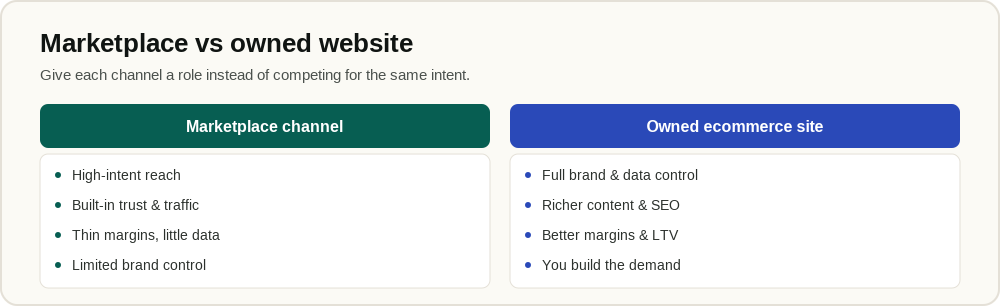
Marketplace search generally operates within a platform’s catalogue, policies, ranking systems, and listing requirements. Owned-site SEO focuses on helping search engines discover and understand the brand’s pages across categories, products, and useful editorial resources. The ranking factors, reporting access, and available controls differ, so do not assume a tactic that helps one channel will work identically in the other.
Create a channel role for each product group
Decide which products are suited to marketplace discovery, which need richer education or configuration on the owned site, and where exclusivity or assortment differences matter. Consider price competition, fulfilment costs, return rates, stock reliability, and customer service requirements. Avoid listing products on a channel simply because competitors do so; calculate whether the economics and operational demands make sense.
Keep product information consistent
Maintain a reliable source of truth for product names, identifiers, dimensions, materials, variants, availability, and imagery. Channel-specific formatting may be necessary, but core facts should not contradict one another. Clear data reduces customer confusion and makes feed maintenance easier. Do not copy marketplace reviews or user content to your own site unless usage rights and platform rules permit it.
Build the owned site’s distinct value
An owned website should offer more than a duplicate catalogue. It can provide detailed category guidance, comparison tools, compatibility information, care advice, brand story, policies, and support content. Use these resources to answer questions that listings cannot fully resolve. Ensure product pages and guides connect naturally through internal links.
Measure channel economics honestly
Compare contribution after channel fees, fulfilment, promotions, returns, and other relevant costs, not revenue alone. Attribution between marketplace discovery and later branded search can be difficult to establish. Use available platform reports and analytics without claiming that one channel caused every subsequent sale. Define channel-specific goals and a shared view of total demand where data supports it.
A practical operating model
Maintain a central product-data workflow, channel-specific listing checks, an owned-site SEO backlog, and a regular profitability review. Assign owners for feed quality, inventory, content, technical SEO, and reporting. For product launches, coordinate availability, landing pages, marketplace listings, and support content so that customers encounter consistent information.
Risks and common mistakes
Avoid underpricing the owned site without understanding channel agreements, making unsupported delivery promises, allowing conflicting product data, or treating marketplace ranking as proof of overall brand demand. Do not assume that traffic from marketplaces is fully measurable across channels. Protect customer privacy and follow platform terms when using customer information.
FAQ
Frequently asked questions
The decision depends on economics, audience, control, and operating capacity; many brands use both with different roles.
Marketplace listing performance does not automatically transfer ranking authority to your own site.
Core facts should remain consistent, while presentation can be adapted to each channel’s rules and shopper needs.
Evaluate contribution and strategic value alongside revenue, using reliable channel-specific data.
Similar posts

SEO
Ecommerce SEO: The Complete Guide to Growing Organic Revenue
Learn how to grow ecommerce organic revenue with category SEO, product pages, technical SEO, structured data, internal linking, content strategy and measurement.
24 min read
SEO
Ecommerce Category Page SEO: How to Build Pages That Rank and Help Shoppers Choose
Learn how to optimise ecommerce category pages with better architecture, helpful copy, internal links, filters, and measurement.
15 min read
Technical SEO
Ecommerce Product Data Quality: Connecting SEO, Merchant Feeds, and On-Site Experience
Connect SEO, merchant feeds and on-site experience with one source of truth. Consistent titles, identifiers, price, availability and images across every surface.
3 min read
Related services
Related work