Technical SEO
Ecommerce Product Data Quality: Connecting SEO, Merchant Feeds, and On-Site Experience


Product data is shared across the ecommerce experience: category listings, product detail pages, structured data, shopping feeds, ads, inventory systems, and customer support. When the same product has conflicting names, prices, identifiers, availability, or variant attributes, the result can be confusing for shoppers and difficult for teams to diagnose. A dependable product-data process supports both organic discovery and commercial operations.
Quick answer
It supports clearer pages, crawlable product information, and consistent structured data, but it does not guarantee rankings.
Key takeaways
- Decide which system owns each attribute.
- Titles should identify the product clearly and include distinguishing attributes where useful, such as type, model, size, material, or colour.
- Use valid product identifiers when available and appropriate.
- Visible price, structured data, and submitted feed values should reflect the actual offer and applicable currency.
Define a source of truth
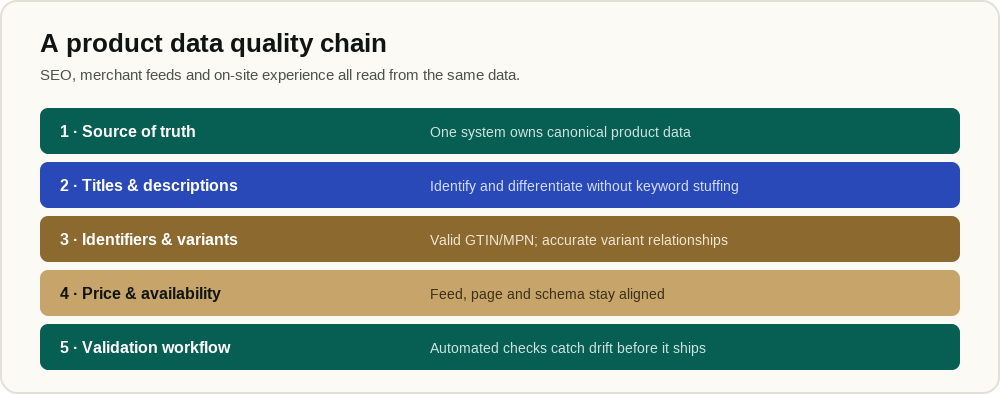
Decide which system owns each attribute. A product information management system, ecommerce platform, ERP, inventory tool, or feed service may be authoritative for different fields. Document the owner of product titles, identifiers, price, availability, dimensions, materials, images, and variant relationships. Avoid manual edits in downstream channels that are overwritten or become inconsistent later.
Create useful product titles and descriptions
Titles should identify the product clearly and include distinguishing attributes where useful, such as type, model, size, material, or colour. Descriptions should explain meaningful features and use cases without unsupported superlatives or repetitive keyword strings. Differentiate variants accurately. Do not force every possible keyword into every title.
Validate identifiers and variants
Use valid product identifiers when available and appropriate. Ensure parent-child relationships and variant attributes are clear. If colour or size variants have separate URLs, determine how the pages should be canonicalised and represented. The right implementation depends on the platform and whether each variant provides a distinct useful page experience. Avoid inventing GTINs, SKUs, or manufacturer details.
Keep price and availability aligned
Visible price, structured data, and submitted feed values should reflect the actual offer and applicable currency. Availability should be updated when stock changes. If discounts have conditions, communicate them accurately. Stale prices and contradictory availability can harm customer trust and create feed or structured-data issues.
Align images and attributes
Use images that represent the actual item and variant. Add meaningful alt text where it helps describe an image to users who cannot see it; do not stuff alt attributes with keywords. Fill structured product attributes only when they are accurate. If a material, dimension, or compatibility field is unknown, do not guess.
Create a validation workflow
Run checks before launch and after bulk updates. Useful tests include missing required fields, duplicate identifiers, malformed URLs, broken images, invalid price formats, availability mismatches, variant gaps, and discrepancies between the feed and live page. Prioritise errors that affect many products or commercially important groups.
Governance and measurement
Assign an owner for each attribute group and define how issues are escalated. Monitor feed diagnostics, page errors, product disapprovals where applicable, organic landing performance, and customer-facing mistakes. Use a change log for large imports or catalogue transformations so that teams can connect an issue to a source update.
FAQ
Frequently asked questions
It supports clearer pages, crawlable product information, and consistent structured data, but it does not guarantee rankings.
They should describe the same product accurately, but formats can differ to meet channel requirements.
No. Use verified supplier or product information and mark unknown fields for review.
Frequency should match how often price, stock, and catalogue data change and the channel’s requirements.
Similar posts

CRO
Ecommerce Product Page Optimisation: SEO, UX, and Conversion Checklist
Learn how to optimise ecommerce product pages for search visibility, customer confidence, and conversions with a practical product-page checklist.
17 min read

Technical SEO
Beyond Alt Text: An Ecommerce Image SEO Workflow for Product Discovery and Accessibility
A practical ecommerce image SEO workflow: accurate product imagery, purposeful alt text, optimised delivery and supporting page context for discovery and accessibility.
3 min read

SEO
Ecommerce Category Page SEO: How to Build Pages That Rank and Help Shoppers Choose
Learn how to optimise ecommerce category pages with better architecture, helpful copy, internal links, filters, and measurement.
15 min read
Related services
Related work