SEO
Ecommerce SEO Content Strategy: Build Useful Content That Supports Organic Growth

An ecommerce SEO content strategy is not simply a calendar of blog posts. It is a plan for creating and maintaining useful pages that help people discover products, understand their options, solve buying questions, and move naturally toward relevant categories or product pages. A store may publish regularly and still struggle to earn meaningful organic results if topics are chosen without a clear audience need, articles repeat one another, category pages remain unsupported, or content fails to answer the questions that influence a purchase. Publishing more is not automatically the same as building topical usefulness. A strong strategy connects customer questions, search intent, product expertise, site architecture, and business priorities. It also defines what to update, consolidate, or retire, not just what to publish next. My working framework is Diagnose → Acquire → Convert → Scale → Compound. For ecommerce content, that means diagnosing audience needs and existing gaps, creating content that earns relevant discovery, connecting it to useful shopping paths, scaling what works with consistent quality controls, and compounding value through maintenance and internal links.
Quick answer
It is a plan for creating, organising, connecting, measuring, and maintaining useful content that answers customer questions and supports the discovery of relevant products. It includes choosing topics, assigning page types, building internal links, and reviewing quality and performance.
Key takeaways
- Begin with the questions customers ask before, during, and after choosing a product.
- Prioritise questions that help customers choose correctly, reduce uncertainty, explain important differences, or address a real product-selection problem.
- Before creating new content, understand what is already published.
- Different searches call for different page formats.
1. Start with customer and business questions
Begin with the questions customers ask before, during, and after choosing a product. These questions are often more useful than starting with a large list of keywords and trying to turn every phrase into an article.
Gather evidence from:
Use customer information responsibly. Remove personal details and avoid publishing private support conversations. Treat recurring questions as signals to investigate, not proof that every question needs a standalone blog post.
- Customer support tickets and chat conversations
- On-site search terms and search refinements
- Reviews and product questions
- Sales and merchandising teams
- Returns, exchanges, and cancellation reasons
- Search Console query data
- Competitor category structures and public buying guides
- Product specifications, manuals, and manufacturer documentation
- Frequently misunderstood product differences or compatibility issues
Connect questions to business priorities
Prioritise questions that help customers choose correctly, reduce uncertainty, explain important differences, or address a real product-selection problem. The best content opportunities often sit at the intersection of customer need, credible expertise, product relevance, and a realistic ability to create something useful.
Do not choose a topic only because a keyword tool reports search volume. Check whether the query matches the products and expertise the business can genuinely support.
2. Audit the content you already have
Before creating new content, understand what is already published. An audit can reveal strong pages that need better internal links, outdated guides that require revision, overlapping articles that compete for the same purpose, and topics that are missing entirely.
Build a content inventory with fields such as:
Classify each page into a practical action group:
Do not consolidate pages solely because their keywords overlap. Review their audience, intent, links, performance, and distinct information first. Likewise, do not delete content just because traffic is low; it may serve customers or support an important product decision.
- URL and page type
- Topic and intended audience
- Primary intent or question
- Publication and last meaningful update dates
- Organic impressions and clicks where available
- Relevant engagement and conversion measures where available
- Internal links to and from the page
- Accuracy and freshness status
- Product or category relationships
- Recommended action
- Keep: accurate, useful, and still relevant.
- Improve: valuable topic but incomplete, unclear, outdated, or poorly connected.
- Consolidate: multiple pages serve substantially the same need and one stronger resource may be more useful.
- Retire: no longer useful and has no defensible replacement or ongoing purpose.
- Investigate: insufficient evidence to decide.
3. Map topics to search intent and page type
Different searches call for different page formats. A person looking for a specific product may need a product page; someone comparing materials may need a comparison guide; someone exploring a broad product group may need a category page.
A practical mapping table:
These are starting points, not rigid rules. Search results and customer behaviour should help determine the best page type.
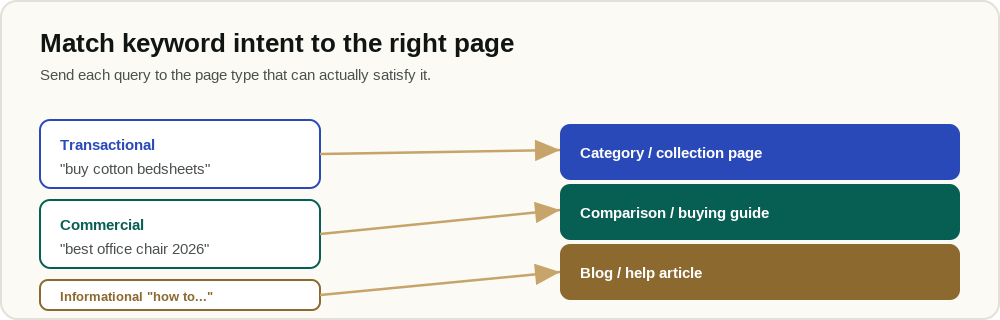
| Search need | Likely page type | Main purpose |
|---|---|---|
| Broad product discovery | Category or collection page | Help users browse the assortment |
| Specific item or model | Product page | Explain the exact product and purchase details |
| Product comparison | Comparison guide or structured category content | Clarify differences and trade-offs |
| How to choose | Buying guide | Explain decision criteria |
| How to use or maintain | Tutorial or care guide | Help the customer use the product correctly |
| Compatibility or sizing question | Specific support guide or product information | Reduce uncertainty and prevent unsuitable purchases |
| Brand or product family exploration | Relevant brand or product-family page | Organise a distinct shopping need |
Avoid keyword cannibalisation by clarifying page purpose
Two pages can discuss related terms without being duplicates. The important question is whether they serve distinct needs. A category page may help people browse available products, while a buying guide explains how to choose among them.
If multiple articles answer the same question with little additional value, consider improving one comprehensive resource, consolidating overlapping content where appropriate, and redirecting retired URLs when a genuinely equivalent destination exists.
Do not force a unique page for every keyword variation. Build pages around distinct user needs.
4. Build content clusters around real expertise
A content cluster organises related pages around a clear topic. For ecommerce, the cluster should help customers move between broad understanding, selection guidance, and relevant products.
For example, a bedding retailer might organise useful resources around choosing materials, understanding sizes, caring for fabrics, comparing product types, and selecting products for different needs. A furniture retailer might cover room measurements, materials, assembly, care, and product comparisons. The actual cluster should reflect the business’s assortment and expertise.
A practical cluster structure
Link these pages where the relationship is useful. The goal is not to create a large number of pages; it is to cover the important customer questions without leaving gaps or producing repetitive content.
- Core category page: the main product group and its available assortment.
- Buying guide: key decision criteria and trade-offs.
- Supporting articles: specific questions, care instructions, comparisons, or use cases.
- Product pages: accurate specifications, images, variants, and purchase details.
- Support resources: delivery, returns, warranty, compatibility, or care information.
Demonstrate depth through usefulness
Topical depth is not measured by how many posts are published. It comes from addressing meaningful questions accurately, using consistent terminology, linking related information, and keeping pages current. A smaller set of genuinely useful resources can be more valuable than a large library of generic articles.
5. Choose the right ecommerce content formats
Not every topic needs a conventional blog post. Select the format that best answers the question.
Buying guides
Help readers understand selection criteria, trade-offs, and practical considerations. Explain how to make a decision rather than merely listing product features.
Comparisons
Compare products or options using relevant, verifiable criteria. Be transparent about limitations and avoid unsupported claims that one option is universally best.
How-to and care guides
Provide clear steps, safety notes where relevant, and guidance based on reliable product information. Avoid advice that conflicts with manufacturer instructions.
Explainers and terminology guides
Clarify technical terms, materials, certifications, or specifications. Define terms in plain language and distinguish general explanations from claims about a particular product.
Category support content
Help users understand an assortment, select a size or material, or compare subcategories. Keep the content connected to the actual products available.
FAQs and support content
Answer recurring customer questions in the place where they are most useful. A short answer on a product page may be better than a separate article for a narrow question.
Product-led editorial content
Use product knowledge to help readers make an informed decision. Recommendations should be accurate and relevant, and any commercial relationship or incentive should be disclosed where required.
6. Create a useful content brief
A strong brief gives the writer a clear purpose without scripting a generic article or forcing keyword repetition.
Include:
The brief should also list prohibited assumptions: unsupported statistics, invented personal experience, unverified certifications, fictional customer stories, and claims that cannot be substantiated.
- 01Audience: who the page is for and what they are trying to do.
- 02Primary question: the specific need the content must answer.
- 03Search intent: informational, comparative, transactional support, or another relevant purpose.
- 04Recommended page type: guide, comparison, category content, product content, or support page.
- 05Primary and related terms: natural language that helps describe the topic, not a checklist for repetition.
- 06Required facts: specifications, definitions, policies, or claims that must be verified.
- 07Unique contribution: what useful insight, explanation, example, or organisation this page adds.
- 08Outline: a logical sequence of questions and decisions.
- 09Internal links: relevant pages to link to and why.
- 10Visual requirements: original diagrams, authorised photos, or useful screenshots.
- 11Author and review needs: subject-matter expert or technical review where appropriate.
- 12Measurement plan: the intended outcome and the signals to review after publication.
7. Make content original, accurate, and trustworthy
Search visibility is not a substitute for editorial quality. Content should be created primarily to help people, with a clear purpose and accurate information.
Add genuine value
Useful contributions can include an original decision framework, clear explanations of trade-offs, verified specifications, practical examples, an original diagram, or a concise answer based on real product knowledge. Rephrasing several existing pages without adding insight is unlikely to produce a strong resource.
Verify claims
Check technical claims against reliable primary sources, product documentation, standards bodies, or appropriate subject-matter experts. Be careful with health, safety, sustainability, performance, and certification claims. If evidence is incomplete, qualify the statement or omit it.
Be transparent about experience
Do not invent personal case studies, client results, author credentials, testimonials, or first-hand product testing. Use examples only when they are genuine, documented, and approved for publication. Protect confidential client and customer information.
Use AI responsibly
AI tools can support research organisation, outlines, editing, or quality checks, but the final content needs human judgement, factual review, and a clear reason to exist. Do not publish large volumes of unreviewed, repetitive content simply to target keywords. The standard should be usefulness, accuracy, originality, and accountability, not whether a detector labels a passage as AI-written.
Keep content current
Set review triggers for changes in product specifications, policies, standards, technology, or search guidance. A page does not need a cosmetic rewrite every few months; it needs an update when its information, usefulness, or context has materially changed.
8. Connect content to categories and products
Content should support the customer journey without turning every article into a sales pitch.
Use contextual links when a reader would naturally benefit from the next step:
Use descriptive anchor text that accurately explains the destination. Avoid inserting the same commercial phrase into every paragraph. Links should help readers, not interrupt them.
- A size guide can link to the relevant size-specific category or products.
- A materials comparison can link to the categories that contain those materials.
- A care guide can link to products or accessories relevant to the care task.
- A product comparison can link to the exact products being discussed.
- A category page can link to a buying guide that helps customers choose.
- Product pages can link to relevant setup, compatibility, or care instructions.
Check the whole journey
Review whether a visitor can move from an informational article to a useful category, then to a product page, and back to supporting information if needed. Also check that product pages have logical routes back to categories and guides. This is an information architecture task as much as a content task.
9. Plan publishing and maintenance
A calendar is useful only if it reflects priorities, capacity, and quality controls.
For each planned page, record:
- Topic and intended audience
- Search need and page type
- Business or customer rationale
- Content owner and reviewer
- Brief and source requirements
- Draft, review, and publication status
- Required visuals
- Internal-link destinations
- Publication date
- Planned review trigger
- Success measures
Prioritise work sensibly
A useful prioritisation model considers customer importance, relevance to the assortment, evidence of demand, existing content gaps, competitive difficulty, and the resources needed to create a genuinely useful page.
Do not overcommit to a publishing cadence that leaves no time for review or maintenance. A smaller, sustainable schedule is preferable to a high-volume calendar that produces repetitive content.
Create a maintenance loop
After publication, review whether the page is accurate, discoverable, linked appropriately, and useful to visitors. Update when products, policies, facts, or search intent change. Consolidate overlapping pages when evidence supports it. Retire pages deliberately, with suitable redirects only when a relevant replacement exists.
10. Measure content performance beyond traffic
Organic traffic is one signal, not the complete outcome. A page may help customers make better choices without becoming a major traffic source, while a high-traffic article may have little relevance to the business.
Use consistent definitions and account for attribution limitations. Do not claim that a blog post caused a sale simply because a user visited it before purchasing. Treat assisted journeys as evidence of a possible contribution, not automatic proof of causality.
| Area | Measures to review | What to investigate |
|---|---|---|
| Search visibility | Impressions, clicks, CTR, query themes | Whether the page matches the intended need |
| Discoverability | Indexation, internal links, crawl access | Whether users and search engines can reach the page |
| Engagement | Relevant next-page clicks, internal search behaviour, engaged sessions where reliably measured | Whether the content supports a useful next step |
| Product discovery | Clicks to categories and product pages | Whether editorial content connects to the assortment |
| Commerce | Assisted journeys, add-to-cart activity, conversions where measurable | Whether content supports purchase decisions |
| Quality | Support questions, returns themes, content accuracy issues | Whether the page reduces confusion or needs improvement |
| Maintenance | Update backlog, broken links, outdated claims | Whether the content library remains reliable |
Use Search Console and analytics together
Search Console can help show which queries generate impressions and clicks. Analytics can help show what visitors do after arriving, subject to consent, configuration, and data quality. Customer support and sales feedback can reveal questions that neither platform fully explains.
Use the evidence together to decide whether to improve a title, expand a useful explanation, add internal links, update facts, change the page format, or consolidate overlapping content.
11. A 30-day strategy-building plan
Week 1: Audit and research
Deliverable: A content opportunity map based on evidence and customer value.
- Inventory existing category, product, and editorial pages.
- Collect customer questions and recurring product-selection issues.
- Review search query data and relevant competitor page types.
- Identify overlapping content and missing customer needs.
- Confirm business priorities and subject-matter review capacity.
Week 2: Build the topic and page map
Deliverable: A content map and prioritised editorial backlog.
- Group related questions into sensible topic clusters.
- Assign the most appropriate page type to each need.
- Define the purpose of existing and planned pages.
- Identify internal links between guides, categories, and products.
- Prioritise work based on value, feasibility, and quality.
Week 3: Brief and create priority content
Deliverable: Publication-ready content that has passed quality checks.
- Prepare detailed briefs for the highest-priority pages.
- Gather primary sources and verify product facts.
- Draft content with a clear unique contribution.
- Create original visuals or identify authorised assets.
- Complete editorial, technical, and subject-matter review.
Week 4: Publish, connect, and measure
Deliverable: A live content cluster with a measurement and maintenance plan.
This is a starting workflow, not a guarantee of ranking or revenue changes within 30 days. Results depend on site authority, competition, content quality, crawlability, demand, and implementation.
- Publish approved pages with accurate metadata.
- Add relevant internal links from existing content.
- Validate canonicals, indexability, structured data where applicable, and mobile rendering.
- Record baseline measures and the date of publication.
- Schedule reviews based on expected change and factual risk.
12. Common ecommerce content mistakes
- 01Publishing just to meet a quota: Output volume can crowd out useful research and review.
- 02Choosing topics only by search volume: The topic may not match customer needs or the assortment.
- 03Creating multiple pages for the same question: Overlap can confuse users and create maintenance work.
- 04Writing generic introductions: Broad statements often delay the answer instead of helping readers.
- 05Repeating keywords unnaturally: Readability and accuracy matter more than mechanical repetition.
- 06Making unsupported claims: Product, health, sustainability, and certification statements need evidence.
- 07Ignoring internal links: Useful content may become disconnected from categories and products.
- 08Using AI output without review: Errors and repetitive material can undermine trust.
- 09Leaving outdated content live: Old specifications and policies can mislead customers.
- 10Measuring only pageviews: Traffic alone does not explain content usefulness or business contribution.
- 11Using fake experience or examples: Fabricated case studies and testimonials damage credibility.
- 12Failing to maintain the library: Content strategy includes updating and retiring pages, not only publishing new ones.
FAQ
Frequently asked questions
It is a plan for creating, organising, connecting, measuring, and maintaining useful content that answers customer questions and supports the discovery of relevant products. It includes choosing topics, assigning page types, building internal links, and reviewing quality and performance.
There is no universal ideal frequency. Publish at a pace that allows research, original contribution, fact-checking, subject-matter review, and maintenance. A consistent quality process matters more than a fixed volume target.
No. A separate page should serve a distinct user need. Closely related queries may be answered well by one comprehensive resource, while genuinely different needs may justify separate pages or formats.
No. Ecommerce SEO also depends on category and product pages, site architecture, technical health, internal links, product information, and usability. Editorial content supports that system but does not replace it.
Use customer questions, search query data, product expertise, support themes, business priorities, and an audit of existing content. Choose topics where the business can provide accurate, useful information and connect it naturally to the customer journey.
Review search visibility, relevant engagement, internal clicks to categories and products, and business outcomes where measurable. Include quality signals such as outdated facts, customer confusion, and support questions. Be careful not to overstate causality from attribution data.
No. Update pages when facts, products, policies, search intent, or usefulness have materially changed. Some pages should remain stable; others may need consolidation or retirement if they no longer serve a purpose.
Similar posts
SEO
Ecommerce SEO Keyword Research: Map Search Demand to Categories, Products, and Buying Guides
13 min read
SEO
Ecommerce Internal Linking Strategy: A Practical Framework for SEO and Product Discovery
Build a stronger ecommerce internal linking strategy with practical guidance for categories, products, buying guides, breadcrumbs, and crawlable site architecture.
10 min read
SEO
Ecommerce SEO: The Complete Guide to Growing Organic Revenue
Learn how to grow ecommerce organic revenue with category SEO, product pages, technical SEO, structured data, internal linking, content strategy and measurement.
24 min read
Related services
Related work