Ecommerce SEO
Ecommerce SEO for B2B and Wholesale Catalogues: Products, Applications, and Buyer Intent

B2B and wholesale websites often serve buyers who need more than a product name and a price. They may be evaluating specifications, production capability, certifications, minimum order quantities, customisation, lead times, and supplier reliability. SEO for these businesses should help the right buyer discover the right product or capability, then provide enough verified information to support the next step in a longer buying process.
Quick answer
The technical foundations overlap, but B2B content often needs deeper specifications, application context, and lead-oriented measurement.
Key takeaways
- Identify the audiences involved: procurement teams, technical evaluators, designers, distributors, manufacturers, or business owners.
- Use category names and navigation that reflect how buyers search and select products.
- Include verified specifications, tolerances, material composition, dimensions, production methods, available customisation, and documentation where relevant.
- Provide accurate company information, contact routes, manufacturing or sourcing details where approved, quality processes, technical documentation, and clear enquiry steps.
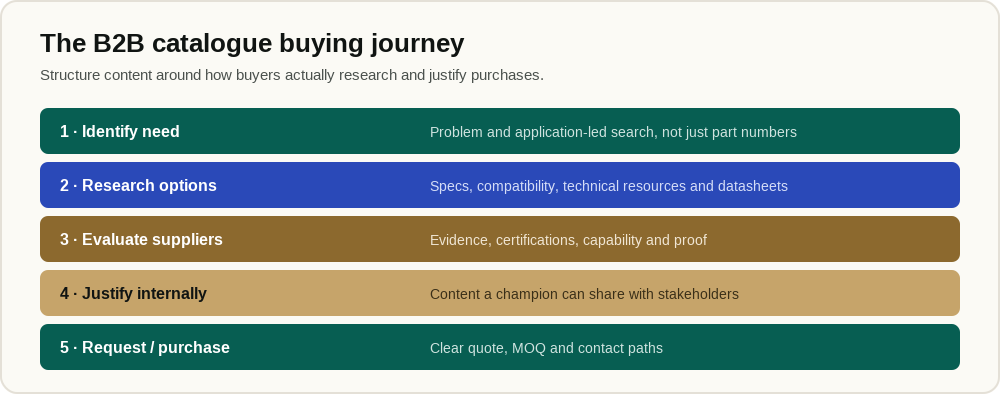
Map the B2B buying journey
Identify the audiences involved: procurement teams, technical evaluators, designers, distributors, manufacturers, or business owners. Their searches may range from material and application research to specification comparisons, supplier discovery, and quotation requests. Map each intent to a page type, such as a category, product specification page, application page, capability page, or technical guide.
Structure the catalogue around buyer language
Use category names and navigation that reflect how buyers search and select products. Technical taxonomies may be necessary, but explain specialist terms and connect related categories where it helps. Avoid building a separate thin page for every keyword variation. Create distinct pages when products, applications, specifications, or buyer needs are meaningfully different.
Write product and capability content with evidence
Include verified specifications, tolerances, material composition, dimensions, production methods, available customisation, and documentation where relevant. Clearly distinguish standard capabilities from options that require confirmation. Do not claim certifications, capacity, sustainability attributes, or delivery timelines without evidence and current approval.
Build trust for high-consideration purchases
Provide accurate company information, contact routes, manufacturing or sourcing details where approved, quality processes, technical documentation, and clear enquiry steps. Use genuine photographs and approved certifications. Avoid generic claims such as ‘world-class quality’ when a more specific, verifiable explanation would help buyers evaluate the supplier.
Support research with technical resources
Useful content may include specification explainers, material comparisons, application guides, care or processing instructions, compliance explanations, and procurement checklists. Have technical specialists review claims. Make downloadable resources accessible and link them from relevant category or product pages. Do not gate every useful detail if open access would help buyers assess fit.
Measure lead quality, not just traffic
Track relevant enquiries, quote requests, specification downloads, distributor contacts, and qualified leads where measurement and privacy rules allow. A low-volume page may be commercially valuable if it attracts the right buyers. Work with sales to define lead quality and document the limitations of attribution across long sales cycles.
Technical considerations
B2B catalogues can include many product attributes, filters, PDFs, and legacy URLs. Ensure important pages are internally linked and indexable where appropriate. Manage duplicates, parameter URLs, canonical tags, sitemaps, and document accessibility. Protect confidential pricing or customer-specific pages from unintended public indexing using appropriate access controls rather than relying only on SEO directives.
FAQ
Frequently asked questions
The technical foundations overlap, but B2B content often needs deeper specifications, application context, and lead-oriented measurement.
That is a business decision. Provide clear next steps and protect genuinely restricted information appropriately.
State only current, verifiable certifications and their relevant scope.
PDFs can be discovered, but essential product information should also be available in accessible page content where useful.
Similar posts
SEO
Ecommerce SEO: The Complete Guide to Growing Organic Revenue
Learn how to grow ecommerce organic revenue with category SEO, product pages, technical SEO, structured data, internal linking, content strategy and measurement.
24 min read
SEO
Ecommerce SEO Content Strategy: Build Useful Content That Supports Organic Growth
Build an ecommerce SEO content strategy with search-intent mapping, buying guides, category support, content quality checks, and measurement.
15 min read
SEO
Ecommerce SEO Keyword Research: Map Search Demand to Categories, Products, and Buying Guides
13 min read
Related services
Related work