SEO
Ecommerce SEO for Seasonal Campaigns: Plan, Optimise, and Retain Search Visibility

Seasonal demand creates a particular challenge for ecommerce SEO. A campaign may generate a short-term sales opportunity, but search visibility often depends on preparation well before the peak, a useful landing page during the campaign, and a sensible plan after the event ends. Seasonal SEO is not just publishing a holiday article or changing a banner. It requires understanding when customers begin researching, which products and offers will actually be available, how campaign URLs should be managed, and what should happen to the page when the promotion ends. Poor planning can leave the team with late content, fragmented signals, broken links, or a set of expired pages that provide little value. This guide explains how to build a repeatable seasonal SEO process for ecommerce brands, from demand research and page planning to technical checks, campaign execution, post-season maintenance, and measurement.
Quick answer
Start with the demand and operational calendar, then work backwards from the expected peak. Research, page preparation, internal linking, and technical QA should happen early enough to be completed before the main shopping window. Exact timing depends on the category and market.
Key takeaways
- SEO title: Ecommerce Seasonal SEO: A Practical Campaign Planning Guide
- Start by mapping the commercial calendar for the markets the business actually serves.
- Seasonal shoppers may move through several stages: discovering ideas, comparing options, checking availability and delivery, and finally choosing a product or offer.
- Choose the page type based on the campaign's purpose, the catalogue, and the likely duration of the demand.
SEO metadata
SEO title: Ecommerce Seasonal SEO: A Practical Campaign Planning Guide
Meta description: Learn how to plan seasonal ecommerce SEO with demand research, campaign landing pages, internal links, technical checks, post-season page management, and reporting.
Suggested URL: /insights/ecommerce-seasonal-seo-campaign-planning/
Primary keyword: seasonal ecommerce SEO
Secondary keywords: ecommerce seasonal SEO, holiday SEO strategy, seasonal landing pages, ecommerce campaign SEO, seasonal keyword research
Category: Ecommerce SEO
Author: Afshaan Ahmed Memon
1. Build a seasonal demand calendar
Start by mapping the commercial calendar for the markets the business actually serves. Depending on the catalogue, relevant periods may include major shopping events, local holidays, wedding seasons, back-to-school periods, weather changes, gifting occasions, or product-specific buying cycles.
For each event, record:
Use previous Search Console data, analytics, internal site search, customer-service questions, and business sales history where available. Do not assume every event has the same lead time or that last year's demand will repeat exactly. Search interest can begin well before the purchase window, and the timing differs by product and market.
Create one calendar shared with merchandising, paid media, content, development, inventory, and customer support. SEO planning is more effective when the landing page and the commercial offer are aligned before the campaign begins.
- Target market and relevant dates.
- Products and categories expected to be available.
- Offer mechanics, if confirmed.
- Content and landing pages required.
- Creative, merchandising, and development dependencies.
- Stock, fulfilment, and customer-support considerations.
- SEO preparation deadline and launch owner.
- Post-campaign review date.
2. Research the customer's seasonal journey
Seasonal shoppers may move through several stages: discovering ideas, comparing options, checking availability and delivery, and finally choosing a product or offer. The keyword plan should reflect those needs rather than focus only on the event name.
Research:
Review search results for the target market and note the page types that appear: category pages, product pages, buying guides, gift collections, or other formats. Map each query group to a page that can satisfy its intent.
Avoid building a new page for every wording variation. Combine related terms when one useful page can serve them, and separate them when the shopper's need or product selection is materially different.
- Event and occasion terms.
- Product-category terms with seasonal modifiers.
- Gift, use-case, size, material, and budget questions.
- Comparison and buying-guide queries.
- Delivery deadlines and availability questions.
- Brand and product searches that may rise during the period.
- Local language and country-specific terminology.
3. Choose the right landing-page strategy
Choose the page type based on the campaign's purpose, the catalogue, and the likely duration of the demand.
Existing category or collection page: Often the strongest option when the seasonal demand is closely related to an established product category. Updating an existing page can preserve its ongoing usefulness and avoid unnecessary URL duplication.
Dedicated seasonal landing page: Useful when the event creates a distinct shopping journey, curated assortment, or campaign experience that cannot be served well by a normal category page. Give the page a clear purpose and useful content beyond a temporary headline.
Buying guide or editorial page: Appropriate when shoppers need advice, comparisons, planning help, or product-selection information before they are ready to purchase.
Product pages: Keep evergreen product URLs where possible. Update accurate stock, price, availability, delivery, and relevant seasonal details without changing the product identity unnecessarily.
A new URL is not automatically better for SEO. Before creating one, check whether an existing page already satisfies the intent and whether the new page will provide distinct value. Record the preferred URL, intended queries, internal links, and post-season treatment before launch.
4. Prepare campaign pages early
Publish or prepare important seasonal pages well ahead of the expected demand peak when the business has enough information to make them genuinely useful. Early preparation provides time for crawling, indexing, internal linking, quality assurance, and content review; it does not guarantee rankings by a particular date.
A campaign brief should specify:
Avoid publishing empty placeholders simply to make a URL exist. A page should be useful and accurate when it becomes accessible. If offer details are not confirmed, build the reusable page structure and add the final details when they are reliable.
- Audience, market, and search intent.
- Primary and supporting query groups.
- Preferred URL and page type.
- Products and categories included.
- Confirmed prices, offers, and availability.
- Delivery, returns, and other key customer information.
- Internal links from relevant evergreen pages.
- Visual assets and accessibility requirements.
- Structured data requirements, where applicable.
- Launch, review, and post-season ownership.
7. Handle inventory, offers, and expired pages
Seasonal pages need an explicit end-of-campaign plan. The correct action depends on whether the URL has continuing value, whether products remain available, and whether a suitable replacement exists.
If the page remains useful: Keep it live and update it for the next season. Preserve useful guidance, remove outdated dates and expired offers, and add current information when available.
If the offer ends but the category remains relevant: Remove the expired promotion and help visitors find current products or offers. A category page may remain useful year-round.
If the seasonal page has a close replacement: Consider a redirect when the destination genuinely satisfies the same user need. Update internal links and verify the redirect.
If the page has no continuing purpose or replacement: A suitable not-found or gone response may be appropriate. Do not redirect every expired campaign URL to the homepage or an unrelated category.
If a product sells out temporarily: Keep the product page when it remains useful and the product is expected to return, while clearly communicating availability and relevant alternatives. If it is permanently discontinued, assess demand, links, and replacement relevance before choosing a removal or redirect strategy.
Document the decision before the campaign ends. This reduces the risk of broken links, misleading offers, and unnecessary URL churn.
8. Check technical SEO before launch
Use a pre-launch checklist for each priority campaign page:
After launch, verify the live page rather than relying only on a staging preview. For significant changes, record the date and inspect relevant Search Console data over a suitable period. Requesting a recrawl can help discovery but does not guarantee indexing or ranking.
- The URL returns the intended status code.
- The page is accessible to users and search crawlers.
- Robots directives do not unintentionally prevent indexing.
- The canonical points to the intended preferred URL.
- The page is included in the sitemap when appropriate.
- The title, meta description, heading, and visible content match the campaign.
- Product prices, availability, and structured data agree.
- Internal links resolve to the correct pages.
- Images are optimised and have meaningful alternative text where needed.
- Mobile navigation, filters, and key purchase journeys work.
- Analytics and campaign annotations are ready.
- Offer terms, shipping deadlines, and policy details have been checked.
9. Measure performance across the season
Review performance at several stages instead of judging the campaign only on its final sales days.
Before the peak: Check whether pages are accessible and indexable, whether impressions begin to appear, and whether internal links and content are complete.
During the peak: Monitor relevant search clicks and impressions, landing-page behaviour, stock, conversion activity, and customer questions. Interpret changes alongside paid media, promotions, pricing, and demand.
After the peak: Assess the pages and query groups that attracted relevant visitors, the commercial outcomes supported by reliable measurement, and the work needed to retain ongoing value.
Useful measures may include:
Search Console clicks and analytics sessions are different measures. Revenue attribution also depends on the analytics model and data quality. Do not claim that SEO alone caused a sales change simply because the movement happened during the campaign.
- Search Console clicks, impressions, click-through rate, and query/page trends.
- Organic landing-page sessions and ecommerce events where tracking is reliable.
- Product availability and conversion context.
- Performance by category, market, device, and branded/non-branded demand where possible.
- Technical errors, indexation status, and post-campaign URL handling.
- Lessons for next year's calendar and content brief.
10. A 60-day planning framework
Days 1-15: Research and decisions
Days 16-30: Build and optimise
Days 31-45: QA and discovery
Days 46-60: Launch and learn
This is an adaptable planning example, not a universal timeline. Large catalogues and major retail events may need substantially earlier preparation.
- Review previous seasonal performance and demand signals.
- Confirm commercial dates, products, markets, and inventory assumptions.
- Map keyword groups to existing or proposed pages.
- Decide URL strategy and post-season treatment.
- Assign owners and deadlines.
- Prepare useful content and accurate product/category information.
- Improve titles, headings, internal links, and page navigation.
- Create or update approved visual assets.
- Validate technical requirements and analytics.
- Review offer terms and fulfilment information with the responsible teams.
- Test pages across devices and key user journeys.
- Verify indexability, canonical tags, sitemap inclusion, and structured data.
- Add relevant links from evergreen pages.
- Confirm inventory and offer details.
- Record launch annotations and monitoring responsibilities.
- Monitor search visibility, landing-page performance, and technical errors.
- Coordinate SEO changes with paid media and merchandising.
- Update pages as stock or offers change.
- Capture observations and prepare the post-season plan.
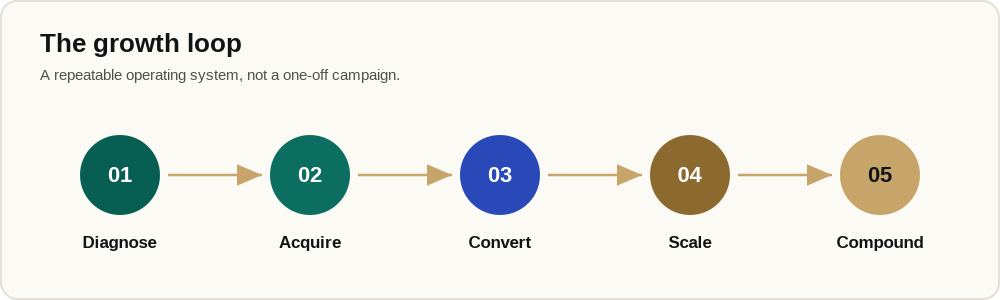
11. How seasonal SEO fits Diagnose → Acquire → Convert → Scale → Compound
Diagnose: Use prior performance, customer questions, and search demand to identify the seasonal opportunity and risks.
Acquire: Prepare useful pages and internal links before demand peaks so shoppers can discover relevant products and advice.
Convert: Keep product information, prices, stock, delivery promises, and offer terms accurate during the campaign.
Scale: Reuse successful page patterns and operational checklists for related events without creating thin duplicate pages.
Compound: Preserve evergreen value, document learnings, and update the calendar and page plan for the next cycle.
Seasonal SEO is a repeatable operating process. Its strongest gains come from coordination, accurate information, and disciplined post-campaign management, not from adding a holiday keyword at the last minute.
Conclusion
Seasonal ecommerce SEO works when search demand, page purpose, inventory, fulfilment, and technical implementation are planned together. Prepare early, map intent to the right URL, make the page genuinely useful, monitor performance in context, and decide what happens after the campaign ends.
A disciplined process helps the team preserve useful pages, avoid unnecessary URL churn, and turn each season's learning into a stronger plan for the next one.
FAQ
Frequently asked questions
Start with the demand and operational calendar, then work backwards from the expected peak. Research, page preparation, internal linking, and technical QA should happen early enough to be completed before the main shopping window. Exact timing depends on the category and market.
No. An existing category or evergreen guide may already satisfy the intent. Create a dedicated page when it provides a distinct, useful shopping experience and has a clear maintenance plan.
Not automatically. Keep and refresh pages that remain useful, redirect only to a genuinely relevant replacement, and remove pages that have no continuing purpose when appropriate.
No. Early preparation gives search engines time to discover and process pages, but rankings and indexing depend on many factors and cannot be guaranteed by a particular date.
Use Search Console visibility data, reliable analytics landing-page and ecommerce measures, page availability, and commercial context. Compare similar periods where appropriate and account for promotions, stock, paid media, and seasonality.
Do not leave misleading or expired offer claims active. If the URL has ongoing value, update it with accurate current information and useful alternatives; otherwise, decide whether to redirect or remove it based on user need and page value.
Similar posts
SEO
Ecommerce SEO Content Strategy: Build Useful Content That Supports Organic Growth
Build an ecommerce SEO content strategy with search-intent mapping, buying guides, category support, content quality checks, and measurement.
15 min read
SEO
Ecommerce Category Page SEO: How to Build Pages That Rank and Help Shoppers Choose
Learn how to optimise ecommerce category pages with better architecture, helpful copy, internal links, filters, and measurement.
15 min read
SEO
Ecommerce SEO: The Complete Guide to Growing Organic Revenue
Learn how to grow ecommerce organic revenue with category SEO, product pages, technical SEO, structured data, internal linking, content strategy and measurement.
24 min read
Related services
Related work