Technical SEO
Beyond Alt Text: An Ecommerce Image SEO Workflow for Product Discovery and Accessibility

Product images help shoppers understand colour, shape, material, fit, construction, scale, and use. They can also contribute to image search discovery when they are accessible, relevant, and presented within a useful page. Effective image SEO is therefore not simply adding keywords to alt attributes. It combines accurate imagery, appropriate file delivery, accessible descriptions, and a page that gives the image meaningful context.
Quick answer
No. Alt text should describe meaningful information for accessibility; keyword stuffing is not useful.
Key takeaways
- Images should represent the actual product and variant.
- Alt text should communicate the relevant information of an image to people who cannot see it.
- Choose appropriate formats and dimensions, compress without damaging useful detail, and use responsive image techniques where the platform supports them.
- A descriptive product name, useful surrounding copy, clear category placement, and internal links help users understand an image.
Use accurate product imagery
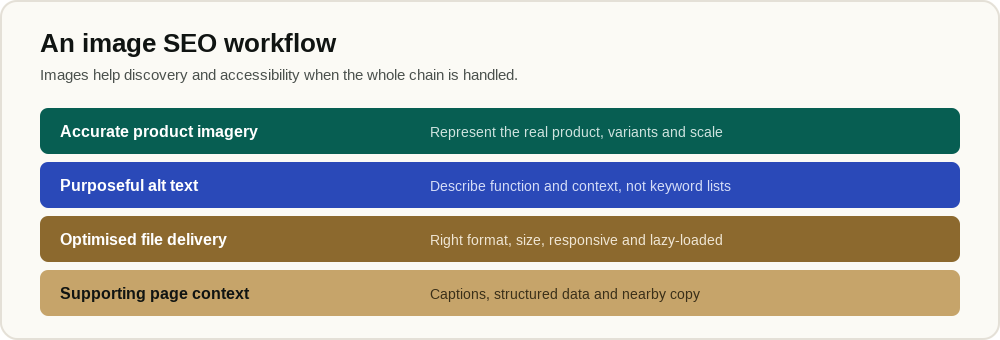
Images should represent the actual product and variant. Show useful angles, details, scale, and in-use context where appropriate. Do not alter colour or construction in a way that misleads buyers. If an image is illustrative rather than an exact product representation, make that distinction clear.
Write alt text for purpose
Alt text should communicate the relevant information of an image to people who cannot see it. A product image may need a concise description that identifies the product and distinguishing visible detail. Decorative images may use empty alt text when appropriate. Avoid repeating the same keyword-heavy text across every image or stuffing attributes with unrelated terms.
Optimise file delivery
Choose appropriate formats and dimensions, compress without damaging useful detail, and use responsive image techniques where the platform supports them. Reserve sufficient layout space to reduce layout shifts and avoid loading unnecessarily large files on small screens. Lazy-load below-the-fold images where appropriate, but do not defer the primary image in a way that harms the initial experience.
Provide page context
A descriptive product name, useful surrounding copy, clear category placement, and internal links help users understand an image. File names can be descriptive, but changing them is not a substitute for accurate alt text or a useful page. Keep captions where they add information rather than repeating what is already obvious.
Manage galleries and variants
Make sure gallery controls work on mobile and that important images can be accessed without confusing interactions. Images should match the selected colour or variant. Where separate variant URLs exist, coordinate image selection with canonical and structured-data strategy. Avoid indexing many duplicate image or parameter URLs without a clear purpose.
Measure and troubleshoot
Review image loading, page performance, broken assets, image search visibility where available, and user behaviour. Use lab tools to diagnose issues, but compare field data when available. If an image does not appear in image search, investigate access, rendering, relevance, page context, and competition rather than assuming alt text is the only factor.
FAQ
Frequently asked questions
No. Alt text should describe meaningful information for accessibility; keyword stuffing is not useful.
Excessive compression can damage details, so test quality at the size users actually see.
Often for below-the-fold images, but the main visible image needs careful handling to avoid delaying the initial experience.
No. It can improve accessibility and clarity, but visibility is determined by search systems and competition.
Similar posts
CRO
Ecommerce Product Page Optimisation: SEO, UX, and Conversion Checklist
Learn how to optimise ecommerce product pages for search visibility, customer confidence, and conversions with a practical product-page checklist.
17 min read
Technical SEO
Ecommerce Product Data Quality: Connecting SEO, Merchant Feeds, and On-Site Experience
Connect SEO, merchant feeds and on-site experience with one source of truth. Consistent titles, identifiers, price, availability and images across every surface.
3 min read
SEO
Ecommerce Category Page SEO: How to Build Pages That Rank and Help Shoppers Choose
Learn how to optimise ecommerce category pages with better architecture, helpful copy, internal links, filters, and measurement.
15 min read
Related services
Related work