SEO
Ecommerce Link Building (White-Hat)

Links remain one of the strongest signals of authority in search, and ecommerce sites have a particular problem with them: the pages you most want to rank, product and category pages, are the hardest to attract links to, because nobody naturally links to a product listing. This tempts stores towards shortcuts, bought links and schemes, that promise fast results and deliver long-term risk. This piece sets out the white-hat approach: earning links the durable way, and solving the specific ecommerce challenge of getting authority to commercial pages that rarely earn links directly. It is honest about the fact that this is slower work, because pretending otherwise leads people to the shortcuts that eventually cost them.
Quick answer
White-hat ecommerce link building earns links from other sites by deserving them, through genuinely useful content, real relationships, digital PR and quality products, rather than buying or manufacturing them. It is slower than the shortcuts but durable and safe, whereas bought links, link schemes and spam risk penalties that can undo years of work. The hard truth for ecommerce is that product and category pages rarely attract links on their own, so you build links to link-worthy assets and let internal linking pass that authority to commercial pages.
Key takeaways
- White-hat link building earns links by deserving them; it is slower but durable and safe, unlike bought links and schemes that risk penalties.
- Ecommerce has a specific problem: product and category pages rarely attract links because nobody cites a listing.
- The solution is two-step: earn links to link-worthy assets, then pass that authority to commercial pages via strong internal linking.
- The tactics that work: genuinely link-worthy content, digital PR and real stories, relationships and thoughtful outreach, and being a cite-worthy brand.
- Being genuinely worth mentioning overlaps with the reputation that earns AI citations, so it pays off in several directions.
- Avoid bought links, schemes, networks and mass low-quality links; if a link exists only to manipulate rankings, it is the risky kind.
Why white-hat, plainly
The case for white-hat link building is risk and durability. Search engines actively fight link manipulation, and schemes that work for a while, bought links, link networks, mass low-quality links, are exactly what penalties target. A store that builds its rankings on manipulated links is building on ground that can give way, sometimes catastrophically and with little warning.
Earned links, by contrast, are durable. Links you got because you deserved them do not evaporate in an algorithm update aimed at manipulation, because they are the very thing those updates reward. White-hat is slower, but it compounds and it is safe, which over the life of a business beats fast-and-fragile.
The ecommerce link-building problem
Here is the specific difficulty. People link to things that are useful, interesting or reference-worthy: guides, tools, research, stories. They rarely link to a product page or a category listing, because there is nothing to cite. So the pages ecommerce most wants to rank are the pages least able to earn links on their own.
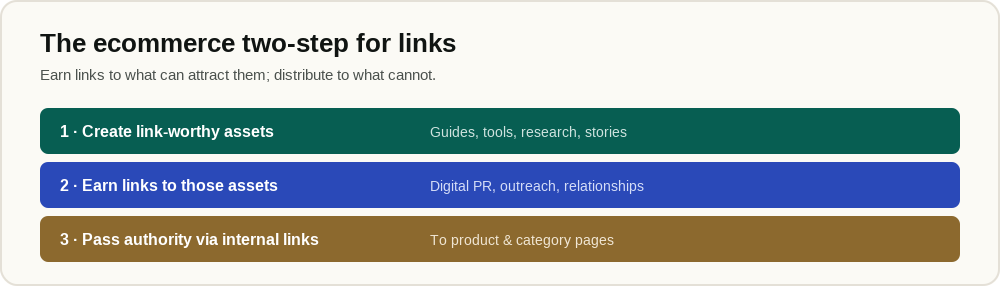
The solution is a two-step structure. First, create link-worthy assets, content and resources genuinely worth linking to, and earn links to those. Second, use strong internal linking to pass the authority those assets accumulate through to your commercial product and category pages. You build links to what can earn them, and distribute the benefit to what cannot. This is why internal linking and link building are connected disciplines for ecommerce.
White-hat tactics that work
Create genuinely link-worthy content
The foundation is assets people want to link to: useful guides, original research or data, free tools, comprehensive resources in your field. Content created specifically to earn links must actually deserve them; thin content dressed up as a resource earns nothing. This is the single most reliable white-hat engine, and it doubles as content marketing.
Digital PR and real stories
Earning coverage and links from publications and journalists through genuine newsworthy angles, data, stories, expert commentary, is one of the strongest white-hat tactics. It gets authoritative links that are hard to replicate, and it builds brand at the same time. It deserves, and has, its own deeper treatment, but it belongs on any list of what works.
Relationships and outreach
Building real relationships in your industry, with publishers, creators, complementary businesses, leads to links through genuine connection rather than transactions. Thoughtful outreach that offers real value, not spammy mass requests, earns links and partnerships that last.
Being genuinely cite-worthy
Sometimes the best link building is being a business worth mentioning: distinctive products, genuine expertise, a real reputation. Links follow brands people talk about. This overlaps with the reputation-building that also helps you get cited in AI answers, so the investment pays off in several directions.
What to avoid
Avoid buying links, participating in link schemes and networks, mass low-quality directory and comment links, and any tactic whose only purpose is to manipulate rankings. These risk penalties, and search engines are good at detecting them. The simple test: if a link exists only to influence rankings rather than because it genuinely belongs, it is the kind that eventually causes problems.
FAQ
Frequently asked questions
It is earning links by genuinely deserving them, through useful content, digital PR, real relationships and a cite-worthy brand, rather than buying links or using schemes to manufacture them. It is slower than shortcuts but durable and safe, because earned links are exactly what search engines reward rather than penalise.
Because people link to useful or interesting things, guides, tools, research, stories, and rarely to a product or category page, which has nothing to cite. So the pages ecommerce most wants to rank are the least able to earn links directly, which is why a two-step approach is needed.
Usually indirectly. Create link-worthy assets, guides, tools, research, that genuinely attract links, then use strong internal linking to pass the authority those assets accumulate through to your product and category pages. You earn links to what can attract them and distribute the benefit to what cannot.
No, for a business that wants durable results. Bought links and schemes are exactly what search engine penalties target, and rankings built on them sit on ground that can give way suddenly. Earned links are slower but compound safely. The risk of manipulation far outweighs the temporary gain for a real business.
Digital PR is a specific white-hat tactic within link building: earning coverage and links from publications and journalists through newsworthy angles, data and stories. Link building is the broader discipline that also includes link-worthy content, relationships and outreach, and being a genuinely cite-worthy brand. Digital PR is one of its strongest components.
Similar posts
SEO
Ecommerce SEO: The Complete Guide to Growing Organic Revenue
Learn how to grow ecommerce organic revenue with category SEO, product pages, technical SEO, structured data, internal linking, content strategy and measurement.
24 min read
SEO
Digital PR for Ecommerce
Digital PR earns authoritative, hard-to-replicate links and brand awareness through genuinely newsworthy material, never product pitches or fabricated data. What works, and the hard rule that keeps it credible.
5 min read
SEO
Ecommerce Internal Linking Strategy: A Practical Framework for SEO and Product Discovery
Build a stronger ecommerce internal linking strategy with practical guidance for categories, products, buying guides, breadcrumbs, and crawlable site architecture.
10 min read
Related services