SEO
Digital PR for Ecommerce

Digital PR is where link building and brand building meet. Instead of chasing links directly, you create things worth reporting on and earn coverage from publications, which brings authoritative links and brand exposure together. For ecommerce, where product pages rarely attract links on their own, digital PR is one of the most effective engines for earning the authority that lifts the whole site. It is also widely done badly, as thinly disguised product promotion blasted at journalists who ignore it. This piece explains what genuinely works: giving the press material they actually want, built on real substance, and doing it in a way that compounds into authority and reputation rather than burning your name.
Quick answer
Digital PR earns coverage and links from publications and journalists through genuinely newsworthy material, data studies, stories, expert commentary, timely reactions, rather than product pitches. For ecommerce it is one of the strongest ways to earn authoritative links that are hard to replicate, while building brand awareness at the same time. The discipline is to offer journalists something they actually want to cover, be genuinely useful and timely, and never fabricate the data or stories, because the credibility is the whole point.
Key takeaways
- Digital PR earns authoritative coverage and links through genuinely newsworthy material, not product pitches, and builds brand at the same time.
- It suits ecommerce because product pages rarely earn links, while brands often sit on data and stories worth covering.
- The links are valuable because they are hard to replicate and carry the weight of respected publications.
- Newsworthy angles are built on substance: original data and research, timely expert commentary, and genuinely strong stories.
- Never fabricate data or stories; credibility is the entire asset, and fabrication destroys it when it unravels.
- Succeed through substance and relationships, understanding what journalists want and becoming a trusted source, not mass blasting.
Why digital PR suits ecommerce
Ecommerce brands have a link problem, product and category pages are not naturally link-worthy, and an advantage, they often sit on interesting data, trends and stories. Digital PR turns that advantage into a solution. By creating newsworthy material and earning coverage, you get authoritative links from publications that would never link to a product page, and you build brand awareness with audiences at the same time.
The links earned this way are particularly valuable because they are hard to replicate: a competitor cannot simply buy the same coverage, and links from respected publications carry weight. And unlike many link tactics, digital PR produces something beyond the link, real brand exposure, which makes it efficient.
What makes something newsworthy
The core skill is offering journalists material they genuinely want to cover. Journalists need stories their audience cares about, not advertisements for your products. The angles that work are built on genuine substance.
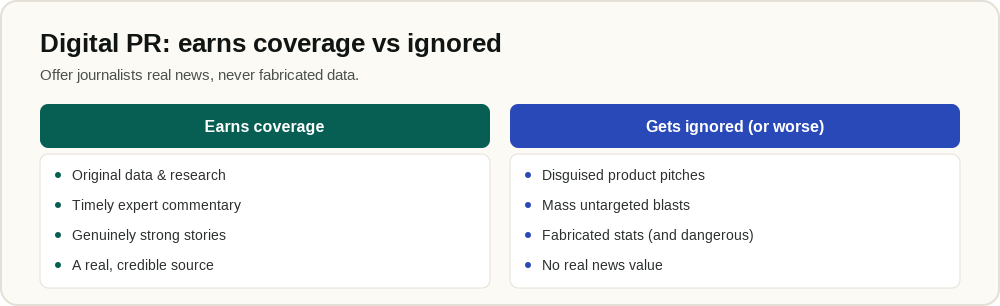
Original data and research is among the strongest: a study, survey or analysis that reveals something interesting and quotable gives journalists a reason to write and to cite you as the source. Timely reactions and expert commentary, useful perspective on something happening now, can earn coverage when you are genuinely qualified to comment. Strong stories, surprising, human, or trend-revealing, travel when they are real. The common thread is that the material must stand on its own merits as something worth reporting, with your brand as the credible source rather than the subject of an advert.
The hard rule: never fabricate
Because digital PR trades on credibility, fabricating the data or stories is both unethical and self-destructive. A made-up statistic or invented study that gets cited is a lie propagated under your name, and when it unravels, as fabrications do, it damages the reputation the whole exercise was meant to build. Journalists and audiences lose trust fast, and that trust does not come back easily.
So the material must be real: genuinely measured data, honestly represented; real stories; commentary you are actually qualified to give. This is not only an ethics point but a strategy point, because the entire value of earned coverage rests on being a credible source. Fabrication spends the very asset you are trying to grow.
Doing it well
Digital PR rewards substance and relationships over volume. Create material genuinely worth covering rather than dressing up promotion. Understand what the publications and journalists in your space actually want, and offer it to them specifically, not as a mass blast. Build real relationships over time, so you become a trusted source journalists return to. Be responsive and timely, since newsworthiness is often about timing. And measure what matters, the quality and authority of coverage and links earned, and the brand exposure, rather than vanity volume.
Done this way, digital PR compounds: each genuine piece of coverage builds authority and relationships that make the next easier, and the brand and link benefits accumulate together.
FAQ
Frequently asked questions
It is earning coverage and links from publications and journalists through genuinely newsworthy material, data studies, stories, expert commentary, rather than pitching products. It brings authoritative, hard-to-replicate links and brand awareness together, which makes it one of the strongest white-hat link-building approaches, especially for ecommerce.
Traditional link building pursues links in many ways; digital PR specifically earns them through press coverage of newsworthy material. Its distinguishing features are that the links come from respected publications and are hard to replicate, and that it produces real brand exposure alongside the links, making it efficient.
Material journalists genuinely want to cover: original data and research that reveals something quotable, timely reactions and expert commentary from someone actually qualified, and strong, surprising or human stories. The common thread is substance that stands on its own merit, with your brand as the credible source rather than the subject of an advert.
No, never. Digital PR trades entirely on credibility, so a fabricated statistic or study is a lie spread under your name that damages your reputation when it unravels, as fabrications do. The material must be genuinely measured and honestly represented; fabrication destroys the very asset the exercise is meant to build.
By the quality and authority of the coverage and links earned, and the brand exposure gained, rather than raw volume. A few links from respected, relevant publications are worth far more than many low-quality mentions. Track authoritative coverage, the strength of the links, and awareness, and value relationships that make future coverage easier.
Similar posts
SEO
Ecommerce SEO: The Complete Guide to Growing Organic Revenue
Learn how to grow ecommerce organic revenue with category SEO, product pages, technical SEO, structured data, internal linking, content strategy and measurement.
24 min read
SEO
Ecommerce Link Building (White-Hat)
White-hat link building earns links by deserving them, the durable, safe way. How to solve the ecommerce problem that product pages rarely earn links, with link-worthy assets and internal linking.
6 min read

AI Search & GEO
SEO, AEO & GEO: The Complete Guide to Search and AI Visibility
Understand SEO, answer engine optimization and generative engine optimization, and learn how to improve visibility across Google Search and AI-powered discovery.
20 min read
Related services