Ecommerce Growth
Ecommerce Growth in Pakistan: The Complete Performance Marketing Playbook

Ecommerce growth in Pakistan requires more than increasing advertising spend. Brands need a clear product offer, reliable fulfilment, workable unit economics, accurate tracking, useful creative and a website or checkout experience that makes buying easy. Meta Ads can help create demand, Google Ads can capture existing intent, SEO can build long-term discovery, and retention channels can help turn first-time buyers into repeat customers. The right mix depends on category, margin, average order value, purchase frequency, geography, payment methods, delivery performance and the brand's ability to fulfil orders. In a market where cash on delivery, failed deliveries, confirmation calls, shipping charges and trust concerns may affect the buying journey, measure delivered and retained revenue where possible, not only orders attributed to ads.
Quick answer
Ecommerce growth in Pakistan requires more than increasing advertising spend. Brands need a clear product offer, reliable fulfilment, workable unit economics, accurate tracking, useful creative and a website or checkout experience that makes buying easy. Meta Ads can help create demand, Google Ads can capture existing intent, SEO can build long-term discovery, and retention channels can help turn first-time buyers into repeat customers. The right mix depends on category, margin, average order value, purchase frequency, geography, payment methods, delivery performance and the brand's ability to fulfil orders. In a market where cash on delivery, failed deliveries, confirmation calls, shipping charges and trust concerns may affect the buying journey, measure delivered and retained revenue where possible, not only orders attributed to ads.
Key takeaways
- An ecommerce brand can have high traffic and weak sales, strong order volume and low delivered revenue, or attractive platform ROAS and poor cash contribution.
- Start with average order value, but do not stop there.
- A simplified way to calculate break-even ROAS is:
- Work backward from the contribution available per delivered order.
Table of contents
- 01Understand the real growth problem
- 02Build the business case before buying traffic
- 03Design a channel strategy
- 04Use Meta Ads to create demand
- 05Use Google Ads to capture intent
- 06Build SEO as a compounding channel
- 07Address COD, payments, delivery and trust
- 08Improve conversion rate
- 09Measure beyond platform ROAS
- 10Build a practical reporting rhythm
- 11Scale without losing control
- 12A 90-day action plan
- 13FAQs
1. Understand the real growth problem
Related guides: performance marketing in Pakistan, COD returns and the new online store marketing checklist.
Free tool: plug your own margin, order value and click cost into the eCommerce ad budget planner to see break-even ROAS and the budget a revenue target needs.
An ecommerce brand can have high traffic and weak sales, strong order volume and low delivered revenue, or attractive platform ROAS and poor cash contribution. Before choosing a tactic, identify the constraint.
Common constraints include:
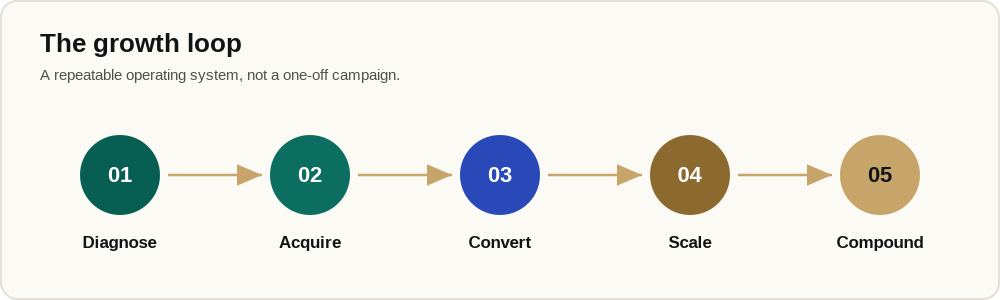
The job of performance marketing is to find and improve the bottleneck, not merely to launch more campaigns. Diagnose the business system first, then select the intervention.
- Demand: Too few relevant people know the product exists.
- Intent: Visitors are interested but not ready to buy, or campaigns reach the wrong people.
- Offer: Price, product differentiation, bundles or delivery terms do not justify the purchase.
- Conversion: Product pages, mobile experience, checkout or payment options create friction.
- Trust: Shoppers cannot confidently assess quality, authenticity, returns or delivery.
- Fulfilment: Orders are delayed, refused, cancelled, returned or not reconciled.
- Economics: Margin is too low to support the acquisition cost.
- Measurement: Platforms, analytics and order records disagree or miss important events.
- Retention: The business repeatedly pays to acquire customers who could have been encouraged to return.
2. Build the business case before buying traffic
Understand the true order value
Start with average order value, but do not stop there. Consider discounts, product cost, packaging, delivery subsidy, payment fees, fulfilment, returns, exchanges, failed COD deliveries and other variable costs. The cost of an order that is placed but never delivered can be materially different from the cost of a completed sale.
For COD-heavy businesses, separate at least these outcomes where data permits:
Not every store can capture all these stages cleanly on day one. Begin with the most reliable data available and improve the connection between advertising, order management and finance over time.
- Orders placed
- Orders confirmed
- Orders dispatched
- Orders delivered
- Orders retained after returns or exchanges
- Revenue collected and reconciled
Calculate a break-even acquisition target
A simplified way to calculate break-even ROAS is:
Break-even ROAS = 1 ÷ contribution margin percentage before advertising
If a business retains 35% of revenue to cover advertising, overhead and profit after the relevant variable costs, its simplified break-even ROAS is 1 ÷ 0.35, or about 2.86x. This is an illustrative calculation, not a market benchmark. The margin definition must be consistent and must not double-count advertising.
The required ROAS may be higher if the company needs to cover overhead and achieve a profit target. If repeat purchases are expected, model them carefully using real cohort data rather than assuming every new customer will return.
Set a maximum acceptable acquisition cost
Work backward from the contribution available per delivered order. A business selling a product with thin margins cannot safely use the same acquisition target as a brand with high margins and strong repeat purchase behaviour. Include the cost of failed delivery and returns when those costs are material.
Set targets by product or product group where margins differ. A campaign-wide average can hide the fact that low-margin products are consuming budget while high-margin products create most of the contribution.
3. Design a channel strategy
Channels perform different jobs. Avoid assigning every channel the same goal or judging every campaign only by last-click sales.
A sensible mix is based on the customer journey and the business's constraints. For example, a brand with strong search demand may prioritise Google Search and Shopping, while a visually differentiated product may benefit from Meta creative. Both may need SEO and retention to improve the overall economics.
Do not use a fixed channel split as a universal rule. Set an initial allocation based on demand, margin, data quality, campaign maturity and operational capacity. Reallocate based on incremental opportunity and business outcomes, not only on the lowest reported cost per purchase.
| Channel | Primary role | Useful signals | Watch-outs |
|---|---|---|---|
| Meta Ads | Demand creation, product discovery and eligible retargeting | Purchase quality, new-customer share, creative response | Platform attribution may overstate incremental impact |
| Google Search | Capture active demand | Search terms, conversion rate, cost per qualified order | Search volume may limit scale |
| Google Shopping / Performance Max | Product discovery and conversion across eligible Google inventory | Feed quality, product-level outcomes, total business results | Requires careful conversion values and channel-level interpretation |
| SEO | Long-term discovery and non-paid demand | Relevant organic clicks, category performance, assisted revenue | Takes sustained work; rankings alone are not business outcomes |
| Email / SMS / WhatsApp where consented | Retention, service updates and repeat purchase | Repeat purchase, revenue per recipient, opt-outs | Respect consent, privacy and customer expectations |
| Creator / influencer content | Demonstration, credibility and creative supply | Qualified traffic, assisted demand, reusable content performance | Reach and engagement alone do not prove sales impact |
4. Use Meta Ads to create demand
Meta Ads can introduce a product to shoppers who are not actively searching for it. The creative must quickly explain what the product is, who it is for, why it is useful and why the offer is credible.
Build a creative testing plan
Test distinct buying motivations rather than simply changing colours or headlines:
A useful creative brief includes the target motivation, key benefit, proof, opening hook, visual sequence, offer, destination page and test hypothesis. Make sure the landing page matches the ad.
- Product demonstration and real-world use
- Benefits and customer problems solved
- Materials, craftsmanship, sizing or product details
- Genuine customer feedback and reviews, used with permission
- Comparison with alternatives where claims are substantiated
- Bundles, offers and delivery propositions with clear conditions
- Founder or expert explanations when they add useful credibility
Keep campaign structure purposeful
A purchase-focused Sales campaign may be a reasonable starting point for a store that has reliable purchase tracking and a clear conversion goal. Automated campaign options, including Advantage+ where available, may suit some accounts. More controlled structures can be appropriate for a specific market, product, test or business constraint. Check current Meta guidance because interface names and controls change.
Avoid unnecessary fragmentation. Too many campaigns and ad sets can spread budget and signals too thinly. Separate activity when there is a meaningful reason, such as distinct countries, product economics, inventory or objectives.
Measure order quality
For COD-heavy stores, the campaign that generates the most placed orders may not generate the most delivered orders. If possible, feed qualified downstream outcomes back into analysis and compare campaign results with order management data. Avoid making optimisation decisions from incomplete or inconsistent signals.
5. Use Google Ads to capture intent
Google Ads can capture shoppers who are actively searching for a product or category. The account structure should reflect product range, search intent, margins and conversion tracking.
Search campaigns
Separate brand and non-brand demand in reporting so the team can understand how much growth comes from people already looking for the brand versus people discovering it through generic searches. Use relevant ad groups and landing pages, review search terms and add negatives where queries are clearly irrelevant.
Ad copy should communicate real differentiators: availability, product range, material, delivery, warranty or other verified benefits. Avoid claims the business cannot substantiate.
Shopping and Performance Max
Product feed quality is a key input. Product titles, images, identifiers, descriptions, pricing, availability and landing pages should accurately represent the item. Keep Merchant Center data aligned with the store, particularly for price, stock and delivery information.
Performance Max can reach customers across eligible Google inventory, but the campaign should not be treated as a black box. Use appropriate conversion values, review product and business performance, and compare platform reporting with broader business outcomes. Confirm current campaign controls and reporting features in official Google Ads documentation before publication or implementation.
Track meaningful conversions
A purchase event should report accurate value and currency. If order cancellations, COD failures or returns are material, use reliable downstream reporting to understand the difference between a tracked order and a completed sale. Do not send fabricated values simply to make campaign performance look better.
6. Build SEO as a compounding channel
SEO helps customers discover a store through relevant searches over time. It is not a substitute for paid media when immediate demand is needed, and it should not be treated as a bulk publishing exercise.
Prioritise high-value pages
Start with the pages closest to purchase:
Each page should have a clear purpose, original useful information, appropriate titles and headings, descriptive copy, internal links and accurate structured data where relevant. Avoid creating near-duplicate pages for every minor keyword variation.
- Main category and subcategory pages
- Product collection pages
- High-value product pages
- Brand or product-type landing pages where they serve a distinct search need
- Delivery, returns, sizing, warranty and other helpful service pages
- Editorial guides that answer genuine customer questions and support commercial pages
Make category pages useful
A good category page helps a shopper choose. Depending on the product, useful information may include materials, fit, size, use cases, product comparisons, care instructions, buying guidance and links to relevant subcategories. Content should support the shopping decision, not exist only to reach an arbitrary word count.
Technical SEO foundations
Check crawlability, indexation, canonical tags, XML sitemaps, redirects, duplicate URLs, faceted navigation, page speed, mobile usability and structured data. For a large catalogue, coordinate SEO and development work so important pages remain discoverable and filter URLs do not create uncontrolled duplication.
Measure organic growth through relevant traffic, qualified product discovery, conversions and revenue where available. Rankings and impressions help diagnose visibility, but they are not the final business result.
7. Address COD, payments, delivery and trust
The customer journey does not end when someone clicks an ad or places an order. Payment preference, delivery confidence and fulfilment quality can shape the economics of ecommerce in Pakistan.
Make payment choices clear
Offer the payment methods the business can support reliably, which may include COD and digital payment options. Display fees, eligibility, refunds and conditions before the customer reaches the final step. Do not imply that a particular payment method is universally preferred by every customer or category.
Reduce avoidable COD failures
Potential improvements include clear delivery timelines, accurate contact details, confirmation processes proportionate to the order risk, address validation, clear product information and proactive service messages. Monitor cancellation and refusal reasons rather than treating every failed order as a marketing problem.
Where possible, analyse failed deliveries by product, geography, campaign, customer segment and operational cause. Use this information carefully and lawfully. A campaign may attract valid demand while a fulfilment problem creates the loss, so diagnosis must cross team boundaries.
Build trust with evidence
Use real product photography, clear sizing and specifications, transparent return policies, working contact channels and genuine customer reviews. If a product is imported, handmade, locally manufactured or covered by a warranty, describe the facts accurately. Do not invent testimonials, scarcity or certification claims.
Coordinate marketing and operations
Marketing should know about stock shortages, delivery delays, service constraints and return spikes. Operations should know when a campaign or promotion is expected to increase volume. Scaling ads without stock and fulfilment readiness can increase cancellations and damage customer trust.
8. Improve conversion rate
Before increasing traffic spend, review the shopping experience on a real mobile device.
Use funnel data to identify where customers drop off. If ad clicks are strong but landing-page views are low, investigate page loading and tracking. If product views are healthy but add-to-cart is weak, review product appeal, price, imagery and information. If carts are strong but completed orders are weak, investigate delivery costs, payment, trust and checkout.
Run changes as tests when possible. Avoid changing the offer, site layout, campaign structure and budget at the same time if the team needs to learn which intervention caused the result.
- Ensure the first screen explains the product and value proposition.
- Use sharp product images and helpful alternate views.
- Show price, discount terms, sizes, dimensions, materials and availability clearly.
- Explain delivery costs and estimated delivery timing before checkout.
- Make return and exchange policies easy to find.
- Keep navigation, search and filters useful.
- Reduce unnecessary checkout fields and confusing steps.
- Test payment methods, error messages and confirmation pages.
- Check that promotional landing pages match the ads.
- Monitor site speed and errors during campaigns.
9. Measure beyond platform ROAS
ROAS is useful, but it is not profit and it does not prove incremental growth. Platform attribution can differ from analytics and order records because of attribution windows, view-through credit, modelling, consent, reporting delays and duplicated or missing events.
Use a measurement framework with three layers:
A simple operating dashboard might include:
Agree on definitions before comparing reports. For example, “purchase” in an ad platform may mean a tracked website event, while the finance team may only recognise revenue after fulfilment and reconciliation. Both measures can be useful, but they answer different questions.
- 01Media delivery: Spend, reach, impressions, CPM, frequency, CTR and CPC.
- 02Shopping funnel: Landing-page views, product views, add-to-cart, checkout, placed orders and completed purchases.
- 03Business outcomes: Delivered revenue, returns, contribution margin, new-customer acquisition, repeat purchases, stock availability and cash collected where relevant.
| Business question | Useful metric or data |
|---|---|
| Are we generating demand? | Qualified sessions, new-customer orders, relevant search demand |
| Does traffic convert? | Product-page conversion rate, add-to-cart rate, checkout completion |
| Are orders fulfilled? | Confirmation rate, dispatch rate, delivery rate, cancellation and return rate |
| Is acquisition sustainable? | New-customer CAC, contribution per delivered order, break-even ROAS |
| Is growth improving? | Net revenue, contribution after marketing, repeat purchase rate |
| Can operations support scale? | Stock cover, dispatch time, customer-service load, delivery performance |
10. Build a practical reporting rhythm
Daily checks
Review spend pacing, major delivery changes, tracking alerts, stock issues, website outages and unusually large shifts in orders. Avoid reacting to every small daily fluctuation when volume is low.
Weekly review
Review performance by channel, campaign, product, creative, new versus returning customers and order quality where available. Record what changed, what the data suggests and what remains uncertain. Check search terms, creative fatigue signals, feed issues and conversion funnel drop-offs.
Monthly business review
Compare media spend with net sales and contribution, evaluate channel roles, assess new-customer acquisition, review returns and fulfilment, and agree on the next month's priorities. Include finance and operations when their data is needed to explain the result.
The purpose of reporting is to make better decisions, not to produce a dashboard with as many metrics as possible.
11. Scale without losing control
Scale only when the evidence supports it and the business can fulfil additional demand. Check:
There is no universal safe budget increase or fixed Meta-to-Google allocation for every Pakistani ecommerce brand. Increase or reallocate spend in a controlled way, monitor marginal performance and document the rationale. Avoid changing multiple major variables simultaneously unless urgent circumstances require it.
The next growth opportunity may not be more media spend. It could be better merchandising, higher average order value, fewer failed deliveries, improved search visibility, stronger product content, a clearer offer or a repeat-purchase programme.
- Tracking and revenue reconciliation are reliable.
- The target acquisition cost is based on real unit economics.
- Results are stable enough to inform a decision.
- Inventory, delivery and customer service can handle higher volume.
- New creative is available.
- Product pages and checkout can convert the expected traffic.
- Cash flow can support the timing of ad spend, delivery and collections.
12. A 90-day action plan
Days 1-30: Diagnose and repair
Outcome: A prioritised plan based on business constraints rather than assumptions.
- Map the customer journey from click to delivered order.
- Review margins, discounts, fulfilment costs, returns and COD failure.
- Audit Meta Pixel, Google Ads conversions, analytics and order records.
- Review campaign structure, search terms, product feeds and creative.
- Identify mobile website and checkout issues.
- Establish baseline metrics and consistent definitions.
Days 31-60: Improve and test
Outcome: Clearer evidence about which channels, messages and site improvements create valuable demand.
- Fix high-impact tracking and checkout issues.
- Launch a structured set of creative concepts.
- Refine Google search intent, negatives and product feed quality.
- Improve high-value category and product pages.
- Test a clear offer or landing-page improvement.
- Build weekly reporting that includes order quality and business outcomes.
Days 61-90: Consolidate and scale
Outcome: A more repeatable growth system, with clear priorities for the next quarter.
- Expand winning creative concepts while continuing new tests.
- Reallocate budget based on marginal opportunity and contribution.
- Improve retention and post-purchase communication with appropriate consent.
- Address repeat causes of cancellation, return or delivery failure.
- Build a quarterly SEO and content roadmap around real search demand.
- Align marketing plans with inventory, cash flow and fulfilment capacity.
Final takeaway
Ecommerce growth in Pakistan is a cross-functional business challenge. Paid media can create demand, search advertising can capture intent and SEO can build discovery, but profitable growth also depends on product economics, website conversion, trust, payment options, fulfilment and accurate measurement.
Start with the numbers and the customer journey. Fix the most important constraint, test one meaningful improvement at a time and judge success using completed orders and business contribution, not only platform-reported ROAS.
For the broader paid-media framework, connect this guide to the existing performance marketing and Meta Ads pillar articles after their final URLs are confirmed.
FAQ
Frequently asked questions
Start by identifying the biggest constraint: demand, conversion, product economics, fulfilment, trust or retention. Build a channel plan around that constraint, measure the full customer journey and scale only when delivered sales and contribution support it.
Neither is universally better. Meta can create demand and showcase products, while Google Ads can capture active search intent and promote eligible product listings. The right mix depends on category, search demand, creative, margin, tracking and business goals.
There is no universal minimum that guarantees results. Set a test budget based on acceptable risk, product economics, expected conversion volume and the time needed to learn. A small budget spread across too many campaigns can make results difficult to interpret.
Payment preferences vary by customer, category and business. Stores should analyse their own order and payment data rather than assume one payment method dominates every segment. If COD is material, track confirmation, delivery, refusal and return outcomes where possible.
ROAS is attributed revenue divided by advertising spend. For example, PKR 500,000 in attributed revenue from PKR 100,000 in ad spend equals 5x ROAS. This illustrative ratio is not profit. Compare it with contribution margin, returns, fulfilment costs and the business's definition of revenue.
Possible causes include low margin, heavy discounting, failed COD deliveries, returns, shipping costs, weak order quality, inaccurate attribution or high acquisition costs. Reconcile advertising with delivered orders and finance data, then calculate contribution per completed order.
Timing varies with site quality, competition, crawlability, content usefulness, authority and the scale of required technical work. SEO is usually a sustained programme rather than an instant substitute for paid acquisition. Track meaningful visibility, qualified traffic and business outcomes over time.
Include media spend and delivery, funnel conversion, placed and completed orders, net revenue, acquisition cost, returns, contribution margin and repeat purchase where data is available. Make metric definitions explicit so advertising, analytics, operations and finance reports can be compared meaningfully.
Similar posts
Performance Marketing
Performance Marketing for Ecommerce: What Actually Drives Profitable Growth
A profit-first guide to ecommerce performance marketing: how to connect paid media, SEO, conversion optimisation and measurement into one system that grows revenue without sacrificing margin.
11 min read
SEO
Ecommerce SEO: The Complete Guide to Growing Organic Revenue
Learn how to grow ecommerce organic revenue with category SEO, product pages, technical SEO, structured data, internal linking, content strategy and measurement.
24 min read
Ecommerce Growth
How Much Should an Ecommerce Business Spend on Marketing? A Practical Budgeting Framework
Learn how to set an ecommerce marketing budget using margins, customer acquisition cost, channel performance, cash flow, and a practical 90-day planning framework.
13 min read
Related services
Related work