Ecommerce Growth
How Much Should an Ecommerce Business Spend on Marketing? A Practical Budgeting Framework

Learn how to set an ecommerce marketing budget using margins, customer acquisition cost, channel performance, cash flow, and a practical 90-day planning framework.
Quick answer
There is no universal amount. Base the budget on contribution margin, acquisition economics, growth goals, customer behaviour, cash flow, and the capacity to fulfil orders. Use business-specific scenarios rather than copying a generic percentage.
Key takeaways
- There is no single percentage of revenue that every ecommerce business should spend on marketing.
- Before choosing channels, calculate what an order can contribute to the business.
- Use the accounting definitions that apply to your business.
- Suppose an illustrative store has PKR 10,000 in net sales on a first order.
Table of Contents
- 01Why there is no universal marketing budget
- 02Start with business economics
- 03Separate the total marketing budget from ad spend
- 04Choose a budgeting method
- 05Allocate budget across channels
- 06Plan testing and learning
- 07Build a realistic forecast
- 08Monitor performance and cash flow
- 09Common budgeting mistakes
- 10A practical 90-day budget plan
- 11Frequently asked questions
- 12Visual assets and internal links
- 13SEO and publishing checklist
1. Why there is no universal marketing budget
Free tool: plug your own margin, order value and click cost into the eCommerce ad budget planner to see break-even ROAS and the budget a revenue target needs.
There is no single percentage of revenue that every ecommerce business should spend on marketing. The right budget depends on gross margin, contribution margin, average order value, customer acquisition cost (CAC), repeat-purchase behaviour, growth goals, inventory, fulfilment capacity, and cash available to fund the plan.
A business launching a new product may need to invest in awareness and learning before performance becomes predictable. An established store may focus on efficient demand capture, retention, and measured expansion. A low-margin business cannot use the same acquisition economics as a premium brand with strong contribution per order.
Treat a budget as a set of hypotheses and limits, not a number copied from another company. Decide what the business can afford, what it wants to learn or achieve, and what evidence will trigger a change.
2. Start with business economics
Before choosing channels, calculate what an order can contribute to the business.
Understand the difference between revenue, gross profit, and contribution
Use the accounting definitions that apply to your business. Do not treat revenue as money available for advertising.
- Revenue is the value of sales under the company’s defined reporting rules.
- Gross profit typically deducts cost of goods sold from net sales.
- Contribution after variable costs may also deduct discounts, payment processing, fulfilment, shipping subsidies, returns, and other costs that vary with orders.
Estimate the acquisition cost the business can support
Suppose an illustrative store has PKR 10,000 in net sales on a first order. After product cost and other variable costs, PKR 3,000 remains as contribution before acquisition cost. If the business spends PKR 2,000 to acquire that customer, PKR 1,000 remains before fixed overhead and any other excluded costs.
These figures are illustrative only. They are not industry benchmarks or results from a real client.
The example highlights why budget decisions should consider contribution, not just revenue. If acquisition cost exceeds first-order contribution, the business needs a supported reason to expect future repeat contribution, or it must change the offer, cost structure, conversion performance, or acquisition approach.
Define the objective before setting the spend
Clarify whether the budget is intended to:
Different objectives require different metrics, time horizons, and budget structures.
- Acquire first-time customers.
- Capture existing demand through search and shopping ads.
- Launch a product or enter a new market.
- Improve profitable revenue from current customers.
- Grow organic visibility and reduce dependence on paid channels.
- Validate product-market fit or test a new creative direction.
3. Separate the total marketing budget from ad spend
Advertising is only one component of marketing investment. A useful plan separates paid media from the broader costs needed to make marketing work.
The categories will vary by business. The key is to make the full investment visible. A paid-media plan that excludes necessary creative or measurement costs may look affordable but fail in execution.
| Budget line | Examples | Planning consideration |
|---|---|---|
| Paid media | Meta, Google Ads, TikTok, Snapchat, affiliates | Set channel and campaign limits; account for platform billing and spend volatility |
| Creative production | Photography, video, design, copy, editing | Include the creative volume needed for a realistic testing cadence |
| People and agency support | Internal team, contractors, agency fees | Clarify which services are included and avoid double-counting |
| SEO and content | Technical work, category pages, editorial content | Plan for compounding work rather than expecting immediate paid-media timing |
| Analytics and tools | Analytics, feeds, testing, reporting tools | Keep essential measurement and data quality funded |
| Promotions | Discounts, bundles, gifts, shipping offers | Model their impact on contribution; a promotion can raise conversion while lowering margin |
| Lifecycle and retention | Email/SMS platforms, customer service campaigns | Separate retention activity from new-customer acquisition where possible |
| Contingency | Approved reserve for opportunities or issues | Define who can release it and what evidence is required |
4. Choose a budgeting method
No single method works for every company. Select one that fits the maturity of the business and review it as evidence improves.
Method A: Budget from unit economics
Start with the acquisition cost and contribution the business can support. Work backward from the number of new customers required, then estimate the investment needed using a realistic acquisition-cost assumption.
Illustrative example: If a business aims to acquire 250 new customers and plans around a paid CAC assumption of PKR 2,000, the implied media investment is PKR 500,000. This is a planning calculation, not a guarantee. The actual number of customers depends on demand, auction conditions, conversion rates, creative, attribution, and fulfilment.
Use a range rather than a single forecast. Model a conservative case, a base case, and an upside case.
Method B: Budget from a revenue or sales target
If the business has a sales target, estimate the marketing investment needed to support it. This requires assumptions about average order value, conversion rate, repeat revenue, organic contribution, and the share of sales that paid activity can reasonably influence.
Avoid assuming all revenue is paid-attributable. Branded search, returning customers, direct visits, and organic demand can overlap with paid campaigns.
Method C: Budget from available cash and operational capacity
For a new or cash-constrained business, available working capital may be the most important limit. Marketing can generate demand faster than the business can buy stock, deliver orders, handle returns, or collect cash.
Set a spend ceiling that protects essential operations. Increase it only when fulfilment, customer service, inventory, and cash collection can support additional demand.
Method D: Budget through controlled tests
When reliable history is limited, fund a defined learning period. Each test should have a hypothesis, a budget limit, a success criterion, and a decision rule. Do not call an experiment successful simply because it generates clicks or a few orders.
A test budget buys information as well as possible sales, but it should still be sized responsibly.
5. Allocate budget across channels
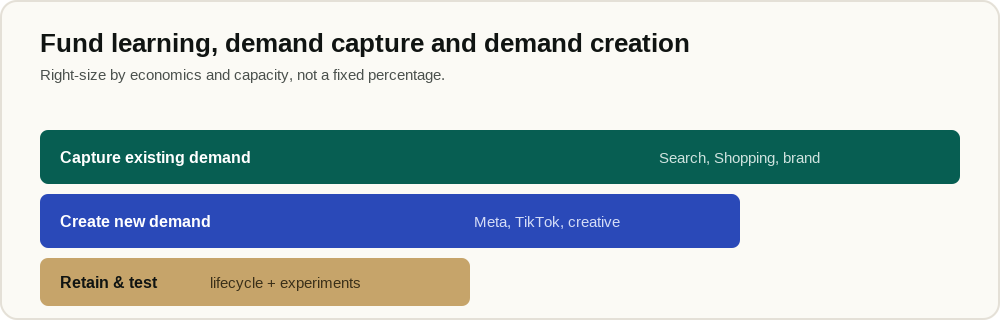
Channel allocation should follow customer behaviour, business economics, measurement quality, and the role each channel plays in the buying journey. Avoid treating a fixed percentage split as a universal rule.
Paid search and Shopping
Google Ads can capture active product or category demand. Search terms, product availability, feed quality, branded versus non-branded demand, and landing-page relevance affect the quality of spend. Performance Max may combine multiple Google inventory types, so interpret results with an understanding of campaign reporting and attribution.
Paid social
Meta, TikTok, and Snapchat can help introduce products, generate demand, and retarget audiences where permitted and appropriate. Creative quality, offer clarity, audience-message fit, and landing-page experience all influence performance.
SEO and content
SEO can support discoverability for category, product, and informational searches. It requires technical access, useful content, internal linking, and ongoing maintenance. Budget it as a long-term capability, not as a substitute for immediate demand when the business needs near-term sales.
Retention and lifecycle marketing
Email, SMS, customer support, and post-purchase communication can help encourage repeat purchase and improve customer experience. Track the cost and results separately where possible so retention activity is not mistaken for new-customer acquisition.
Use roles, not just channel labels
For each channel, define:
A channel with a different role should not be judged by exactly the same short-term metric as every other channel.
- The audience or demand it is meant to reach.
- The part of the customer journey it supports.
- The primary success metric and guardrails.
- The attribution limitations.
- The budget limit and review cadence.
- The conditions under which spend will increase, remain stable, or decrease.
6. Plan testing and learning
A budget must leave room to test without making every campaign change at once.
Prioritise tests that can change a decision:
For each test, write down the hypothesis, what will change, the main metric, guardrail metrics, minimum evidence needed, and the decision that follows. If several major variables change simultaneously, it may be difficult to know what caused the result.
Do not assume every test requires a formal A/B testing platform. Some changes can be evaluated through controlled campaign experiments, staged rollouts, or well-documented before-and-after analysis, but acknowledge the limits of those methods.
- New creative concepts and product demonstrations.
- Landing-page message match and product information.
- Product-feed titles, images, attributes, and diagnostics.
- Search-query quality and campaign structure.
- Checkout friction and delivery or payment clarity.
- New-customer versus returning-customer measurement.
- Offer structure and its impact on contribution.
7. Build a realistic forecast
Use a simple forecast that makes assumptions visible. Avoid false precision.
A planning table might include:
Populate this table with business-specific data. The scenario labels are not predictions, and the assumptions should be revisited as actual results arrive.
For each scenario, also estimate contribution after acquisition costs, potential return/refund exposure, and cash-flow timing. A forecast of revenue alone is incomplete.
| Scenario | Spend assumption | CAC assumption | Expected new customers | Interpretation |
|---|---|---|---|---|
| Conservative | Lower or tightly capped | Higher | Lower | Protect cash and test carefully |
| Base case | Planned budget | Expected range | Expected range | Main operating plan |
| Upside | Increased only after evidence | Stable or improved | Higher | Requires inventory and service capacity |
8. Monitor performance and cash flow
Review the budget using a consistent reporting rhythm. Daily monitoring can identify technical issues or unexpected spend, while larger allocation decisions may require a longer period and enough conversion data.
Useful measures may include:
Use leading indicators to diagnose problems, but avoid treating them as final proof of profitability. If a platform reports a strong result that conflicts with order records, investigate the discrepancy before scaling.
- Spend against plan.
- New customers and fulfilled first-time customers.
- Paid CAC and blended CAC, with definitions documented.
- ROAS and attributed revenue, with attribution caveats.
- Contribution after relevant variable costs and acquisition spend.
- Conversion rate, average order value, and order quality.
- Refunds, returns, cancellations, and cash-on-delivery refusal rates where relevant.
- Inventory availability, fulfilment performance, and customer support capacity.
- Cohort repeat purchase and payback timing when data is mature enough.
Create explicit budget rules
Examples of rules to adapt:
These are governance examples, not universal thresholds. Set numerical limits using the business’s own economics and data.
- Increase spend only when tracking is functioning and fulfilment can handle demand.
- Hold a campaign when results are inconclusive rather than making repeated changes every day.
- Reduce or pause spend when the business’s defined risk limit is breached.
- Reserve contingency budget for evidence-backed opportunities, not to rescue every underperforming campaign.
- Reassess assumptions when product margin, pricing, delivery costs, or conversion rates change.
9. Common budgeting mistakes
- 01Copying an industry percentage without checking margins. A percentage of revenue does not reveal what the business can afford.
- 02Confusing ad spend with the total marketing budget. Creative, people, tools, content, and measurement may also be necessary.
- 03Budgeting from revenue alone. Revenue can grow while contribution deteriorates.
- 04Assuming every platform-reported sale is incremental. Attribution systems may overlap or claim credit for existing demand.
- 05Scaling before fulfilment is ready. Stockouts, late delivery, returns, and poor service can erase acquisition gains.
- 06Ignoring cash-flow timing. Ad costs can be paid before COD remittances or repeat purchases arrive.
- 07Changing too many variables at once. This makes results harder to interpret.
- 08Cutting SEO or measurement because results take longer. Short-term efficiency can come at the expense of long-term capability.
- 09Treating forecast CAC as guaranteed. Auction conditions and conversion performance can change.
- 10Having no decision rules. Without limits and review criteria, budget changes become reactive.
10. A practical 90-day budget plan
Days 1-30: Establish the baseline
Output: A documented baseline, channel plan, and risk limits.
- Confirm margin, contribution, average order value, refund and return exposure, and cash constraints.
- Audit conversion tracking and reconcile platform data with ecommerce records.
- Document the new-customer definition and CAC cost scope.
- Map channel roles and current spend.
- Identify technical, creative, feed, landing-page, and fulfilment blockers.
Days 31-60: Test and improve
Output: A learning log, updated forecast, and evidence-backed budget recommendations.
- Fund a manageable set of high-priority creative, landing-page, feed, or campaign tests.
- Review results using pre-agreed decision rules.
- Improve weak conversion steps and measurement gaps.
- Compare paid and blended CAC without mixing definitions.
- Monitor order quality and cash collection alongside platform results.
Days 61-90: Reallocate and scale selectively
Output: A next-quarter budget with assumptions, owners, review cadence, and explicit scale/hold/reduce rules.
- Move budget toward areas with repeatable results and acceptable contribution.
- Reduce waste where evidence is strong, not just because a short period looks weak.
- Scale gradually while checking marginal CAC and operational capacity.
- Continue SEO, content, and retention work appropriate to the strategy.
- Refresh the next-quarter scenarios and contingency plan.
FAQ
Frequently asked questions
There is no universal amount. Base the budget on contribution margin, acquisition economics, growth goals, customer behaviour, cash flow, and the capacity to fulfil orders. Use business-specific scenarios rather than copying a generic percentage.
A revenue percentage can be a useful planning reference when interpreted in context, but it should not replace unit economics or cash-flow planning. Two stores with the same revenue may have very different margins and acquisition needs.
An advertising budget usually covers paid media. A broader marketing budget may also include creative production, people or agency support, SEO and content, analytics tools, promotions, and retention activity.
Start with a responsible test plan, a clear hypothesis, a spend limit, reliable tracking, and operational readiness. Use conservative scenarios and do not assume that early conversion costs will remain stable as spend increases.
There is no fixed split that works for every store. Consider customer intent, product category, creative capacity, search demand, contribution margin, tracking quality, and each channel’s role. Test and reallocate based on evidence rather than a universal percentage.
The amount depends on available cash, conversion volume, and the number of meaningful tests the business can support. Reserve enough to learn responsibly, but define the hypothesis, stop conditions, and decision criteria before spending.
Increase spend when measurement is reliable, acquisition economics are acceptable, results are repeatable enough for the decision, and inventory, fulfilment, service, and cash flow can support additional orders.
Similar posts
Performance Marketing
Performance Marketing for Ecommerce: What Actually Drives Profitable Growth
A profit-first guide to ecommerce performance marketing: how to connect paid media, SEO, conversion optimisation and measurement into one system that grows revenue without sacrificing margin.
11 min read
Measurement
ROAS vs CAC vs MER: Which Metrics Actually Measure Marketing Performance?
Understand ROAS, customer acquisition cost and marketing efficiency ratio, when each metric helps, and how to use them together for better growth decisions.
11 min read
Performance Marketing
What I Check Before Increasing an Ecommerce Advertising Budget
Use this practical checklist to assess profitability, tracking, creative capacity, stock, conversion rates and cash flow before increasing ecommerce ad spend.
15 min read
Related services
Related work