Technical SEO
Log-File Analysis and Crawl Budget for Ecommerce

Crawl budget is one of the most misunderstood ideas in SEO. Small-site owners worry about it needlessly, while large-site owners often ignore it until products mysteriously fail to get indexed. The truth is specific: crawl budget is a real constraint, but only at scale, and the way to understand and manage it is to look at what search engines actually do on your site, which means reading your log files. This piece explains what crawl budget really is, when it matters, how log-file analysis exposes crawl waste, and what to do about it. It is aimed at large ecommerce sites, because that is where this work pays off; if you run a small store, the honest advice is to spend your effort elsewhere.
Quick answer
Crawl budget is the attention search engines are willing to spend crawling your site, and it only becomes a real constraint on large ecommerce sites with many thousands of URLs. Log-file analysis, examining your server logs to see what search engines actually crawl, reveals where that budget is wasted: on faceted URLs, parameters, redirects, duplicates and dead pages, instead of on your important products. For big catalogues, directing crawl budget to pages that matter is a high-value technical SEO task; for small sites, it rarely matters.
Key takeaways
- Crawl budget is the finite crawling attention search engines spend on your site; it matters only at scale, large catalogues with many thousands of URLs.
- Wasted crawl budget means important products are crawled less and can be slow to index or drop out.
- Ecommerce wastes it on faceted URLs, parameters, redirects, duplicates and dead pages.
- Log-file analysis shows what crawlers actually request, exposing where budget goes versus where it should.
- Act on the findings with standard levers, blocking low-value URLs, consolidating duplicates, fixing redirects, strengthening internal links, clean sitemaps, applied with evidence.
- If your site is small, crawl budget is almost certainly not your problem; spend effort on content, architecture and links instead.
What crawl budget actually is
Search engines do not crawl every page of every site constantly; they allocate finite crawling attention based on a site's size, health and importance. Crawl budget is loosely the number of URLs an engine will crawl on your site in a given period. If your important pages are crawled regularly, their changes get picked up and they stay well-indexed. If crawl attention is consumed by worthless URLs, important pages are crawled less, and new or updated products can be slow to appear or drop out.
Crucially, this is only a meaningful constraint when you have far more URLs than your crawl budget comfortably covers, which in practice means large catalogues with tens of thousands of URLs or more, especially those generating many parameter and facet combinations. A few hundred or few thousand clean pages will be crawled fine without any crawl-budget management.
Where ecommerce wastes crawl budget
Large stores waste crawl budget in predictable ways, and naming them is half the battle.
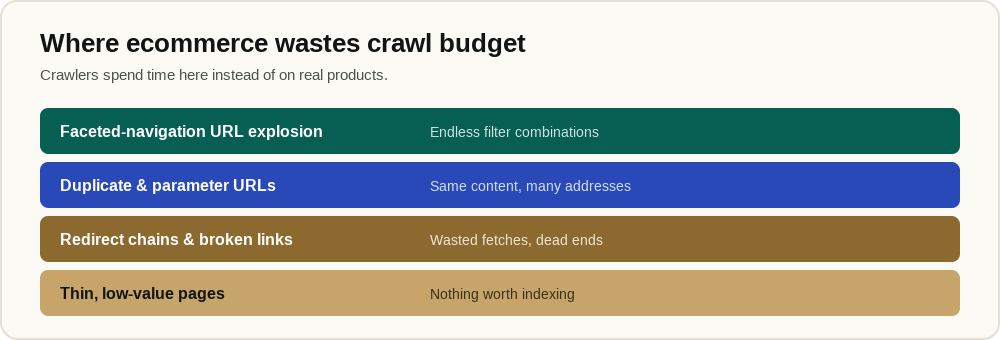
Faceted navigation generates vast numbers of filter and sort URLs, most of them low value. Parameters, session IDs, tracking tags, sort orders, multiply URLs that are really the same content. Redirects and redirect chains consume crawls that reach nothing new. Duplicate pages, the same product via multiple paths, get crawled repeatedly. And dead pages, 404s, soft 404s, long-gone products, absorb attention that should go to live products. On a big site, these can consume the majority of crawl activity, starving the pages you actually care about.
How log-file analysis reveals the truth
Log-file analysis means examining your server's access logs to see what search-engine crawlers actually requested, when, and how often. Unlike guessing or relying on reports, logs show the ground truth of crawler behaviour on your site.
This reveals the things you cannot otherwise see: which URLs search engines spend their crawl budget on, whether they are crawling your important products or drowning in facet URLs, how much budget goes to redirects and errors, and which valuable pages are rarely or never crawled. Patterns jump out, for instance, finding that a large share of crawl activity hits parameter URLs while key products are crawled rarely. That insight directs the fix.
What to do with the findings
Once logs show where budget is wasted, the remedies are the standard technical levers, applied with evidence. Block or noindex low-value facet and parameter URLs so crawlers stop spending budget on them. Consolidate duplicates with canonicals and consistent URLs. Fix redirect chains and remove links to dead pages. Ensure important products are well-linked so crawlers reach them. Keep your sitemaps clean and current so engines have a reliable list of what matters. The goal throughout is to redirect finite crawl attention away from waste and towards the pages that earn revenue.
Do not over-worry if you are small
The honest caveat, worth repeating: if your site is small, a few thousand clean URLs or fewer, crawl budget is almost certainly not your problem, and log-file analysis is probably not the best use of your time. Spend it on content, architecture and links instead. Crawl-budget work earns its keep specifically on large, URL-heavy catalogues, and applying it to a small site is effort spent on a constraint you do not have.
FAQ
Frequently asked questions
It is the finite amount of crawling attention a search engine allocates to your site, roughly how many URLs it will crawl in a given period. If important pages are crawled regularly they stay well-indexed; if worthless URLs consume the budget, key pages are crawled less and can be slow to index or drop out.
Only if you are large. Crawl budget becomes a real constraint on sites with far more URLs than the budget comfortably covers, typically tens of thousands of URLs, especially with many facet and parameter combinations. For a small store with a few thousand clean pages, it is not a meaningful concern.
It is examining your server's access logs to see what search-engine crawlers actually requested, how often and when. Unlike reports or guesses, logs show the ground truth of crawler behaviour, revealing which URLs consume crawl budget and whether your important products are being crawled or ignored.
Mainly through faceted-navigation URLs, parameters and session IDs, redirect chains, duplicate pages reachable via multiple paths, and dead or error pages. On large sites these can absorb the majority of crawl activity, leaving less for the live product pages that actually drive revenue.
Apply standard technical fixes with the evidence: block or noindex low-value facet and parameter URLs, consolidate duplicates with canonicals, fix redirect chains, remove links to dead pages, strengthen internal links to important products, and keep sitemaps clean. The aim is to steer finite crawl attention toward the pages that matter.
Similar posts

SEO
Ecommerce SEO: The Complete Guide to Growing Organic Revenue
Learn how to grow ecommerce organic revenue with category SEO, product pages, technical SEO, structured data, internal linking, content strategy and measurement.
24 min read

Technical SEO
Ecommerce Site Architecture for SEO
Good ecommerce architecture is shallow and logical, so authority and crawlers reach every product. How to structure categories, internal links and URLs, and tame large-catalogue problems.
5 min read

Technical SEO
Ecommerce SEO for Large Catalogues: Managing Faceted Navigation, Crawl Budget, and Indexation
10 min read
Related services