Agentic Commerce
AI Chatbots for Ecommerce That Actually Convert

Chatbots have a mixed reputation for good reason. Plenty of them are frustrating: rigid scripts, irrelevant answers, and no way to reach a human. Yet the better ones genuinely help people buy, by meeting them at the moment of doubt with a useful answer. The difference is almost never the underlying technology. It is whether the bot was built to solve a real problem or to tick a box. This piece is about building the kind that converts. It focuses on the handful of decisions that separate a helpful assistant from an obstacle, and it is deliberately sceptical of the idea that simply adding AI makes a bot good.
Quick answer
An ecommerce chatbot converts when it removes a specific friction between a shopper and a purchase, answering the questions that stall buyers, guiding product choice, and handing off to a human when needed. It fails when it is a scripted maze with no clear job and no escape hatch. Modern AI makes bots more capable, but capability is not the point: solving a real customer problem, fast and honestly, is. Measure completed purchases and resolved issues, not chat volume.
Key takeaways
- A chatbot converts by removing a specific friction between shopper and purchase, not by existing or by being AI-powered.
- Start from a concrete job, pre-purchase questions, guided choice, buying-adjacent support, after-hours cover, rather than from the technology.
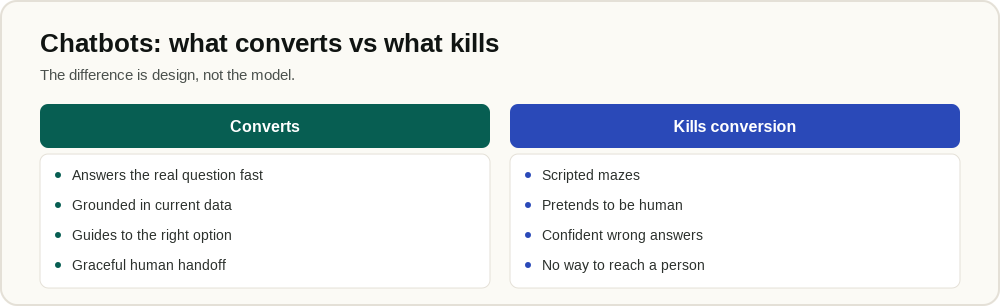
- Converting bots answer the real question quickly and accurately, are grounded in current catalogue data, guide customers forward, and hand off to a human gracefully.
- Conversion killers: scripted mazes, pretending to be human, confident wrong answers, no human escape, and interrupting people who already know what they want.
- AI improves understanding and flexibility but adds the risk of fluent wrong answers unless the bot is grounded in real data.
- Measure completed purchases and resolved issues, not chat volume.
Start from a job, not a technology
The first mistake is to start with "we should have an AI chatbot" and work backwards. Start instead with a specific job: a point in the journey where customers get stuck, hesitate or leave, and where a timely answer would help.
For most stores, a few jobs dominate. Answering pre-purchase questions that block the sale: fit, suitability, compatibility, delivery timing. Guiding choice in a large or confusing range. Handling buying-adjacent support like order status and returns. Covering the hours when no human is available. A bot aimed squarely at one or two of these, done well, beats a general-purpose bot that does everything vaguely.
What makes a chatbot convert
It answers the real question quickly
Conversion comes from resolving the doubt that stands between the customer and checkout. The bot must understand the question, give an accurate, specific answer, and do it fast. Speed and accuracy matter more than personality. A bot that quickly confirms the item fits the customer's need removes the reason to hesitate.
It knows your catalogue and data
A converting bot is grounded in accurate, current product information: availability, specifications, pricing, policies. A bot that gives confident but wrong answers is worse than none, because it erodes trust and creates bad experiences. Grounding the bot in reliable data is what lets it help rather than mislead.
It guides, it does not just answer
Beyond answering, a good bot can move the customer forward: suggesting the right option for a stated need, surfacing the relevant product, easing the path to checkout. This is where it shades into acting as an assistant within your store, doing some of the work the shopper would otherwise do themselves.
It hands off gracefully
No bot resolves everything. The converting ones make it easy to reach a human for anything beyond their scope, early and without a fight. A smooth handoff saves a sale that a trapped customer would have abandoned. Treat the escape hatch as essential, not optional.
What kills conversion
Several patterns reliably destroy a chatbot's value. Scripted mazes that force people through rigid trees. Pretending to be human and then failing. Confident wrong answers from a bot not grounded in real data. No way to reach a person. Interrupting people who already know what they want with an unprompted pop-up demanding attention. Each of these adds friction, and friction is exactly what the bot was supposed to remove.
Does adding AI make a bot better?
Modern AI genuinely improves a bot's ability to understand natural questions and respond flexibly, which is a real advance over rigid decision trees. But AI also introduces the risk of confident, fluent wrong answers if the bot is not grounded in your actual data. So AI is an enabler, not a guarantee. A well-grounded, well-scoped AI bot can be excellent; an ungrounded one can be fluent and misleading, which is worse. The design discipline matters more than the model.
FAQ
Frequently asked questions
They can, when they remove a specific friction such as answering purchase-blocking questions, guiding choice or covering after-hours support. They can also hurt conversion when they obstruct shoppers or give wrong answers. The result depends on scoping the bot to a real job and grounding it in accurate data.
Rigid scripted trees, pretending to be human and failing, confident but wrong answers, no way to reach a person, and interrupting people who already know what they want. These add friction, which is the opposite of what a bot should do. Avoiding them matters more than any feature you add.
No. AI improves the bot's ability to understand natural questions and respond flexibly, but it also risks fluent, confident wrong answers if the bot is not grounded in your real product data. A well-grounded AI bot can be excellent; an ungrounded one can be worse than a simple one.
At minimum, answer common pre-purchase questions accurately, know current availability and specifications, guide customers to the right option, and hand off to a human for anything beyond its scope. Scoping it to the one or two jobs that most often stall your buyers beats trying to do everything.
By outcomes: completed purchases, resolved issues, and reduced abandonment at the points the bot addresses, plus satisfaction with the experience. A high number of conversations that does not move these metrics is a cost, not a win, and frequent failed attempts to reach a human signal a problem.
Similar posts
Agentic Commerce
The Conversational Commerce Playbook
Conversational commerce is selling through chat. Where it helps, the principles that separate useful assistants from annoying ones, and how to measure outcomes rather than chat volume.
5 min read
Agentic Commerce
The Agentic Commerce Guide: Selling When AI Does the Shopping
A practitioner's guide to agentic commerce: what it is, what is real versus hype, and the no-regret work, structured data, feeds, trust and frictionless buying, that makes a store ready.
7 min read
CRO
Ecommerce Conversion Rate Optimisation: A Practical Framework for More Profitable Sales
Learn how to improve ecommerce conversions with a practical CRO framework covering funnel analysis, product pages, checkout, mobile UX, testing, and revenue quality.
14 min read
Related services