Agentic Commerce
Headless and Composable Commerce for AI Readiness

Headless and composable commerce are among the most hyped architectural ideas in ecommerce, and agentic commerce has given the hype a new angle: the claim that you must go headless to be ready for AI. There is a real point buried in the pitch, but it is easy to overpay for. This piece explains what these architectures are, the genuine connection to AI readiness, and how to get the benefit without being talked into a re-platform you do not need. The honest framing is that AI readiness is mostly about your data and your APIs being good, and those can often be improved without tearing up your platform. Architecture is one lever among several, not a prerequisite.
Quick answer
Headless commerce separates your storefront from the backend so each can change independently; composable commerce extends that idea to the whole stack, assembled from best-of-breed parts connected by APIs. Both help AI readiness because AI agents, assistants and new interfaces consume your data and services through APIs, not your web pages. But they are a means, not a goal: most stores should improve their data and APIs pragmatically rather than undertake a costly re-platform on the promise of being agent-ready.
Key takeaways
- Headless commerce decouples the storefront from the backend via APIs; composable extends that to a best-of-breed, API-connected stack.
- The real AI-readiness connection: agents and assistants consume your data and services through APIs and feeds, not your web pages, so API-first plumbing helps.
- But the benefit comes mainly from good data and accessible APIs, which many conventional platforms can already provide.
- Re-platforming to composable is a large, costly, risky project justified by broad business needs, not something to do solely to be agent-ready.
- Judge headless or composable on general merits; if you adopt them for other reasons, AI readiness is a bonus.
- Otherwise invest directly in structured data, clean feeds and exposing your catalogue through your existing platform's APIs.
What the terms mean
Headless commerce decouples the front end, what the customer sees, from the back end, the commerce engine handling catalogue, cart, orders and so on. They communicate through APIs, so you can change or add front ends without rebuilding the backend. That is what the "head" refers to: the presentation layer, detached.
Composable commerce takes the principle further. Instead of one monolithic platform, you assemble your stack from specialised services, search, checkout, content, each chosen for being good at its job and connected by APIs. The promise is flexibility: swap any component without replacing everything.
Both are real, legitimate architectures with genuine benefits and genuine costs. They are not magic, and they are not free.
The real connection to AI readiness
Here is the kernel of truth in the AI-readiness pitch. AI agents, assistants and emerging interfaces do not interact with your pretty product pages; they consume your data and capabilities through structured channels, feeds, APIs, structured data. An architecture built around clean APIs exposes your catalogue, inventory and commerce functions in exactly the form these systems can use.
So an API-first architecture does make it easier to serve new interfaces, including agentic ones, because the plumbing to deliver data and actions programmatically is already there. If you were starting from scratch or already re-platforming for other reasons, API-first is a sensible default.
Why it is not a prerequisite
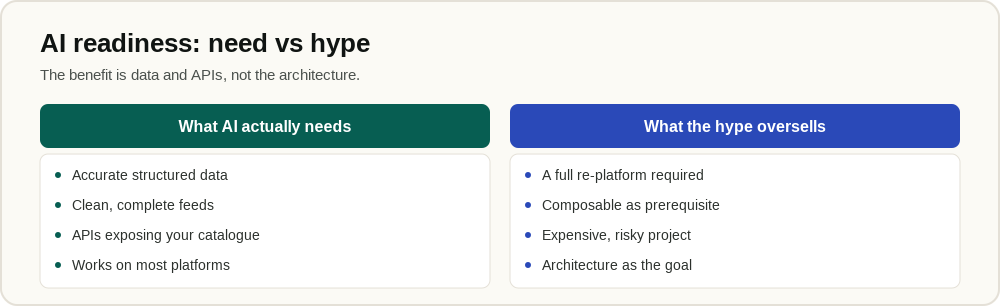
The leap the hype makes is from "API-first helps" to "you must re-platform to be AI-ready". That does not follow. What AI systems actually need from you is good data and accessible services: accurate structured product data, clean feeds, and the ability to expose your catalogue and key functions through APIs. Many conventional platforms already provide APIs and can emit structured data and feeds perfectly well.
In other words, most of the AI-readiness benefit comes from doing the data and API work, which you can often do on your existing platform, not from the architectural pattern itself. Re-platforming to composable is a large, expensive, risky project justified by broad business needs like flexibility and scale, not something to undertake solely to be agent-ready.
How to decide
Judge headless or composable on their general merits for your business: do you need presentation flexibility, best-of-breed components, scale your current platform cannot give? If yes, AI readiness is a nice additional benefit of going API-first. If your current platform serves you well, do not re-platform for AI readiness alone. Instead, invest directly in the things that matter: structured data, clean feeds, and exposing your catalogue and functions through whatever APIs your platform offers.
The discipline is to separate the goal, being legible and serviceable to AI systems, from one particular means of achieving it. The goal is mandatory; this architecture is optional.
FAQ
Frequently asked questions
No. What AI systems need is good data and accessible services: accurate structured data, clean feeds, and APIs that expose your catalogue and functions. Many conventional platforms already provide these. API-first architecture helps, but the benefit comes from the data and APIs, not from re-platforming itself.
Headless decouples the front-end presentation layer from the commerce backend, connected by APIs, so you can change the storefront independently. Composable goes further, assembling the whole stack from specialised best-of-breed services connected by APIs, so any component can be swapped. Composable is the broader, more ambitious pattern.
Because AI agents and assistants consume data and actions through structured channels and APIs, not web pages, and an API-first architecture exposes your commerce capabilities in exactly that form. The point is valid, but the same programmatic access can often be achieved on an existing platform without a full re-platform.
Rarely. It is a large, expensive, risky undertaking that should be justified by broad business needs such as flexibility, best-of-breed components or scale. AI readiness is better achieved directly through data and API work, which is far cheaper and lower-risk than re-architecting your whole stack.
Focus on accurate structured product data and schema, clean and complete product feeds, and exposing your catalogue and key functions through whatever APIs your platform offers. These deliver most of the agent and assistant readiness benefit without the cost and risk of changing architecture.
Similar posts
Agentic Commerce
The Agentic Commerce Guide: Selling When AI Does the Shopping
A practitioner's guide to agentic commerce: what it is, what is real versus hype, and the no-regret work, structured data, feeds, trust and frictionless buying, that makes a store ready.
7 min read
Agentic Commerce
How to Prepare Your Store for AI Shopping Agents
Preparing for AI shopping agents means making products easy for a machine to find, understand, trust and buy, with structured data, clean feeds and a frictionless checkout. Mostly no-regret work.
6 min read
Technical SEO
Structured Data for Agentic Commerce
Structured data tells AI agents what your products are, cost, and whether they can be trusted. Which schema types matter, why accuracy is paramount, and how to keep it synced to reality.
5 min read
Related services