AI Tools
ChatGPT for SEO: A Practical Workflow

SEO is a series of repeatable tasks, and ChatGPT speeds up most of them. But it also tempts people into mass-producing generic content that search engines ignore. This guide lays out a practical, honest ChatGPT-for-SEO workflow, where it helps, where it needs a data tool alongside it, and where human expertise is non-negotiable. The goal is faster, better SEO, not shortcuts that backfire.
Quick answer
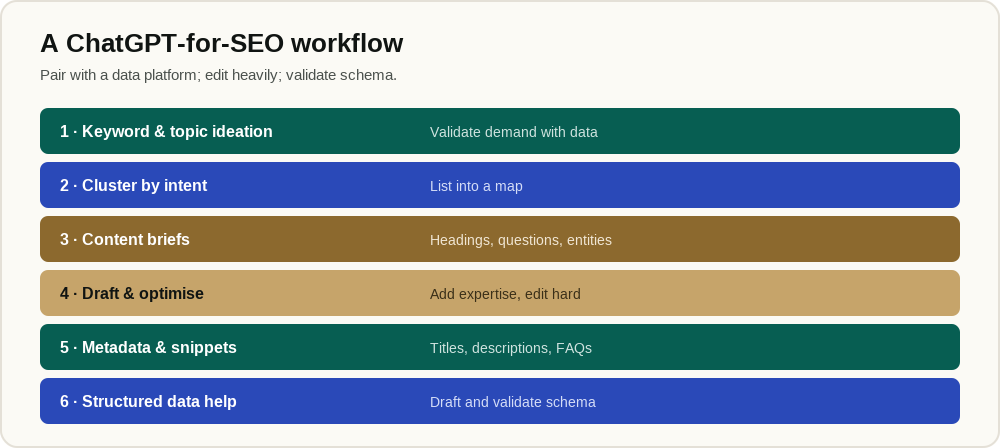
ChatGPT supports SEO across the workflow: generating keyword and topic ideas, clustering them by intent, building content briefs, drafting and optimising copy, writing meta titles and descriptions, and helping with structured data. It does not provide reliable search-volume data or replace genuine expertise, so pair it with a real SEO data platform and edit everything heavily. Used this way, ChatGPT makes SEO faster; it does not make thin content rank.
Key takeaways
- ChatGPT helps across SEO: ideation, clustering, briefs, drafting, metadata and schema.
- It does not provide reliable search data; pair it with an SEO platform.
- Clustering keywords by intent is one of its most useful SEO jobs.
- Drafts need genuine expertise and heavy editing to rank.
- Validate technical output like schema before deploying.
1. Keyword and topic ideation
Use ChatGPT to brainstorm seed topics, questions, subtopics and long-tail variations around a theme. The job is a broad idea list you would not reach by hand. It is strong here, but it does not know real search volume, so validate demand with a data platform before committing.
2. Clustering by intent
Paste a keyword list and ask ChatGPT to group it into topics and tag intent (informational, commercial, transactional). This turns a messy list into the hub-and-spoke structure that underpins a good content plan, and it is one of its most useful SEO jobs.
3. Content briefs
Turn a target query into a brief: suggested headings, questions to answer, entities to cover and angle. The job is a thorough starting structure. Add your own expertise so the brief reflects real understanding, not just surface coverage.
4. Drafting and optimising
Draft sections, rewrite for clarity, and check that key subtopics and questions are covered. Treat the draft as raw material: add genuine experience, specifics and a real point of view, then edit heavily. This is what separates content that ranks from content that fills space.
5. Metadata and snippets
Generate meta titles, descriptions and FAQ answers that are clear and compelling. The job is fast, on-brand metadata at scale. Review for accuracy, length and that they genuinely reflect the page.
Where you still need more than ChatGPT
- Real search-volume, difficulty and trend data: use an SEO platform.
- Genuine expertise and experience: only people provide this.
- Technical verification: validate schema, fixes and changes.
- Editorial judgement: decide what is worth publishing and heavily edit it.
FAQ
Frequently asked questions
It accelerates ideation, clustering, briefs, drafting and metadata, but it does not replace search data, expertise or editing. Use it as a force multiplier alongside a data platform.
No, not reliably. It is great for generating and clustering ideas, but you must validate real demand with an SEO data platform before committing.
It can, if you add genuine expertise, structure and accuracy and edit heavily. Thin, unedited AI content rarely competes and can harm credibility.
It can help draft and explain schema, but always validate the output with a testing tool before deploying, since malformed markup is useless or harmful.
Clustering keywords by intent and building briefs are standout uses, turning raw research into a structured, intent-led content plan quickly.
Similar posts
AI Tools
The AI Marketing Tool Stack (2026): A Practical Buyer's Guide
A practitioner's guide to building an AI marketing tool stack around jobs to be done: general assistant, content, ads, email, analytics and AI visibility. Lean and honest.
4 min read
AI Tools
Best AI Tools for SEO: A Practical Guide by Use Case
The best AI SEO tool depends on the job: keyword research, briefs, technical audits, internal linking and reporting. A use-case guide, honest about what still needs a human.
3 min read

AI Tools
Best AI Tools for Keyword and Topic Research
AI speeds up idea generation, clustering by intent and prioritisation. Pair a data platform like Ahrefs or Semrush with a general assistant, and validate ideas with real demand.
3 min read
Related services