AI Tools
Best AI Tools for Keyword and Topic Research

Keyword research has two halves: the data (what people search, how often, how hard it is to rank) and the judgement (what is worth creating and how to group it). AI is excellent at the second half and increasingly woven into the first. This guide explains how to use AI for keyword and topic research by job, names well-known tools, and is clear about where hard data still matters. Tool names are category illustrations; combine them to fit your workflow.
Quick answer
AI speeds up keyword and topic research in three ways: generating and expanding ideas, clustering keywords by intent and topic, and prioritising what to create. Established SEO platforms like Ahrefs and Semrush supply the search-volume and difficulty data, while general assistants like ChatGPT, Claude and Gemini are strong at ideation, grouping and mapping intent. The best approach pairs a data platform for the numbers with an assistant for the thinking. AI accelerates research; you still decide what fits the business.
Key takeaways
- AI accelerates idea generation, clustering and prioritisation.
- Established platforms supply the search-volume and difficulty data.
- General assistants excel at grouping keywords and mapping intent.
- Pair a data platform with an assistant for the best of both.
- Validate AI ideas with real demand data, and prioritise ruthlessly.
Generating and expanding ideas
General assistants quickly produce seed keywords, questions, related topics and long-tail variations around a theme. The job is a broad, creative starting list you would not reach by hand. Feed the tool your niche, audience and offers, and ask for questions and intents, not just single keywords.
Clustering by intent and topic
AI groups large keyword lists into topic clusters and intent types (informational, commercial, transactional), which is the foundation of a hub-and-spoke content plan. The job is turning a messy list into a structured map. This is where assistants save the most time compared with manual sorting.
Getting the hard data
Ideas need validation: search volume, difficulty, trends and competitiveness. Established platforms like Ahrefs and Semrush provide this, and some now add AI summaries on top. The job is prioritisation grounded in real demand, so do not skip the data step; a clever idea with no search demand is a poor bet.
Prioritising what to create
With clusters and data in hand, AI helps rank opportunities by potential value, difficulty and fit with your expertise. The job is a sequenced plan, not a giant undifferentiated list. You make the final call based on business goals and what you can credibly create well.
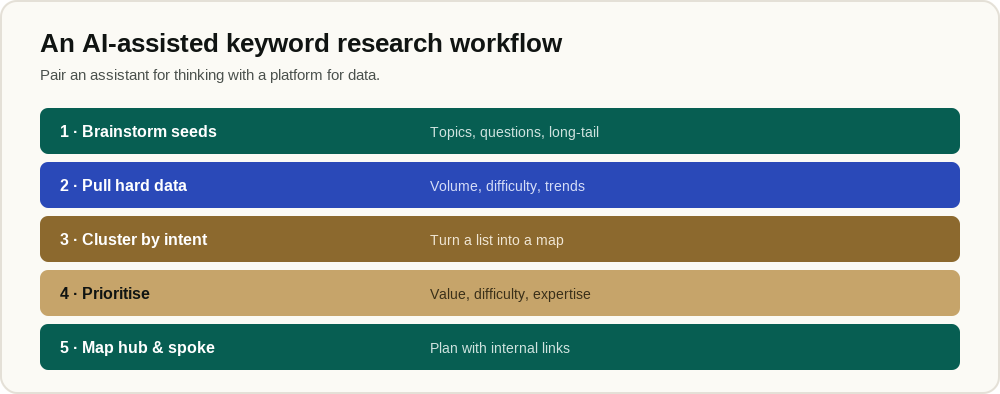
A simple AI-assisted workflow
- 01Use an assistant to brainstorm seed topics, questions and long-tail terms.
- 02Pull volume, difficulty and trend data from an SEO platform.
- 03Use AI to cluster into topics and tag intent.
- 04Prioritise by value, difficulty and your genuine expertise.
- 05Map clusters into a hub-and-spoke plan with internal links.
What to watch
AI can invent plausible-looking keywords and misjudge demand, so validate volumes with real data. It can also over-produce, tempting you into a bloated plan. Prioritise ruthlessly and only commit to topics you can cover with genuine depth.
FAQ
Frequently asked questions
It is great for ideas, clustering and intent, but it does not reliably know real search volume or difficulty. Pair it with a data platform to validate demand.
They do different jobs. ChatGPT excels at ideation and clustering; Ahrefs provides the hard search data. Used together they are stronger than either alone.
Yes, and this is one of its most useful jobs, turning a long list into a structured, intent-tagged content map for hub-and-spoke planning.
It can suggest long-tail and question-based ideas, but you must verify competitiveness with real data. Treat its suggestions as candidates, not confirmed opportunities.
Prioritise by value, difficulty and genuine expertise, and only commit to topics you can cover with real depth. A focused plan beats a sprawling one.
Similar posts
AI Tools
The AI Marketing Tool Stack (2026): A Practical Buyer's Guide
A practitioner's guide to building an AI marketing tool stack around jobs to be done: general assistant, content, ads, email, analytics and AI visibility. Lean and honest.
4 min read
AI Tools
Best AI Tools for SEO: A Practical Guide by Use Case
The best AI SEO tool depends on the job: keyword research, briefs, technical audits, internal linking and reporting. A use-case guide, honest about what still needs a human.
3 min read
SEO
Ecommerce SEO Keyword Research: Map Search Demand to Categories, Products, and Buying Guides
13 min read
Related services