AI Tools
The AI Marketing Tool Stack (2026): A Practical Buyer's Guide

There are hundreds of AI marketing tools and more every week, which makes "what should I use" a genuinely hard question. The answer is not a list of logos; it is a way of thinking. This guide frames the stack by the jobs marketers actually need done, explains what to look for in each layer, names well-known tools as examples, and is honest about where AI helps and where it does not. Treat tool names as illustrations of a category, not endorsements, and always evaluate against your own needs.
Quick answer
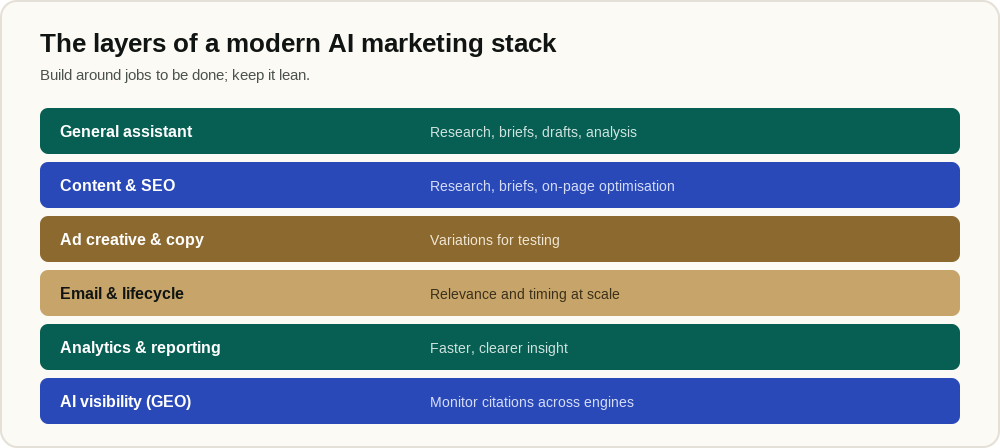
A good AI marketing stack is built around jobs to be done, not hype. At its core sit a general assistant for thinking and drafting, a content and SEO layer, an ad-creative layer, an email and lifecycle layer, an analytics layer, and, increasingly, an AI-visibility layer for GEO. Choose tools by the outcome you need, keep the stack lean, insist on human review, and avoid paying for overlapping features you will not use. The best stack is the smallest one that does the job well.
Key takeaways
- Build the stack around jobs to be done, not around tool hype.
- The core layers: general assistant, content/SEO, ad creative, email/lifecycle, analytics, and AI visibility.
- A capable general model delivers most of the early value; master it first.
- Choose within a layer by real need, fit, output quality, price and measurability.
- Keep the stack lean and governed; AI accelerates skilled people, it does not replace them.
Start with jobs, not tools
Before buying anything, write down the outcomes you need: more qualified traffic, faster content production, better ad creative, stronger retention, clearer reporting. Map each outcome to a job, then ask whether AI genuinely improves that job. Many teams buy tools for jobs they do not have, then pay monthly for features they never open. A lean stack built around real jobs beats a sprawling one built around fear of missing out.
The layers of a modern stack
General assistant
A capable general model (such as ChatGPT, Claude or Gemini) is the backbone: research, briefs, first drafts, analysis, summarising and ideation. For many teams this single layer delivers most of the value, so master it before adding specialised tools.
Content and SEO
Tools in this layer help with research, briefs, drafting and on-page optimisation. Well-known names include writing assistants and SEO platforms with AI features. The job is better, faster content that still meets E-E-A-T standards, so human expertise and editing remain essential.
Ad creative and copy
This layer speeds up variations of ad copy, headlines and images for testing. The value is volume and iteration speed, not a finished campaign. Treat AI output as raw material your team shapes, tests and approves.
Email and lifecycle
Many email and CRM platforms now include AI for subject lines, segmentation and send-time suggestions. The job is relevance and timing at scale, measured by engagement and retention, not by how clever the tool sounds.
Analytics and reporting
AI can speed up querying data, drafting summaries and surfacing anomalies. The job is faster, clearer insight, but the numbers must still be correct, so verify anything that drives a decision.
AI visibility (GEO)
A newer layer helps you monitor whether AI engines cite your brand. It supports generative engine optimization by tracking presence and gaps across engines. Useful, but young, so weigh the cost against doing a lighter manual version.
How to choose within a layer
- Does it clearly improve a job you actually have?
- Does it fit your existing tools, or add yet another silo?
- Is the output good enough to build on with light editing?
- Is pricing justified by time saved or results gained?
- Can you measure its impact, and would you miss it if it went?
Keep it lean and governed
Resist stacking overlapping tools. Prefer fewer, well-used platforms over many half-used ones. Put simple governance in place: who reviews AI output, where brand and factual accuracy are checked, and what is never automated. A lean, governed stack is cheaper, easier to run and less risky than a bloated one.
What AI tools will not do
They will not replace strategy, judgement or genuine expertise, and they will not guarantee results. They accelerate work a skilled marketer directs. Buy them to make good people faster, not to replace the thinking that makes marketing work.
FAQ
Frequently asked questions
For most teams, a capable general assistant like ChatGPT, Claude or Gemini delivers the widest value across research, drafting and analysis. Master it before adding specialised tools.
Fewer than you think. A lean stack of a few well-used tools beats many half-used ones. Add a specialised tool only when it clearly improves a real job.
No. They accelerate work a skilled marketer directs. Strategy, judgement and expertise still decide whether the output is any good.
Often, yes, for individuals and small teams. Many capable tools have free tiers. Pay only when a paid feature clearly saves time or improves results.
Tie it to a job and a metric: time saved, output quality, or a result like traffic or revenue. If you could drop it without noticing, drop it.
Similar posts
AI Tools
Best AI Tools for SEO: A Practical Guide by Use Case
The best AI SEO tool depends on the job: keyword research, briefs, technical audits, internal linking and reporting. A use-case guide, honest about what still needs a human.
3 min read
AI Tools
Best AI Tools for Ecommerce: A Use-Case Guide
The most useful AI tools for ecommerce by job: product content at scale, search, ads, email, support and analytics. Choose by measurable outcome, keep humans in the loop.
4 min read
AI Tools
Best AI Tools for Content Writing (and How to Use Them Well)
AI writing tools split into general assistants (ChatGPT, Claude, Gemini) and marketing writers (Jasper, Copy.ai). The quality comes from your brief, expertise and editing.
4 min read
Related services