AI for Ecommerce
ChatGPT for Ecommerce: Practical Ways to Use It

Ecommerce is full of repetitive, high-volume writing and analysis, which is exactly where ChatGPT earns its place. Used well, it clears backlogs of product descriptions, keeps email and ads flowing, and turns piles of reviews into something useful. Used carelessly, it publishes inaccurate or duplicated content across thousands of SKUs. This guide covers practical, honest ways to use ChatGPT in ecommerce, and where to keep a careful human eye.
Quick answer
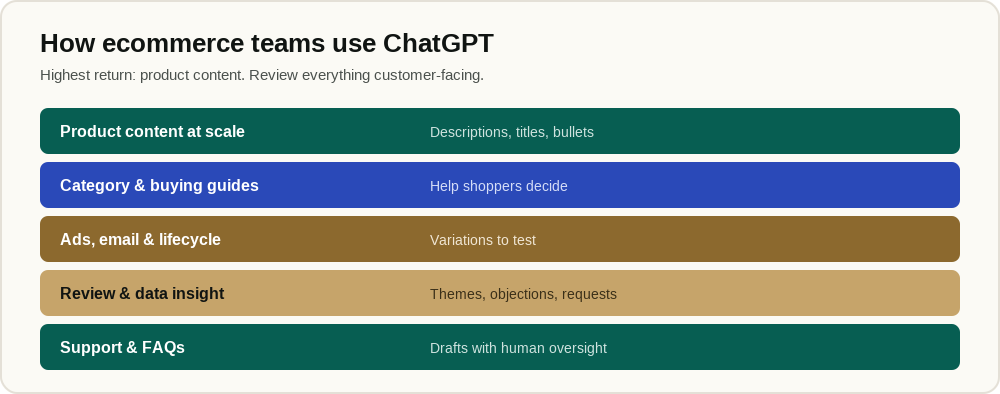
Ecommerce teams use ChatGPT to write and refresh product content at scale, draft category and buying-guide copy, generate ad and email variations, turn reviews and data into insights, and draft support responses and FAQs. The highest-return use is usually product content, because it is high-volume and directly affects discovery and conversion. Everything customer-facing must be checked for accuracy and brand fit, and nothing should be published unedited. ChatGPT speeds the work; your product knowledge and review make it good.
Key takeaways
- ChatGPT's highest-return ecommerce use is product content at scale.
- It also helps with category copy, ads, email, review analysis and support.
- Feed accurate data and brand voice; ask for unique, not duplicated, output.
- Turn reviews and logs into insight, but verify before acting.
- Review everything customer-facing; errors multiply across a catalogue.
Product content at scale
The biggest win is product content: descriptions, titles, bullet points and attributes drafted quickly from your specs. Feed it accurate product details and your brand voice, and ask for unique copy per product, not near-duplicates. Always review for accuracy and originality before publishing, because errors and duplication multiply across a catalogue.
Category and buying-guide copy
ChatGPT drafts category-page introductions, buying guides and comparison content that help shoppers decide and support SEO. Give it the category, audience and key considerations, then add genuine expertise so the content is genuinely helpful rather than generic.
Ads, email and lifecycle copy
Generate variations of ad copy, subject lines, promotional emails and flow messages for testing. The job is range and speed for experiments; your team controls brand, offers, claims and final approval.
Turning reviews and data into insight
Paste in reviews, survey responses or support logs and ask ChatGPT to summarise themes, objections, and feature requests. This turns scattered feedback into insight for product, content and merchandising decisions. Verify before acting on anything significant.
Support responses and FAQs
Draft FAQ content, return-policy explanations and templates for common support queries. The job is faster, consistent responses; keep a human in the loop and never let automated answers mislead a customer about orders, returns or policy.
How to get good results
- Give accurate product data and specifics, not vague prompts.
- Set brand voice and rules, and reuse them across tasks.
- Ask for unique output per product to avoid duplication.
- Request options for copy you will test.
- Review everything customer-facing before it ships.
What to watch out for
Avoid publishing unedited descriptions that are inaccurate or duplicated, letting AI invent specs or claims, and allowing support templates to state anything untrue. In ecommerce, small errors scale into big problems, so accuracy and oversight matter more than speed.
FAQ
Frequently asked questions
Writing and refreshing product content at scale is usually the highest-return use. It is high-volume, repeatable and directly affects discovery and conversion, provided you review for accuracy and uniqueness.
Only if they are thin, inaccurate or duplicated. Edited, accurate, unique descriptions are fine and save significant time across a large catalogue.
Yes. Paste in reviews or support logs and ask for themes, objections and requests. It turns scattered feedback into insight, but verify before making decisions.
For drafting FAQs and templates, yes, with human oversight. Never let automated responses mislead customers about orders, returns or policy.
Ask for unique copy per product, feed distinct specifics for each, and review before publishing. Do not mass-generate near-identical descriptions across variants.
Similar posts
AI Tools
The AI Marketing Tool Stack (2026): A Practical Buyer's Guide
A practitioner's guide to building an AI marketing tool stack around jobs to be done: general assistant, content, ads, email, analytics and AI visibility. Lean and honest.
4 min read
AI Tools
Best AI Tools for Ecommerce: A Use-Case Guide
The most useful AI tools for ecommerce by job: product content at scale, search, ads, email, support and analytics. Choose by measurable outcome, keep humans in the loop.
4 min read
AI for Ecommerce
AI for Product Descriptions at Scale
AI drafts and refreshes product descriptions far faster than by hand. How to do it well: accurate specs, unique benefit-led copy, consistent voice, and review before publishing.
3 min read
Related services