AI Tools
Best AI Tools for Ecommerce: A Use-Case Guide

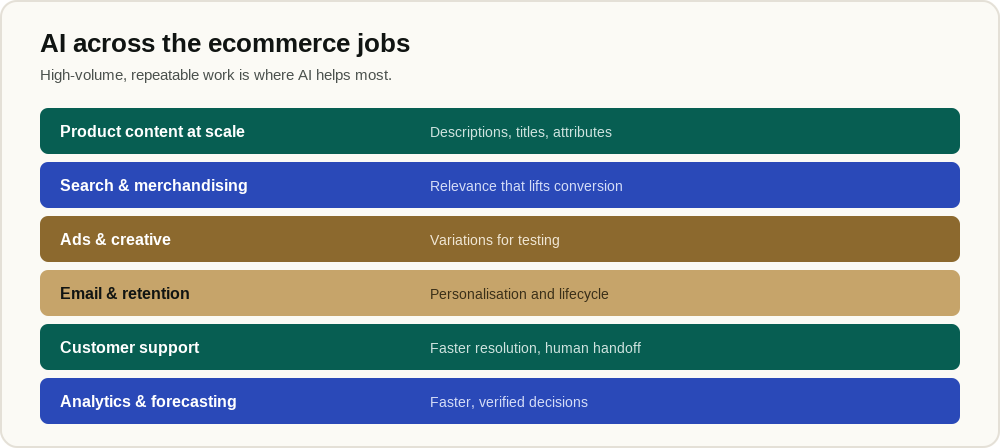
Ecommerce has many repeatable, high-volume jobs, which is exactly where AI helps most: writing hundreds of product descriptions, personalising email, drafting ad variations, triaging support. This guide organises AI ecommerce tools by job, names well-known examples, and stays honest about where human oversight is essential, especially anything a customer sees. Treat tool names as category illustrations, and judge each against your store's needs and margins.
Quick answer
The most useful AI tools for ecommerce map to specific jobs: product content at scale, merchandising and search, ads and creative, email and retention, customer support, and analytics. Your store platform and marketing tools increasingly include AI for these jobs, and a general assistant covers much of the rest. Choose by the job and the measurable outcome, keep a human in the loop for anything customer-facing, and avoid tools that add cost without moving a real metric.
Key takeaways
- The best AI ecommerce tools map to specific, repeatable jobs.
- Product content, search, ads, email, support and analytics are the main layers.
- Your store platform and marketing tools increasingly include AI directly.
- Keep humans in the loop for anything customer-facing and accuracy-critical.
- Choose by measurable outcome and fit with your margins, not by novelty.
Product content at scale
Writing and refreshing product descriptions, titles and attributes is slow by hand. AI drafts these quickly from your specs, and many ecommerce platforms and apps offer it directly. The job is accurate, on-brand, unique content, so review for correctness and avoid publishing near-identical copy across variants, which can create duplicate-content issues.
On-site search and merchandising
AI-powered search and recommendation tools help shoppers find products and surface relevant items. The job is higher conversion through relevance, measured by search-to-purchase and recommendation click-through. Test against your current setup before assuming an upgrade pays for itself.
Ads and creative
AI speeds up ad copy, headlines and image variations for testing across channels. The value is iteration speed and volume for experiments, not finished campaigns. Keep your team in control of brand, claims and final approval.
Email, lifecycle and retention
Email and CRM platforms increasingly use AI for subject lines, segmentation, product recommendations and send timing. The job is relevance and retention at scale, measured by engagement, repeat rate and lifetime value. Personalisation should feel helpful, not intrusive.
Customer support and chat
AI assistants can handle common queries, order status and returns, freeing your team for complex cases. The job is faster resolution without hurting experience, so set clear handoffs to humans and never let automation mislead a customer.
Analytics and forecasting
AI helps query data, draft summaries, flag anomalies and support demand forecasting. The job is faster, clearer decisions, provided the underlying numbers are correct and someone sanity-checks anything that drives stock or spend.
How to choose
- Does it map to a real, repeatable ecommerce job?
- Is the customer-facing output accurate and on-brand?
- Does it integrate with your store and existing tools?
- Can you measure its effect on a metric that matters?
- Does the cost fit your margins at your volume?
What to watch out for
Avoid publishing unedited AI product content that is inaccurate or duplicated, letting support bots mislead customers, or stacking overlapping apps that each take a cut of margin. In ecommerce, small errors multiply across thousands of SKUs and orders, so accuracy and oversight matter more than novelty.
FAQ
Frequently asked questions
Writing and maintaining product content at scale is often the highest-return starting point, because it is high-volume, repeatable and directly affects discovery and conversion. Always review for accuracy and uniqueness.
Many platforms now include AI for content, search and email. Start with what you have, then add specialist apps only when they clearly improve a metric.
For common, low-risk queries, yes, with clear handoffs to humans for anything complex or sensitive. Never let a bot give misleading answers about orders, returns or policy.
Only if they are thin, inaccurate or duplicated. Edited, accurate, unique descriptions are fine and save significant time at scale.
Tie each tool to a metric: conversion, repeat rate, lifetime value, support resolution time or hours saved. Keep the ones that move the number and drop the rest.
Similar posts
AI Tools
The AI Marketing Tool Stack (2026): A Practical Buyer's Guide
A practitioner's guide to building an AI marketing tool stack around jobs to be done: general assistant, content, ads, email, analytics and AI visibility. Lean and honest.
4 min read
AI Tools
Best AI Tools for Content Writing (and How to Use Them Well)
AI writing tools split into general assistants (ChatGPT, Claude, Gemini) and marketing writers (Jasper, Copy.ai). The quality comes from your brief, expertise and editing.
4 min read
AI Tools
Best AI Tools for Email Marketing
AI helps email across copy, personalisation, subject lines and analysis, mostly inside your existing platform. Gains depend on good data, testing and human judgement.
3 min read
Related services