AI for Ecommerce
AI for Product Descriptions at Scale

Writing product descriptions is one of the most time-consuming, repetitive jobs in ecommerce, and one of the most important, because descriptions affect both discovery and conversion. It is a near-perfect use case for AI, but also one where mistakes multiply across thousands of SKUs. This guide explains how to produce product descriptions with AI at scale, honestly and safely, keeping accuracy and uniqueness front and centre.
Quick answer
AI lets you draft and refresh product descriptions far faster than by hand, which is a major win for large catalogues. To do it well, feed accurate specs for each product, prompt for unique benefit-led copy (never invented claims), keep a consistent brand voice, and review before publishing. Done carefully, AI clears description backlogs and improves consistency; done carelessly, it floods your catalogue with duplicated, inaccurate copy that hurts conversion and SEO.
Key takeaways
- Product descriptions are an ideal, high-return use of AI at scale.
- Feed accurate specs; AI must never invent details or claims.
- Prompt for unique, benefit-led copy, not filled-in templates.
- Avoid duplicate content; give each product distinct inputs.
- Keep a consistent brand voice and review before publishing.
Why it is a strong use case
Descriptions are high-volume, structured and repetitive: exactly what AI handles well. From accurate specs, AI can draft clear, benefit-led copy quickly, letting a small team cover a large catalogue and keep descriptions consistent in tone and structure. The time saved is real and significant.
Feed accurate data, every time
The single rule that keeps this safe: give AI the real specs for each product and instruct it to use only those. AI must never invent dimensions, materials, prices or claims. Inaccurate descriptions erode trust, drive returns and can breach advertising rules, so accurate input and review are non-negotiable.
Prompt for unique, benefit-led copy
Ask for unique copy per product, not a template filled with different nouns. A good prompt sets the role, the audience, the specs, the voice and the structure (for example, a short benefit-led intro plus a few bullet points). Benefit-led means translating features into what they mean for the shopper, which is what helps conversion.
Avoid the duplicate-content trap
Mass-generating near-identical descriptions across variants or similar products creates duplicate content that weakens SEO and bores shoppers. Give each product distinct inputs, ask for genuinely different copy, and handle variants thoughtfully. Uniqueness protects both rankings and conversion.
Keep brand voice consistent
Reuse a brand-voice brief across the whole catalogue so descriptions feel like one store, not a patchwork. Consistency in tone and structure makes a large catalogue feel coherent and professional.
Review before publishing
Build a review step into the workflow: check accuracy, uniqueness, voice and claims, especially on high-traffic and high-value products. You do not need to hand-edit every word, but nothing should go live unchecked. Spot-check at scale and fully review your most important pages.
A practical workflow
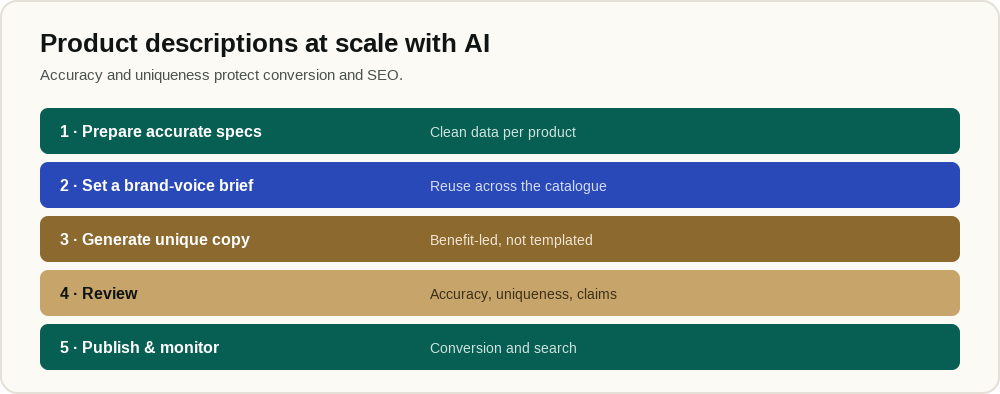
- 01Prepare clean, accurate specs for each product.
- 02Set a reusable brand-voice and structure brief.
- 03Generate unique, benefit-led copy per product.
- 04Review for accuracy, uniqueness and claims.
- 05Publish, then monitor conversion and search performance.
FAQ
Frequently asked questions
Yes, and it is one of the highest-return ecommerce uses. Feed accurate specs, prompt for unique benefit-led copy, and review before publishing across the catalogue.
Only if they are thin, inaccurate or duplicated. Unique, accurate, benefit-led descriptions are fine and save major time. Avoid mass-producing near-identical copy.
Instruct it to use only the specs you provide, forbid invented claims, and review outputs. Never let it fill gaps with guesses about your products.
Fully review high-traffic and high-value products, and spot-check the rest. Nothing should go live completely unchecked, but you need not hand-edit every word.
Give each product distinct inputs, prompt for genuinely different copy, and handle variants thoughtfully rather than duplicating. Uniqueness protects rankings and conversion.
Similar posts
AI Tools
The AI Marketing Tool Stack (2026): A Practical Buyer's Guide
A practitioner's guide to building an AI marketing tool stack around jobs to be done: general assistant, content, ads, email, analytics and AI visibility. Lean and honest.
4 min read
AI for Ecommerce
ChatGPT for Ecommerce: Practical Ways to Use It
Ecommerce teams use ChatGPT for product content at scale, category copy, ads and email, review analysis and support. The highest-return uses, and what to check.
3 min read
AI Tools
AI Prompts for Ecommerce: A Working Library
The most useful ecommerce AI prompts cover product content, categories, email, ads and insight. Adaptable examples to customise, plus the accuracy rule that keeps you safe.
3 min read
Related services