AI Tools
Best AI Tools for GEO and AI Search Visibility

As more journeys start inside AI assistants, marketers want to know: are we being mentioned, and how do we compare. A new category of AI-visibility or GEO tracking tools has appeared to answer that. They are genuinely useful for scaling measurement, but the space is early and easy to over-buy into. This guide explains what these tools do, how to judge them, and how to run a credible manual alternative. Tool categories are described generically because this market is changing fast.
Quick answer
AI-visibility tools track whether and how AI engines like ChatGPT, Google AI Overviews and Perplexity mention your brand. They monitor a set of questions across engines, record citation presence and share of voice, and flag gaps against competitors. The category is young and no tool is essential, you can run a lighter version manually with a fixed question set. Use one to scale measurement once AI visibility matters to your business, but treat the data as directional and keep your effort on the content and authority that actually earn citations.
Key takeaways
- AI-visibility tools track brand mentions across AI engines over time.
- They report presence, prominence, share of voice and gaps.
- The category is young; no tool is essential and a manual version works.
- Judge tools on engine coverage, custom questions, honesty and price.
- Measurement finds gaps; content and authority close them.
What AI-visibility tools do
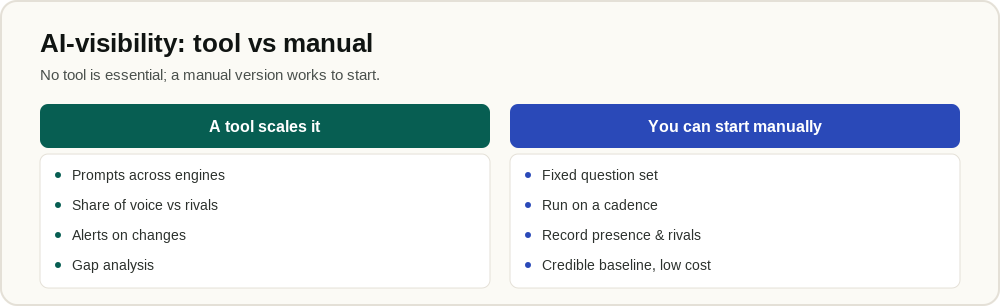
These tools run a set of prompts across multiple AI engines on a schedule and report where your brand appears. Typical features include:
The job is a repeatable, comparable picture of your AI visibility over time.
- Tracking citation presence across engines for chosen questions.
- Share of voice versus named competitors.
- Prominence (lead source versus passing mention).
- Alerts when your presence changes.
- Gap analysis showing questions where rivals appear and you do not.
How to judge one
Be wary of any tool promising to "guarantee" AI citations or implying a secret formula; no one controls organic AI answers.
- Does it cover the engines your audience actually uses?
- Can you track your own real questions, not just generic ones?
- Does it report presence, prominence and share of voice clearly?
- Is it honest that results vary by phrasing, user and time?
- Does the price match the value, given you can do a manual version?
The manual alternative
You do not need a tool to start. Build a fixed set of real customer questions, run them through the main AI engines on a regular cadence, and record for each: were you mentioned, how prominently, was a link included, and which competitors appeared. This gives you a credible baseline and trend for the cost of some disciplined time. Add a tool later to scale, not to begin.
Where your real effort belongs
Measurement shows the gap; it does not close it. Citations are earned by retrievable, clearly answerable, trustworthy content from a recognisable brand entity, the substance of generative engine optimization. Use visibility tools to find gaps and prove progress, then spend your real effort on the content, structure and authority that make engines cite you.
FAQ
Frequently asked questions
Not to start. A fixed question set run manually gives a credible baseline. Add a tool to scale measurement once AI visibility clearly matters to your business.
No. Nothing controls organic AI answers. Be sceptical of any tool claiming guaranteed citations or a secret formula; they can measure, not force, visibility.
It is directional, not exact, because answers vary by phrasing, user and time. Read trends over several cycles rather than single results.
Citation presence, prominence, share of voice against competitors, and gaps, across the engines your audience actually uses, ideally for your own real questions.
SEO tools track rankings and clicks; AI-visibility tools track whether AI engines mention and cite you. They are complementary parts of modern measurement.
Similar posts
AI Tools
The AI Marketing Tool Stack (2026): A Practical Buyer's Guide
A practitioner's guide to building an AI marketing tool stack around jobs to be done: general assistant, content, ads, email, analytics and AI visibility. Lean and honest.
4 min read
AI Search & GEO
Generative Engine Optimization (GEO): The Complete Playbook for Getting Cited by AI
A practitioner's guide to GEO: how to get your brand cited by ChatGPT, Google AI Overviews and Perplexity. What works, what you cannot control, and a 30-day plan.
6 min read
Measurement
How to Track Your Brand Across AI Engines
Track your brand in AI with a fixed question set run on a schedule: presence, share of voice, prominence and supporting signals. A repeatable method, no overclaiming.
3 min read
Related services