AI for Ecommerce
AI Product Discovery and On-Site Search

On-site search is one of the most underrated levers in ecommerce. Shoppers who search are often high-intent, closer to buying than browsers, and yet many stores have search that fails them: literal keyword matching that returns nothing for a slightly different phrasing, irrelevant results, and dead ends. Every failed search is a customer who was ready to buy and could not find the product. AI has made it possible to do far better, by understanding what people mean rather than only what they type. This piece covers how AI improves product discovery and on-site search, what it takes to do it well, and how to avoid the trap of impressive-looking search that does not actually help people buy.
Quick answer
AI-powered on-site search and product discovery help shoppers find the right product by understanding intent, meaning and natural language rather than matching keywords literally. Done well, this rescues the large share of revenue lost when people cannot find what they want, especially in big catalogues. The priorities are clean product data for the AI to work with, understanding real customer intent, graceful handling of no-results, and measuring whether people actually find and buy, not just whether search looks clever.
Key takeaways
- AI on-site search understands intent and meaning rather than matching keywords literally, so more searches succeed and lost revenue is recovered.
- Searchers are often high-intent, so every failed search is a ready buyer who could not find the product.
- AI discovery matters most in large or complex catalogues and wherever customers shop by need rather than product name.
- It requires clean, well-attributed product data, the same data that powers external AI readiness, and genuine understanding of real query intent.
- Handle no-results gracefully with alternatives and guidance rather than a blunt dead end.
- Measure discovery outcomes, search success, purchases, reduced abandonment, not how clever the search looks.
What AI changes about search
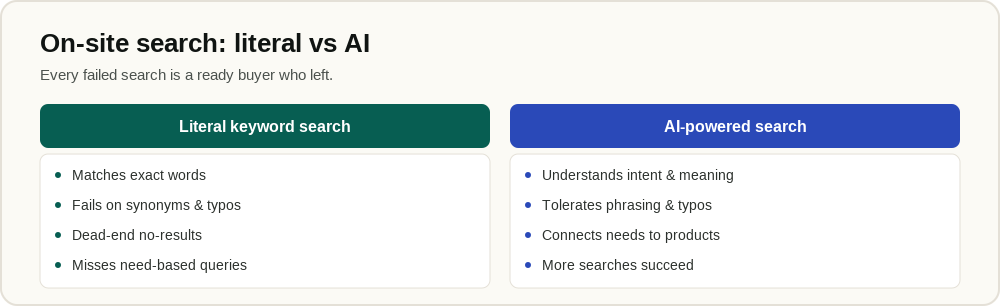
Traditional on-site search matches the words typed against the words in your catalogue. If the shopper phrases things differently from your product data, uses a synonym, describes a need rather than a product name, or makes a typo, literal matching fails. The customer sees no results and leaves.
AI-powered search understands meaning and intent. It can connect a natural-language description to the right products, handle synonyms and variations, tolerate imprecise phrasing, and interpret what the shopper is actually looking for. The result is that more searches succeed, which directly recovers revenue that literal search was quietly losing.
Where it matters most
AI discovery earns its keep most in large or complex catalogues, where the gap between how customers describe needs and how products are catalogued is widest, and where good discovery is the difference between finding the right product and giving up. In a small catalogue, simple search and clear navigation may be enough. The bigger and more varied your range, the more AI-powered discovery pays off.
It also matters wherever customers shop by need rather than by product name: "something for X", "a gift for Y", "goes with Z". Understanding intent, not just keywords, is what turns these vague but valuable queries into successful discovery.
What it takes to do well
Clean product data
AI search is only as good as the data it searches. Rich, accurate, well-attributed product data gives the AI the material to understand and match products to needs. The same structured data that helps external agents and AI search also powers good on-site discovery, so this investment pays off in several places at once.
Genuine understanding of intent
The goal is to serve what the customer actually wants, which means understanding real intent behind queries, including vague and natural-language ones. This is where AI adds value over keyword matching, and it is worth analysing your real search queries to see what people actually look for and where current search fails them.
Graceful handling of no-results
Even good search sometimes finds nothing. How you handle that moment matters: a helpful no-results experience, suggesting alternatives, broadening the query, guiding the shopper, rescues customers that a blunt "no results found" loses. Treat the empty result as a design problem, not an endpoint.
Measure discovery, not cleverness
The common failure is to judge AI search by how sophisticated it looks rather than whether it helps people buy. Measure the outcomes: search success rate, whether searchers find and purchase, reduction in no-results and in search abandonment. A visually impressive search that does not improve these numbers is not working. Watch the searches that fail, because they are a direct list of demand you are not meeting.
FAQ
Frequently asked questions
Traditional search matches the words typed against words in your catalogue, so different phrasing, synonyms or typos cause failures. AI search understands meaning and intent, connecting natural-language descriptions and imprecise queries to the right products. The result is that more searches succeed, recovering revenue literal search was losing.
It depends on your catalogue. AI discovery pays off most in large or complex catalogues and where customers shop by need rather than product name. For a small catalogue with clear navigation, simple search may be enough. The bigger and more varied your range, the stronger the case.
Clean, accurate, well-attributed product data, because the AI can only match what it can understand, plus genuine understanding of the intent behind real queries. Analysing your actual search queries to see what customers look for and where search fails is an important input.
It should handle the moment gracefully, suggesting alternatives, broadening the query or guiding the shopper, rather than showing a blunt dead end. A helpful no-results experience rescues customers that a plain "no results found" would lose, and failed searches also reveal unmet demand.
By outcomes, not sophistication: search success rate, whether searchers find and purchase, and reductions in no-results and search abandonment. Impressive-looking search that does not move these numbers is not helping. Reviewing the searches that fail shows you demand you are not currently meeting.
Similar posts
Agentic Commerce
The Agentic Commerce Guide: Selling When AI Does the Shopping
A practitioner's guide to agentic commerce: what it is, what is real versus hype, and the no-regret work, structured data, feeds, trust and frictionless buying, that makes a store ready.
7 min read
AI for Ecommerce
AI Personalisation in Ecommerce, Done Ethically
AI personalisation helps customers when it serves them and harms trust when it is creepy, manipulative or unfair. The principles that keep it ethical, and why the helpful version also sells.
5 min read
AI Search & GEO
Ecommerce SEO for AI Search: Product Discovery, Helpful Content, and Entity Clarity
How to earn ecommerce visibility in AI search: discoverable pages, explicit product facts, helpful content and clear entities. No guarantees, just durable fundamentals.
3 min read
Related services