AI for Ecommerce
AI Personalisation in Ecommerce, Done Ethically

Personalisation is one of the oldest promises in ecommerce and one of the most abused. The pitch is seductive: show each customer exactly what they want, and sales rise. AI has made personalisation far more powerful, which raises both its upside and its capacity to cross lines. The difference between personalisation that customers appreciate and personalisation that makes them uncomfortable is not mainly technical. It is ethical. This piece sets out how to get the genuine benefits of AI personalisation without the creepiness, manipulation or unfairness that destroy trust and, increasingly, invite regulatory attention. The through-line is simple: personalise to serve the customer, with their knowledge and consent, not to extract from them in the dark.
Quick answer
AI personalisation tailors the shopping experience, recommendations, content, offers, to the individual using data and models. Done well it genuinely helps customers find relevant things and feel understood. Done badly it feels creepy, manipulative or discriminatory, and erodes the trust it depends on. The ethical version rests on a few principles: use data customers knowingly provided, be transparent, personalise to help the customer rather than to exploit them, respect consent, and avoid manipulation and unfair treatment.
Key takeaways
- AI personalisation tailors the experience to the individual; done well it helps customers and lifts satisfaction and sales together.
- It turns harmful when it stops serving the customer: creepiness from unexpected data use, manipulation of psychology, and unfair or discriminatory treatment.
- Base personalisation on data customers knowingly provided, not opaque inferences or unexpected collection.
- Be transparent and give control; personalise with customers, not to them.
- Apply the test "does this serve the customer?" and respect consent and privacy as ongoing commitments.
- Guard against differential pricing and discriminatory outcomes; fairness must be designed and monitored.
What good personalisation does
At its best, personalisation reduces friction and helps people. It surfaces relevant products in a large catalogue, remembers useful preferences, tailors content to stated interests, and spares the customer wading through irrelevance. When it works, it feels like good service: the shop seems to understand what you are looking for and makes it easier to find.
This genuine helpfulness is the whole point, and it is also the commercial case. Personalisation that actually helps customers find what they want tends to lift satisfaction and sales together. You do not have to choose between being helpful and being effective; the helpful version is the effective one.
Where it goes wrong
Personalisation turns harmful when it stops serving the customer and starts exploiting them.
Creepiness
Using data people did not knowingly share, or surfacing inferences in ways that feel invasive, makes customers uneasy even when nothing illegal has happened. The feeling of being watched and profiled undermines trust. If a personalised experience would unsettle the customer were they to see how it was produced, that is a warning sign.
Manipulation
There is a line between helping someone decide and exploiting their psychology against their interest: manufactured urgency, personalised pressure, nudging people towards choices that benefit you at their expense. AI makes such manipulation more precise, which makes the ethical restraint more important, not less.
Unfair treatment
Personalisation that shows different prices or opportunities to different people based on their data can shade into discrimination, and personalising on sensitive characteristics can produce unfair or unlawful outcomes. Models trained on biased data can quietly treat groups differently. This is both an ethical and a legal risk.
Principles for doing it ethically
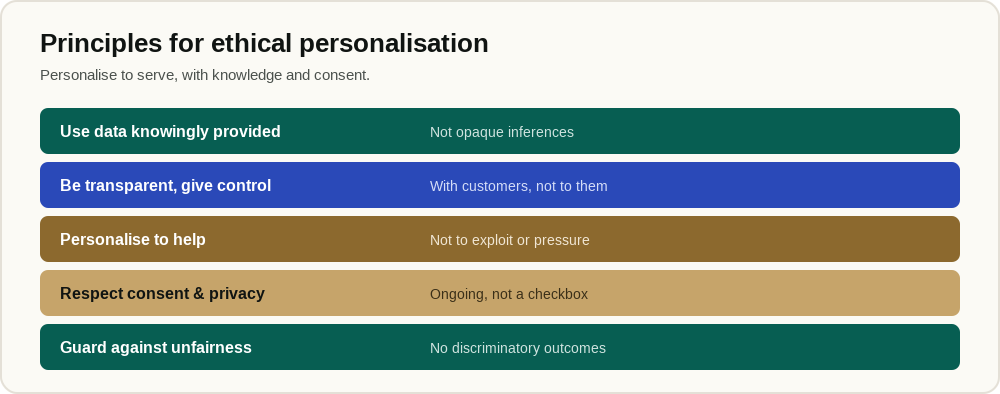
Use data customers knowingly provided
Base personalisation on data people understand they have shared and would expect you to use: their purchases, stated preferences, explicit behaviour on your site. Avoid building experiences on opaque inferences or data gathered in ways customers would not anticipate.
Be transparent
Let customers understand, in plain terms, that their experience is personalised and give them control: the ability to see, adjust or opt out. Transparency turns personalisation from something done to people into something done with them.
Personalise to help, not to exploit
Make the test "does this serve the customer?" If a personalisation tactic only works because it pressures or deceives, it fails the test. Helpful personalisation and manipulative personalisation can use the same technology; the difference is intent and effect.
Respect consent and privacy
Honour the consent people have given, collect only what you need, and treat personal data with care. Consent is not a one-time checkbox to be worked around; it is an ongoing commitment that underpins the trust personalisation requires.
Guard against unfairness
Be cautious with anything approaching differential pricing by person, avoid personalising on sensitive characteristics, and check that your models do not produce discriminatory outcomes. Fairness is not automatic; it has to be designed and monitored.
The trust dividend
The reason to do this ethically is not only to avoid harm and regulation. Trust is the foundation of the customer relationship, and personalisation that respects people strengthens it, while personalisation that exploits them spends it down. In a world where customers are increasingly aware of how their data is used, being the brand that personalises helpfully and honestly is a durable advantage.
FAQ
Frequently asked questions
It is using data and AI models to tailor the shopping experience, recommendations, content and offers, to the individual customer. At its best it reduces friction and helps people find relevant products; at its worst it becomes creepy, manipulative or unfair, which erodes the trust it depends on.
When it uses data people did not knowingly share, or surfaces inferences in ways that feel invasive. A useful test: if the customer would be unsettled to see exactly how the experience was produced, it has probably crossed the line, even if nothing illegal occurred.
It is ethically and legally fraught. Showing different prices to different people based on their data can shade into discrimination and tends to damage trust badly when discovered. Most brands should avoid person-level differential pricing and be very careful with anything resembling it.
Apply the test "does this serve the customer?" Helping someone find relevant products is fine; exploiting their psychology with manufactured urgency or personalised pressure against their interest is not. The same technology can do both, so the discipline is in intent and effect, not the tool.
No. Personalisation that genuinely helps customers find what they want tends to lift satisfaction and sales together, so the helpful version is also the effective one. Manipulative personalisation may win short-term gains but spends down the trust that sustains the relationship, which is a poor trade.
Similar posts
Agentic Commerce
The Agentic Commerce Guide: Selling When AI Does the Shopping
A practitioner's guide to agentic commerce: what it is, what is real versus hype, and the no-regret work, structured data, feeds, trust and frictionless buying, that makes a store ready.
7 min read
AI for Ecommerce
AI Product Discovery and On-Site Search
AI on-site search understands intent and meaning rather than matching keywords, rescuing revenue lost to failed searches. What it takes to do well, and how to measure discovery not cleverness.
5 min read
Ecommerce Growth
Ecommerce Retention Marketing: How to Turn First-Time Buyers into Repeat Customers
Learn how ecommerce retention marketing works, which customer journeys to build, and how to measure repeat purchases, retention, and customer value.
14 min read
Related services