AI Tools
AI Prompts for Ecommerce: A Working Library

Ecommerce has clear, repeatable jobs, which makes it ideal for well-structured AI prompts. But copying prompts blindly produces generic, sometimes inaccurate output across a whole catalogue. This guide gives practical ecommerce prompts organised by job, shows how to adapt them, and stresses the accuracy checks that matter when thousands of SKUs and orders are involved. Treat these as templates to tailor, not scripts to paste.
Quick answer
The most useful ecommerce AI prompts cover product content, category and buying guides, email and lifecycle, ads, and customer insight. As with any prompting, the pattern matters more than the exact words: give the AI a role, your product and audience details, the task, clear constraints and a format. This guide provides adaptable ecommerce prompt examples to customise with your own data, plus the rule that keeps you safe: review every customer-facing output for accuracy before it ships.
Key takeaways
- Useful ecommerce prompts cover product content, categories, email, ads and insight.
- The pattern (role, product, audience, task, constraints, format) matters most.
- Always feed accurate data; AI must never invent specs or claims.
- Ask for unique output per product to avoid duplication.
- Review every customer-facing result before it ships.
The ecommerce prompt pattern
Every good ecommerce prompt includes:
Feed accurate product data every time; AI should never invent specs.
- Role: for example, an ecommerce copywriter or merchandiser.
- Product and audience: accurate specifics and who you are selling to.
- Task: exactly what to produce.
- Constraints: brand voice, length, claims to avoid, uniqueness.
- Format: structure of the output.
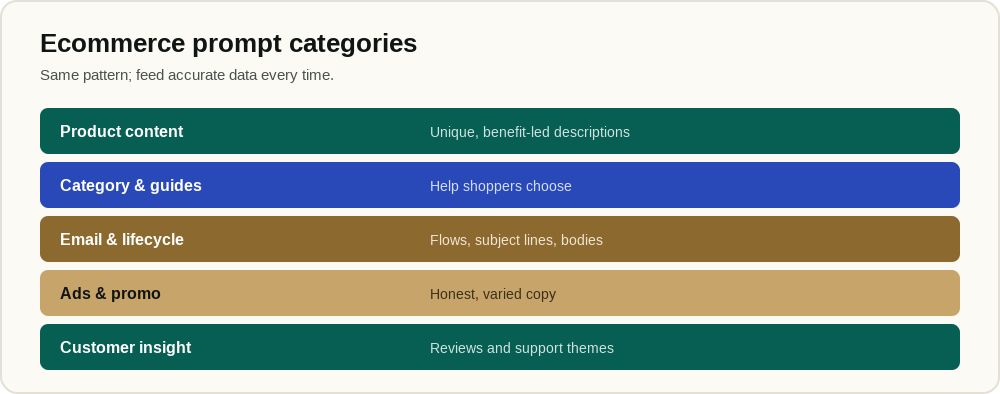
Product content prompts
- "Act as an ecommerce copywriter. Write a unique product description for [product] using only these specs: [specs]. Audience: [audience]. Voice: [voice]. Include a short benefit-led intro, three bullet points, and no invented claims."
- "Rewrite this product description to be clearer and more benefit-led, keeping all specs accurate: [paste]."
Category and buying-guide prompts
- "Act as a merchandiser. Write a category-page introduction for [category] that helps shoppers choose, covering [key considerations], in a [voice] tone for [audience]."
- "Create a buying guide outline for [product type]: the decisions shoppers face, the factors that matter, and common mistakes to avoid."
Email and lifecycle prompts
- "Draft a [type] email for [segment] about [offer]. Give three subject lines, a concise body, and one clear call to action, in a [voice] tone."
- "Suggest a welcome-flow structure for new subscribers of [store], with the goal of [goal] and the key message for each email."
Ad and promo prompts
- "Write five distinct ad headlines and primary texts for [product] aimed at [audience], leading with [benefit]. Keep claims honest and the tone [tone]."
Customer-insight prompts
- "Summarise the themes, objections and feature requests in these reviews, and recommend three actions: [paste reviews]."
- "Group these support queries into common topics and suggest FAQ answers: [paste]."
The rule that keeps you safe
Review every customer-facing output for accuracy, uniqueness and brand fit before publishing. Never let AI invent specs, prices or claims, and never mass-publish near-identical descriptions. In ecommerce, a small prompted error repeats across the catalogue, so human review is not optional.
FAQ
Frequently asked questions
The most valuable cover product descriptions, category and buying-guide copy, email flows, ad variations and review analysis. Adapt the pattern to each job rather than copying fixed prompts.
Instruct it to use only the specs you provide and to avoid invented claims, then review every output. Never let it fill gaps with guesses about your products.
Yes, if you feed accurate data per product and ask for unique copy each time. Review for accuracy and duplication before publishing across the catalogue.
Prompt for unique copy per product, provide distinct specifics for each, and avoid mass-generating variants from one template. Review before publishing.
The pattern is the same, but the role, constraints and format differ. Tailor each prompt to the channel, audience and goal for best results.
Similar posts
AI Tools
The AI Marketing Tool Stack (2026): A Practical Buyer's Guide
A practitioner's guide to building an AI marketing tool stack around jobs to be done: general assistant, content, ads, email, analytics and AI visibility. Lean and honest.
4 min read
AI Tools
AI Prompts for Marketers: A Practical Library
Good marketing prompts share a structure: role, context, task, constraints, format. Learn the pattern, with adaptable examples for research, content, ads, email and analysis.
3 min read
AI for Ecommerce
ChatGPT for Ecommerce: Practical Ways to Use It
Ecommerce teams use ChatGPT for product content at scale, category copy, ads and email, review analysis and support. The highest-return uses, and what to check.
3 min read
Related services