AI Tools
AI Prompts for Marketers: A Practical Library

"Prompt libraries" are everywhere, but copying prompts you do not understand gives mediocre results. The real skill is knowing what makes a prompt work, then adapting it to your task, brand and audience. This guide teaches the pattern and provides starting examples you should customise, not paste blindly. Think of prompting as briefing a capable junior marketer: clarity and context are everything.
Quick answer
Good marketing prompts share a structure: role, context, task, constraints and format. Instead of memorising hundreds of prompts, learn that pattern and adapt it to any task. This guide gives the anatomy of a strong prompt plus adaptable examples for research, content, ads, email and analysis. The best prompt is a clear brief: the more context and specifics you give, the better the output, and the less editing you need afterwards.
Key takeaways
- Strong prompts share a structure: role, context, task, constraints, format.
- Learn the pattern and adapt it rather than memorising fixed prompts.
- Customise example prompts with your own audience, product and goal.
- Iterate, give examples, and reuse a brand-voice brief.
- Prompts improve drafts; they do not replace fact-checking or expertise.
The anatomy of a strong prompt
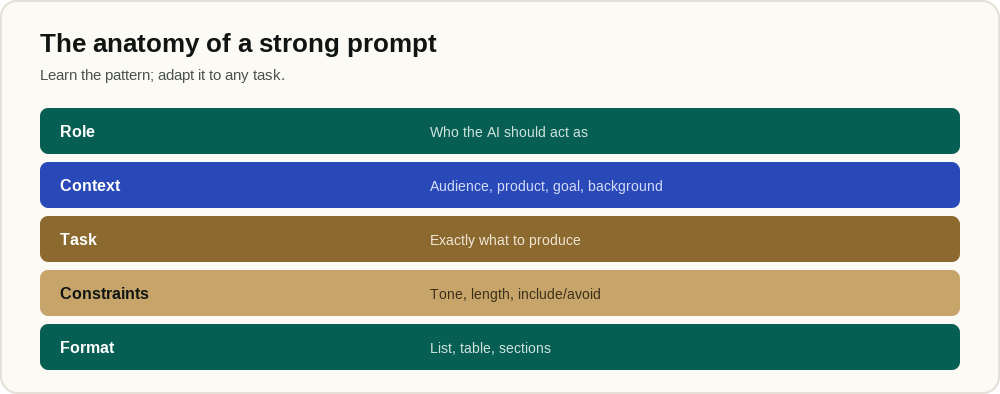
A reliable prompt usually includes five elements:
Add one more habit: ask the AI to request anything it needs to do the task well.
- Role: who the AI should act as (for example, an ecommerce copywriter).
- Context: the audience, product, goal and any background.
- Task: exactly what you want produced.
- Constraints: tone, length, what to include and what to avoid.
- Format: how to structure the output (list, table, sections).
Adaptable prompt examples
Customise these with your own details; do not paste them as-is.
Research and ideation
- "Act as a marketing strategist. Our audience is [audience] and our goal is [goal]. List ten content angles that address their main objections, with a one-line rationale for each."
Content briefs
- "Act as an SEO content strategist. Create a brief for an article targeting [query]: suggested H2s, questions to answer, entities to cover, and the angle, for an audience of [audience]."
Ad copy
- "Act as a direct-response copywriter. Write five distinct ad headlines and primary texts for [product], aimed at [audience], leading with [main benefit]. Keep claims honest and the tone [tone]."
- "Act as a lifecycle marketer. Draft a [type] email for [segment] about [offer]. Give three subject-line options, a short body, and one clear call to action in a [tone] voice."
Analysis
- "Summarise the themes, objections and feature requests in the following reviews, and list the top three actions you would recommend. Here are the reviews: [paste]."
How to get more from any prompt
- Iterate: treat the first output as a draft and refine with feedback.
- Give examples of the style or structure you want.
- Ask for options, then develop the best one.
- Reuse a brand-voice brief at the start of each session.
- Push back: tell the AI what is wrong and ask it to fix it.
A caution on prompts
No prompt turns AI into a source of truth or a substitute for expertise. Always verify facts and edit output in your own voice. A great prompt gets you a better draft faster; it does not remove your responsibility for the final result.
FAQ
Frequently asked questions
A clear structure: role, context, task, constraints and format. The more relevant context and specifics you give, the better and more on-brand the output.
Use them as starting points, not copy-paste solutions. Adapt them to your audience, product and goal, because generic prompts give generic results.
Reuse a brand-voice brief at the start of each session, give examples, and iterate with feedback. Consistency comes from reusable context and editing.
Not longer for its own sake, but more relevant context and specifics do help. Include what matters (audience, goal, constraints) and cut filler.
No. Prompts improve relevance and structure, but AI can still be wrong. Always verify facts and edit before publishing.
Similar posts
AI Tools
The AI Marketing Tool Stack (2026): A Practical Buyer's Guide
A practitioner's guide to building an AI marketing tool stack around jobs to be done: general assistant, content, ads, email, analytics and AI visibility. Lean and honest.
4 min read
AI Tools
How to Use ChatGPT for Marketing
Use ChatGPT across marketing: research, briefs, drafts, ad and email copy, repurposing and analysis. How to prompt well, stay on brand, and keep humans in control.
3 min read
AI Tools
AI Prompts for Ecommerce: A Working Library
The most useful ecommerce AI prompts cover product content, categories, email, ads and insight. Adaptable examples to customise, plus the accuracy rule that keeps you safe.
3 min read
Related services