AI Tools
Best AI Tools for Content Writing (and How to Use Them Well)

AI writing tools are the most adopted category in marketing, and the most misused. Used well, they remove the blank page and speed up drafting and editing. Used badly, they flood the web with generic "AI sludge" that readers and search engines ignore. This guide explains the main types of AI writing tool, names well-known examples, and focuses on the habits that make the output genuinely good. Tool names illustrate categories; your workflow and standards matter more than the logo.
Quick answer
The best AI writing tools fall into two groups: general assistants like ChatGPT, Claude and Gemini that handle research, drafting and editing across any format, and marketing-focused writers like Jasper and Copy.ai built around templates and brand voice. For most marketers a capable general assistant covers the majority of writing jobs. Whichever you choose, the quality comes from your brief, your expertise and your editing, not from the tool. AI drafts; humans make it worth publishing.
Key takeaways
- AI writing tools split into general assistants and marketing-focused writers.
- A capable general assistant covers most marketing writing jobs.
- Quality comes from your brief, your expertise and your editing, not the tool.
- Use AI for drafts and speed; add real insight and verify facts.
- Generic, unedited output is the main risk; helpful, original content wins.
The two main types
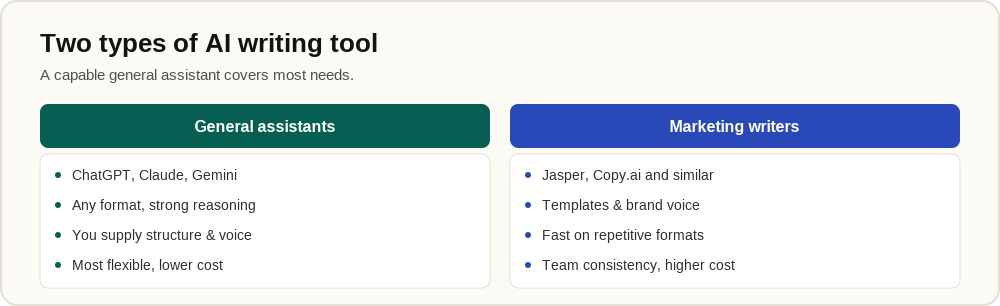
General assistants
ChatGPT, Claude and Gemini are flexible models that research, outline, draft, rewrite and edit in any format. Their strength is range and reasoning, so they suit marketers who want one versatile tool. The trade-off is that you supply the structure and brand voice through prompting.
Marketing-focused writers
Tools like Jasper and Copy.ai wrap models in templates, brand-voice settings and workflows for common marketing formats. Their strength is speed on repetitive formats and consistency across a team. The trade-off is cost and less flexibility than a raw assistant for unusual tasks.
What makes AI writing actually good
A strong brief
The single biggest lever is the brief. Give the tool the audience, intent, angle, key points, evidence, tone and what to avoid. A vague prompt yields generic output; a rich brief yields a usable draft. Treat prompting as briefing a junior writer.
Your expertise on top
AI does not have your experience, data or point of view. The drafts that rank and resonate are the ones where you add real insight, specifics and a genuine perspective. Use AI for structure and speed, then layer on what only you know.
Heavy editing
Always edit: for accuracy, voice, flow and claims. Cut padding, fix anything generic, verify facts, and make sure it sounds like you. Unedited AI content is where quality and credibility go to die.
Where AI writing helps most
- Outlines, first drafts and rewrites.
- Summarising research and long documents.
- Repurposing one asset into many formats.
- Editing for clarity, grammar and tone.
- Overcoming the blank page quickly.
Where to be careful
- Facts and figures: verify everything; models can be confidently wrong.
- Originality: add a real angle so you are not publishing the obvious.
- Brand voice: generic tone is the tell of lazy AI use.
- Volume: more content is not better; helpful content is.
FAQ
Frequently asked questions
General assistants such as ChatGPT, Claude and Gemini work well for revisions: paste the existing draft with a clear brief covering the audience, the goal, what to keep and what to cut. Use a dedicated SEO or editing tool when you need checks against a keyword brief. Read every revision yourself, because AI edits can quietly change facts.
For outlines and first drafts, a general assistant is the most flexible option. Marketing writers such as Jasper or Copy.ai add templates and brand voice settings, which helps teams that publish often. Whichever you use, add your own expertise, check every claim, and edit the draft before it goes live.
A general assistant like ChatGPT is more flexible and covers most needs. Marketing writers like Jasper add templates and brand-voice features that help teams move fast on repetitive formats. Choose by workflow, not hype.
Google rewards helpful, people-first content regardless of how it was produced, and acts against unhelpful, mass-produced content. Edited, expert, genuinely useful AI-assisted content is fine; thin AI sludge is not.
Start with a rich brief, add your own expertise, data and perspective, and edit heavily in your voice. Generic output usually means a thin prompt and no editing.
Often not to begin with. Capable general assistants have free or low-cost tiers. Pay for a marketing writer when team templates and brand-voice consistency justify it.
No. It makes good writers faster and helps non-writers draft. The expertise, judgement and editing that make content worth reading still come from people.
Similar posts
AI Tools
The AI Marketing Tool Stack (2026): A Practical Buyer's Guide
A practitioner's guide to building an AI marketing tool stack around jobs to be done: general assistant, content, ads, email, analytics and AI visibility. Lean and honest.
4 min read
AI Tools
Best AI Tools for SEO: A Practical Guide by Use Case
The best AI SEO tool depends on the job: keyword research, briefs, technical audits, internal linking and reporting. A use-case guide, honest about what still needs a human.
3 min read
AI Tools
ChatGPT vs Claude vs Gemini for Marketers
All three are capable; differences are more about feel and ecosystem than ability. How to choose one, use it well, and why prompting and editing matter more than the model.
4 min read
Related services