AI for Ecommerce
AI Image Tools for Ecommerce: Practical Uses and Cautions

Visuals sell products, and producing them is slow and expensive, which makes AI image tools attractive in ecommerce. They genuinely help with concepting, backgrounds, marketing visuals and adaptation. But ecommerce has a hard constraint that marketing in general does not: the product image must be truthful. This guide covers where AI image tools help in ecommerce, names common examples, and is firm about the line you must not cross on product accuracy.
Quick answer
Ecommerce teams use AI image tools to generate concepts and backgrounds, create lifestyle and social visuals, produce variations for testing, and resize and adapt images across placements. Design tools like Canva and image generators like Midjourney are common examples. The big caution: product images must accurately represent the actual product, so never let AI alter or invent how a product truly looks. Used honestly, AI image tools save real time; used carelessly, they mislead customers and drive returns.
Key takeaways
- AI image tools help with concepts, backgrounds, marketing visuals and adaptation.
- Design and generation tools speed up ecommerce creative work.
- The hard line: product images must truthfully represent the real product.
- Never use AI to alter or fake how a product actually looks.
- Keep humans directing art direction and reviewing for accuracy.
Where AI image tools help
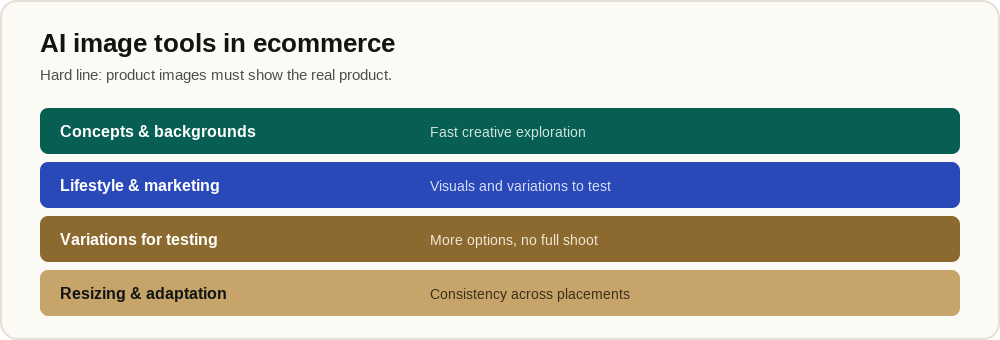
Concepts and backgrounds
AI generates backgrounds, scenes and concepts quickly, useful for marketing imagery, banners and social visuals. The job is faster creative exploration and more on-brand variety.
Lifestyle and marketing visuals
For ads, social and campaign imagery, AI helps produce lifestyle-style visuals and variations to test. The job is volume and iteration speed for marketing creative, directed by a human.
Variations and testing
Generate multiple visual treatments of the same concept to test which resonates. The job is more testable options without a full shoot each time.
Resizing and adaptation
AI design tools quickly resize and adapt images to each platform and placement, saving tedious manual work. The job is consistency across formats.
The hard line: product accuracy
In ecommerce, the product image must show the real product as it actually is. Never use AI to change a product's colour, shape, materials, features or finish, or to generate a product image that misrepresents what the customer will receive. Doing so misleads buyers, drives returns and complaints, and can breach advertising rules. AI is for marketing creative and adaptation around accurate product photography, not for faking the product itself.
How to use them responsibly
- Keep real product photography accurate and unaltered in material ways.
- Use AI for backgrounds, lifestyle scenes, concepts and marketing visuals.
- Disclose where required and follow platform and advertising rules.
- Keep a human directing art direction, brand and quality.
- Review every customer-facing image for accuracy before publishing.
FAQ
Frequently asked questions
Use AI for backgrounds, lifestyle scenes and marketing visuals around accurate product photography. Never use it to alter or fake how the actual product looks, which misleads customers.
Concepting, backgrounds, lifestyle and social visuals, testing variations, and resizing across placements. They speed up marketing creative, not truthful product representation.
Marketing visuals are generally fine if accurate and compliant. Misrepresenting the actual product can breach advertising rules and consumer law, and drives returns. Keep product representation truthful.
Only if they mislead or look low quality. Used for on-brand marketing creative with human direction and accurate product representation, they help. Review everything customer-facing.
Yes. Accurate product photography remains essential. Use AI for marketing creative and adaptation around it, not as a replacement for truthfully showing the product.
Similar posts
AI Tools
The AI Marketing Tool Stack (2026): A Practical Buyer's Guide
A practitioner's guide to building an AI marketing tool stack around jobs to be done: general assistant, content, ads, email, analytics and AI visibility. Lean and honest.
4 min read
AI Tools
Best AI Tools for Ecommerce: A Use-Case Guide
The most useful AI tools for ecommerce by job: product content at scale, search, ads, email, support and analytics. Choose by measurable outcome, keep humans in the loop.
4 min read
AI for Ecommerce
AI for Product Descriptions at Scale
AI drafts and refreshes product descriptions far faster than by hand. How to do it well: accurate specs, unique benefit-led copy, consistent voice, and review before publishing.
3 min read
Related services