AI for Ecommerce
AI for Customer Support and Chat in Ecommerce

Support is high-volume and repetitive, with a long tail of common questions, which makes it a natural fit for AI. Used well, AI resolves routine queries instantly and lets human agents focus on cases that need them. Used badly, it traps customers in unhelpful loops or gives confidently wrong answers. This guide covers where AI helps ecommerce support, and the guardrails that protect the customer experience, because in support a bad AI interaction costs you trust and sales.
Quick answer
AI helps ecommerce support by handling common questions, order-status and returns queries, drafting responses for agents, triaging and routing tickets, and powering self-service FAQs. The gains are faster resolution and freed-up agents for complex cases. The rules that keep it safe: never let AI give wrong information about orders, returns or policy; always offer an easy path to a human; and keep sensitive or complex issues with people. Done well, AI improves support; done carelessly, it frustrates customers and damages trust.
Key takeaways
- AI helps support with common queries, order/returns, drafting, triage and self-service.
- The gains are faster resolution and agents freed for complex cases.
- Never let AI give wrong information about orders, returns or policy.
- Always offer an easy path to a human and keep sensitive cases with people.
- Monitor interactions; a bad AI answer costs trust and sales.
Where AI helps in support
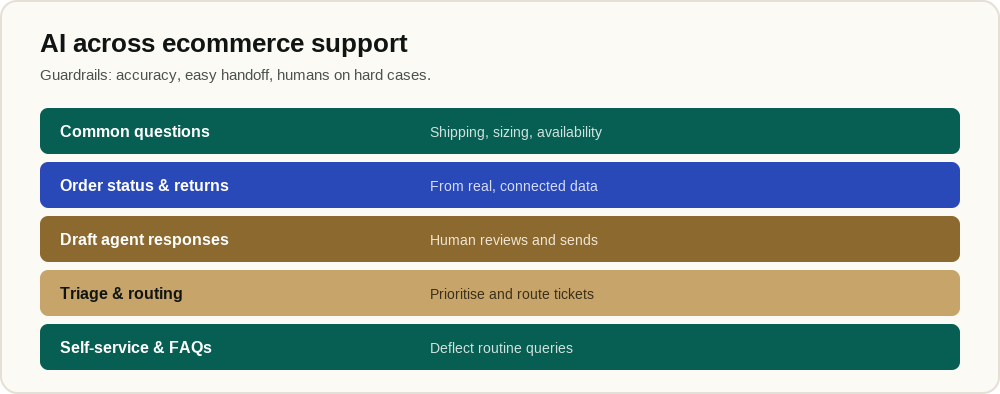
Answering common questions
AI assistants handle the frequent, low-risk questions, shipping, sizing, availability, basic how-tos, instantly and around the clock. The job is fast resolution of routine queries at scale.
Order status and returns
Connected to your systems, AI can answer order-status and returns questions accurately from real data. The job is self-service for the most common contact reasons, which reduces ticket volume.
Drafting agent responses
AI drafts replies for human agents to review and send, speeding up responses while keeping a person in control. The job is agent efficiency without removing human judgement.
Triage and routing
AI classifies and routes incoming tickets, prioritising urgent ones and sending complex cases to the right team. The job is faster, smarter queue management.
Self-service and FAQs
AI helps build and maintain FAQ and help content that deflects routine queries before they become tickets. The job is scalable self-service.
The guardrails that matter
A single confidently wrong answer about a refund can cost a customer for good.
- Accuracy: never let AI state anything untrue about orders, returns, pricing or policy.
- Easy human handoff: always offer a clear, quick path to a person.
- Scope: keep complaints, sensitive issues and complex cases with humans.
- Transparency: be clear when a customer is talking to a bot.
- Oversight: monitor AI interactions and correct failures quickly.
How to introduce it well
- 01Start with low-risk, high-volume queries.
- 02Connect it to accurate order and policy data.
- 03Build in an obvious, fast route to a human.
- 04Keep humans on complaints and complex or sensitive cases.
- 05Monitor transcripts and improve continuously.
FAQ
Frequently asked questions
It can handle common, low-risk queries and order-status questions well, and draft responses for agents. Keep complaints and complex cases with humans, and always offer an easy handoff.
For routine, low-risk questions with accurate data, yes. Never let it give wrong information about orders, returns or policy, and always provide a clear path to a person.
It can if it traps them or gives wrong answers. Avoid that with accurate data, an easy human handoff, and keeping complex or sensitive issues with agents.
Yes. Be transparent that it is a bot, and make the route to a human obvious. Transparency protects trust.
Complaints, sensitive situations, complex problems and anything high-stakes. Use AI for routine volume and agent assistance, and keep judgement-heavy cases with people.
Similar posts
AI Tools
The AI Marketing Tool Stack (2026): A Practical Buyer's Guide
A practitioner's guide to building an AI marketing tool stack around jobs to be done: general assistant, content, ads, email, analytics and AI visibility. Lean and honest.
4 min read
AI Tools
Best AI Tools for Ecommerce: A Use-Case Guide
The most useful AI tools for ecommerce by job: product content at scale, search, ads, email, support and analytics. Choose by measurable outcome, keep humans in the loop.
4 min read
AI for Ecommerce
ChatGPT for Ecommerce: Practical Ways to Use It
Ecommerce teams use ChatGPT for product content at scale, category copy, ads and email, review analysis and support. The highest-return uses, and what to check.
3 min read
Related services