CRO
AI for A/B Testing and Conversion Optimisation (CRO)

Conversion optimisation is a disciplined cycle: research, hypothesise, test, learn. AI can accelerate several steps, generating ideas, producing variations, analysing results, but it cannot replace the experimentation that turns opinion into evidence. Used well, AI helps you test more and learn faster. Used badly, it tempts teams to ship AI-suggested changes without proof. This guide shows how to use AI across CRO while keeping testing rigour intact.
Quick answer
AI supports CRO by generating test hypotheses and variations, drafting alternative copy and layouts to test, helping analyse results, and powering personalisation. It speeds up the idea and production side of experimentation and helps interpret data. What it does not do is remove the need for rigorous testing and statistical discipline: AI suggests, experiments decide. Use AI to run more and better tests, not to skip the testing that proves what actually lifts conversion.
Key takeaways
- AI speeds up CRO ideas, variations, analysis and personalisation.
- It raises test velocity by removing the production bottleneck.
- AI suggests; experiments decide what actually lifts conversion.
- It does not replace hypotheses, test design or statistical discipline.
- Never ship AI-suggested changes without proper testing.
Where AI helps in CRO
Hypotheses and ideas
Free tool: check significance and sample size with the A/B test calculator.
AI helps generate test ideas from your data, research and best practice: what to test on a page, which frictions to address, which audiences to target. The job is a fuller pipeline of hypotheses to prioritise.
Variations to test
AI quickly drafts alternative headlines, copy, calls to action and layout ideas to test. The job is more quality variations without a production bottleneck, so your test velocity rises.
Analysing results
AI helps summarise test outcomes, surface patterns and draft readouts. The job is faster learning between tests, provided you check the statistics and interpretation.
Personalisation
AI can power personalised experiences and recommendations that lift relevance. The job is the right content for the right visitor, measured by conversion and tested like any other change.
What AI does not replace
AI does not replace the fundamentals of good experimentation:
Shipping AI-suggested changes without testing is guessing with extra steps.
- A clear hypothesis tied to a real user problem.
- Proper test design and sufficient sample size.
- Statistical discipline, avoiding calling tests too early.
- Honest reading of results, including losses and flat tests.
A practical AI-assisted CRO loop
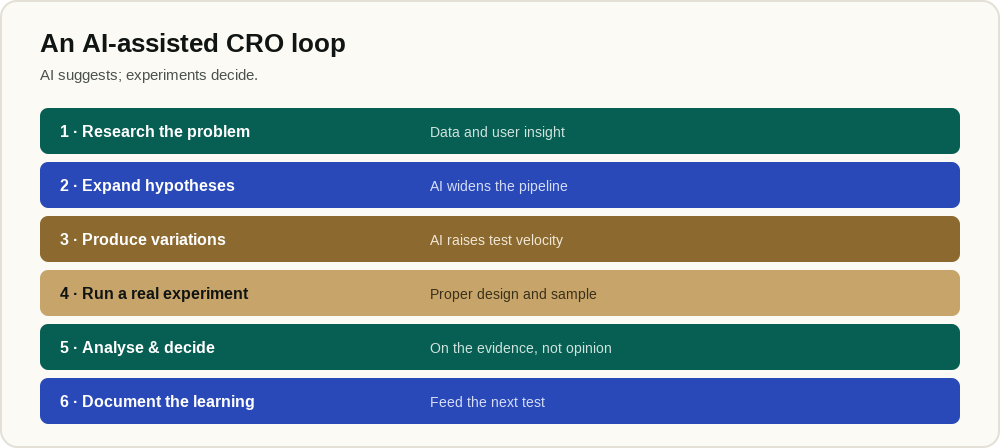
- 01Research the problem with data and user insight.
- 02Use AI to expand and prioritise hypotheses.
- 03Use AI to produce test variations quickly.
- 04Run a properly designed experiment.
- 05Use AI to help analyse, then decide on the evidence.
- 06Document the learning and feed it into the next test.
FAQ
Frequently asked questions
It accelerates ideas, variations and analysis, but it cannot replace rigorous testing. AI suggests changes; experiments prove which ones actually lift conversion.
It generates hypotheses and variations quickly and helps analyse results, raising your test velocity. You still need proper test design and statistical discipline.
No. That is guessing. AI ideas are candidates to test, not proven improvements. Validate with a properly designed experiment before rolling out.
It can summarise outcomes and surface patterns, which speeds learning. Always check the statistics and interpretation before acting, and respect sample size and significance.
It can, by making experiences more relevant, but treat it like any change: test it, measure conversion, and keep what genuinely wins rather than assuming.
Similar posts
AI Tools
The AI Marketing Tool Stack (2026): A Practical Buyer's Guide
A practitioner's guide to building an AI marketing tool stack around jobs to be done: general assistant, content, ads, email, analytics and AI visibility. Lean and honest.
4 min read
AI Tools
Best AI Tools for Marketing Analytics and Reporting
AI speeds up analytics: querying data in plain language, drafting reports, flagging anomalies and supporting forecasts. Where it helps, what to look for, and why you must verify.
3 min read
AI for Ecommerce
AI for Customer Support and Chat in Ecommerce
AI handles common questions, order status, draft responses and triage in ecommerce support. Where it helps, the guardrails that matter, and how to introduce it well.
3 min read
Related services