AI Tools
Best AI Tools for Marketing Analytics and Reporting

Reporting eats marketing time, and much of it is repetitive: pulling the same metrics, writing the same summaries, spotting the same patterns. AI is well suited to compressing that work. But analytics is also where a confident error does real damage, because decisions and budgets follow the numbers. This guide covers AI analytics and reporting tools by job, names the kinds of tools involved, and keeps verification front and centre.
Quick answer
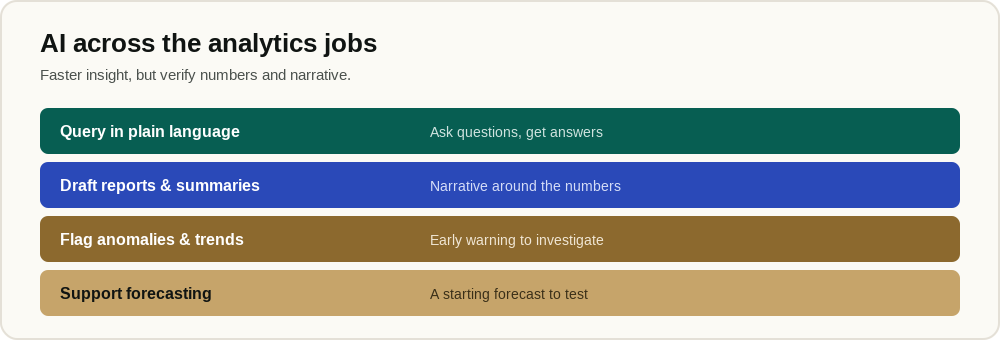
AI helps marketing analytics in four jobs: querying data in plain language, drafting reports and summaries, flagging anomalies and trends, and supporting forecasting. Many analytics and BI platforms now build AI into these jobs, and a general assistant helps interpret and explain data. The value is faster, clearer insight and less time on manual reporting. The catch is that AI can be confidently wrong, so verify the numbers and the narrative before anyone acts on them.
Key takeaways
- AI helps analytics across querying, reporting, anomaly detection and forecasting.
- Many analytics and BI platforms include these features natively.
- A general assistant helps interpret and explain data.
- The value is faster insight and less manual reporting time.
- Always verify numbers and narrative; AI can be confidently wrong.
Querying data in plain language
A growing number of analytics and BI tools let you ask questions in natural language and get charts or answers back. The job is faster access to data without writing queries, which helps non-technical marketers self-serve. Always sanity-check that the question was interpreted the way you meant.
Drafting reports and summaries
AI drafts the narrative around your numbers: what changed, why it might have changed, and what to consider next. Paste in your data and let it write a first-pass summary you then edit. The job is less time on write-ups, more on decisions, provided you verify the interpretation.
Flagging anomalies and trends
AI can scan data for unusual changes and surface trends worth attention, so you spot problems and opportunities sooner. The job is early warning. Treat flags as prompts to investigate, not conclusions, since correlation is not causation.
Supporting forecasting
Some tools use AI to project demand, spend or performance from historical data. The job is a starting forecast to pressure-test, not a guarantee. Combine it with your judgement and context the model does not have.
What to look for
- AI built into the analytics platform you already use, before buying another tool.
- Clear, checkable links between the AI's claims and the underlying data.
- Natural-language querying that your team will actually use.
- Honesty about uncertainty in forecasts and anomaly flags.
- Strong data governance and privacy.
The non-negotiable: verify
AI reporting is a drafting and detection aid, not a source of truth. Check that metrics are defined correctly, that the numbers reconcile, and that the narrative matches reality before acting. A confident, wrong summary that drives a budget decision is worse than slower manual reporting. Keep a human accountable for every number that matters.
FAQ
Frequently asked questions
It can draft summaries and narratives around your data quickly, which saves time. You must verify the numbers and interpretation before the report informs any decision.
Often not. Many analytics and BI platforms now include AI querying and summaries. Start with what you have and add tools only if they clearly help.
It can produce a starting forecast from historical data, useful to pressure-test. Treat it as directional, combine it with context and judgement, and never as a guarantee.
Use it to surface anomalies and trends to investigate, not as a final verdict. Correlation is not causation; verify before acting on any flagged insight.
Confident errors. A wrong but plausible summary can drive bad decisions. Always check metric definitions, reconcile numbers, and keep a human accountable.
Similar posts
AI Tools
The AI Marketing Tool Stack (2026): A Practical Buyer's Guide
A practitioner's guide to building an AI marketing tool stack around jobs to be done: general assistant, content, ads, email, analytics and AI visibility. Lean and honest.
4 min read
AI Tools
Building a Lean AI Marketing Stack on a Budget
Most AI marketing value comes from a few tools used well. Start with one general assistant, use the AI you already pay for and free tiers, and add paid tools only for real bottlenecks.
3 min read
CRO
AI for A/B Testing and Conversion Optimisation (CRO)
AI helps CRO by generating hypotheses, producing test variations and speeding analysis. What it accelerates, what it does not replace, and a practical AI-assisted CRO loop.
3 min read
Related services