Performance Marketing
AI Creative Testing at Scale

On modern ad platforms, the algorithm handles most targeting and delivery, so the quality and variety of your creative does much of the heavy lifting. AI changes the economics of creative: you can produce many more variations, much faster. That only helps if you test with discipline. This guide explains how to combine AI-driven production with sound experimentation so more creative means better results, not just more noise.
Quick answer
With targeting increasingly automated, creative is the main lever advertisers still control, and AI lets you produce and test far more of it. AI creative testing means using AI to generate variations faster, then running disciplined experiments to find what actually works. The value is in volume plus rigour: more angles and formats to test, with proper measurement deciding winners. The risk is volume without rigour: a flood of generic variations that all perform the same. Done well, it raises your testing velocity and your hit rate.
Key takeaways
- Automated targeting makes creative the main lever advertisers control.
- AI lets you produce and test far more creative, far faster.
- Value comes from volume plus rigour: more to test, measured properly.
- The trap is generic variations that differ without really differing.
- Keep human judgement on strategy, quality and claims.
Why creative is the lever now
As Advantage+, Performance Max and similar systems automate audiences and placement, the advertiser's influence concentrates in the creative. The system can only test and deliver what you give it. More, and more varied, strong creative gives it more to work with and more chances to find winners. Creative has quietly become the primary optimisation surface.
Where AI helps in creative testing
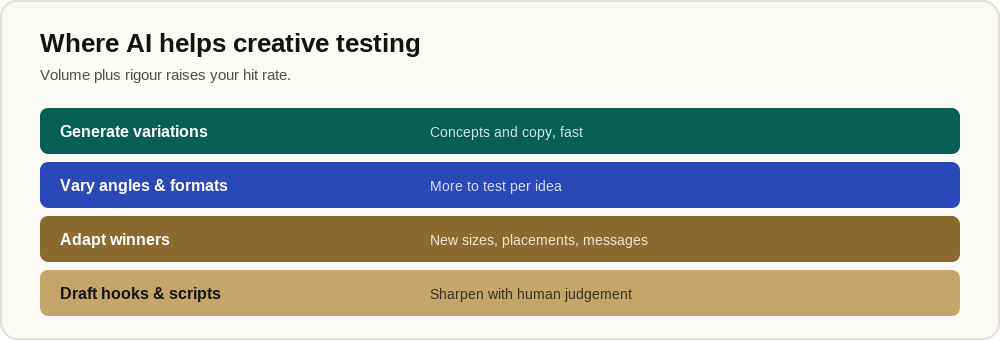
AI raises your production capacity across the testing pipeline:
This lets you feed the algorithm a richer, more varied stream than manual production allowed.
- Generating many concept and copy variations quickly.
- Producing format and angle variations for the same idea.
- Adapting winners into new sizes, placements and messages.
- Drafting hooks and scripts to sharpen with human judgement.
The discipline that makes it work
Volume without rigour is waste. Pair AI production with real testing:
The goal is a higher hit rate, not just a higher count.
- Test distinct ideas and angles, not trivial variants of the same thing.
- Define what a win looks like and give tests enough data to be meaningful.
- Let the platform and your own metrics, not opinion, pick winners.
- Keep brand standards and claim accuracy on everything AI produces.
Avoid the generic-sludge trap
The failure mode is obvious: AI churns out variations that are technically different but strategically identical, all bland, all performing the same. Guard against it by using AI to explore genuinely different angles and by keeping human creative judgement in charge of strategy and quality. Quantity is only useful when it carries real variety.
A practical workflow
- Decide the strategic angles worth testing.
- Use AI to produce strong, genuinely varied creative for each.
- Run disciplined tests with clear win criteria.
- Scale winners, learn from losers, and feed insights into the next round.
- Refresh continually to fight creative fatigue.
FAQ
Frequently asked questions
Because systems like Advantage+ and Performance Max automate targeting and placement, the creative you supply is the main thing you still control. The algorithm can only test and deliver what you give it, so creative quality and variety drive results.
It raises production capacity: generating many concepts, copy and format variations quickly, and adapting winners. That lets you feed the algorithm a richer, more varied stream to test than manual production allowed.
Generic sludge: many variations that are technically different but strategically identical and all perform the same. Volume without real variety and rigour is wasted effort. Keep human judgement on strategy and quality.
Test genuinely distinct angles, not trivial variants. Define what winning means, give tests enough data, and let metrics pick winners. Then scale winners and feed learnings into the next round.
No. AI accelerates production, but humans must decide the angles worth testing, judge quality, protect the brand and interpret results. AI expands capacity; strategy and taste stay human.
Similar posts
AI Tools
The AI Marketing Tool Stack (2026): A Practical Buyer's Guide
A practitioner's guide to building an AI marketing tool stack around jobs to be done: general assistant, content, ads, email, analytics and AI visibility. Lean and honest.
4 min read
Meta Ads
Meta Ads Creative Testing for Ecommerce: A Practical Framework for 2026
Learn how to test Meta Ads creatives for ecommerce with clear hypotheses, useful variations, reliable measurement, and a repeatable optimisation process.
18 min read
Meta Ads
AI in Meta Ads: A Practical Guide to Advantage+
Meta's Advantage+ automates targeting, placement and budget. Where it helps most, why strong creative is now your main lever, and how to measure on real profit.
3 min read
Related services