Agentic Commerce
Agentic Commerce Risks: Brand Control in an Agent-Led Market

Most discussion of agentic commerce focuses on how to be ready for it: clean data, good feeds, machine-readable trust. That is necessary, but it is only half the picture. There is a strategic risk running underneath the practical preparation, and a brand that optimises hard to be an easy option for agents while ignoring this risk can win the battle and lose the war. This piece is the counterweight. It lays out the genuine risks agentic commerce poses to brands, so you can prepare for the mechanics without sleepwalking into a weaker strategic position. The goal is not alarm; it is clear eyes. Agentic commerce brings real opportunity and real danger, and the danger is easy to miss precisely because the preparation feels productive.
Quick answer
The central risk of agentic commerce is disintermediation: if AI agents become the primary interface between customers and products, brands can be reduced to interchangeable options chosen on price and specifications, losing the relationship, the margin and the ability to tell their own story. Related risks include misrepresentation by agents, commoditisation, dependence on platforms you do not control, and reduced first-party data. The defence is to stay a brand customers ask for by name, keep owned relationships, and ensure agents represent you accurately.
Key takeaways
- The central risk of agentic commerce is disintermediation: agents capturing the customer relationship and reducing brands to interchangeable options.
- Related risks are commoditisation and price pressure, misrepresentation by agents, dependence on platforms you do not control, and loss of first-party data and direct relationships.
- The things brands differentiate on, story, experience, emotion, are exactly what attribute-comparing agents tend to ignore.
- Defend by staying a brand customers ask for by name, built on genuine differentiation and loyalty.
- Own your customer relationships and first-party data through direct channels, and diversify discovery to limit any one platform's power.
- Ensure accurate representation through good data; prepare for agentic commerce and guard against its risks at the same time.
The central risk: disintermediation
The deepest risk is that an agent becomes the layer between your brand and the customer, and in doing so captures the relationship you used to own. When a customer tells an agent "find me a good X" and buys what it recommends, the agent, not your brand, is where the decision and the loyalty live. You become a supplier fulfilling an agent's choice rather than a brand a customer chose.
Taken far enough, this reduces brands to interchangeable options ranked on attributes an agent can compare, chiefly price and specifications. The things brands use to differentiate, story, experience, emotional connection, are exactly the things an attribute-comparing agent is liable to ignore. That is the heart of the danger.
Commoditisation
If agents compete options mainly on price and specs, the pressure is towards commoditisation and a race to the bottom. Brands that cannot be distinguished on the dimensions an agent weighs get selected on price, eroding margin. This is disintermediation's economic consequence.
Misrepresentation
An agent represents your products based on the data and information it can read, and it can get you wrong: stale prices, missing context, misunderstood attributes, or simply an unflattering summary you had no hand in. You lose some control over how your brand is presented at the moment of decision.
Platform dependence
As agents and assistants mediate more discovery, brands can become dependent on platforms they do not control, whose rules, ranking and economics can change. Building your business on a channel someone else owns is a familiar risk, and agentic commerce extends it to the discovery layer itself.
Loss of first-party data and direct relationship
When an agent sits between you and the customer, you may lose visibility into who the customer is and the chance to build a direct relationship. The data and connection that fuel retention and lifetime value can accrue to the intermediary instead of to you.
How to protect your position
The defences are strategic, not just technical.
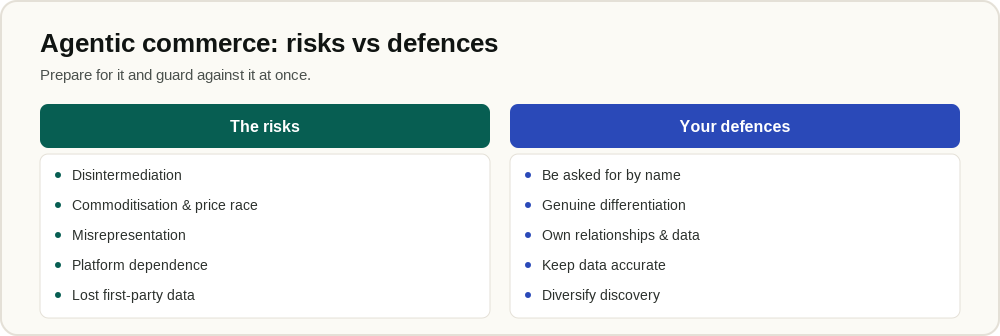
Stay a brand customers ask for by name. The strongest protection against disintermediation is demand for you specifically, so that customers instruct the agent to find your product, not merely a product. That comes from genuine differentiation, distinctive products, and real loyalty, the things an agent cannot commoditise because the customer brings them.
Own your customer relationships and first-party data. Invest in direct channels, accounts, email, loyalty, community, so that even where agents mediate discovery, you retain a direct line and the data that powers retention. Do not let the intermediary become the sole owner of the relationship.
Ensure agents represent you accurately. The same readiness work, clean data, accurate structured information, consistent presence, reduces the risk of misrepresentation, because an agent working from good data is likelier to get you right. Being legible is both preparation and defence.
Diversify your discovery. Avoid over-dependence on any single agent or platform. A spread of discovery sources, owned, earned and several mediated channels, limits the power any one intermediary holds over you.
The balance to strike
The right posture is to prepare for agentic commerce and guard against its risks at the same time. Be easy for an agent to find, understand and recommend, and be a brand strong enough that customers want you specifically and come to you directly. Optimising only for the first makes you a well-prepared commodity. Doing both keeps you a brand with a future in an agent-led market.
FAQ
Frequently asked questions
Disintermediation: AI agents becoming the layer between customers and products, capturing the relationship and loyalty, and reducing brands to interchangeable options chosen on price and specifications. The differentiation brands rely on, story and experience, is exactly what an attribute-comparing agent tends to ignore.
It is when an agent, rather than your brand, becomes where the customer's decision and loyalty live. The customer asks the agent to find a good option and buys its recommendation, so you become a supplier fulfilling the agent's choice rather than a brand the customer actively chose, losing the relationship and often the margin.
Stay a brand customers ask for by name, through genuine differentiation, distinctive products and real loyalty, so customers instruct agents to find your product specifically. Own direct customer relationships and first-party data, and ensure agents represent you accurately. Being merely an easy, legible option is what leads to commoditisation.
Yes. An agent represents you based on the data it can read, so stale prices, missing context or an unflattering summary can misstate your products at the moment of decision, with little input from you. Keeping your structured data accurate and consistent reduces this risk, because an agent working from good data is likelier to get you right.
No. Avoiding it just cedes a growing discovery channel to competitors. The right response is to prepare for it and guard against its risks at once: be easy for agents to find and recommend, while staying a differentiated brand that owns its customer relationships and is asked for by name. Doing both is the defensible position.
Similar posts
Agentic Commerce
The Agentic Commerce Guide: Selling When AI Does the Shopping
A practitioner's guide to agentic commerce: what it is, what is real versus hype, and the no-regret work, structured data, feeds, trust and frictionless buying, that makes a store ready.
7 min read
Agentic Commerce
What Is Agentic Commerce?
Agentic commerce is shopping where an AI agent acts on your behalf. What it is, how it differs from a chatbot, the spectrum from assisting to buying, and where it really is today.
6 min read
Performance Marketing
A First-Party Data Strategy for Ecommerce
First-party data is your most valuable asset as cookies disappear. How to collect it with value and consent, unify it into one customer view, and activate it everywhere.
3 min read
Related services