Performance Marketing
Scaling Paid Ads Without Wrecking Efficiency

Every store that does well on paid ads eventually wants to spend more, and discovers that more spend does not buy proportionally more sales. The ROAS that looked great at a small budget sags as the budget grows. This is not a mistake you made. It is the normal economics of advertising, and the question is not how to avoid it but how to scale into it without destroying your margins. This piece explains why efficiency falls as you scale and sets out the practical ways to grow spend while keeping profit intact. None of it is magic. It is disciplined expansion with the right expectations.
Quick answer
Paid ads get less efficient as you scale because you exhaust the cheapest demand first and then pay more to reach less likely buyers. You cannot avoid this entirely, but you can manage it: scale in measured steps, give the algorithm room to relearn, protect profit with margin-aware targets, and feed growth by widening the audience and refreshing creative rather than simply raising budgets on the same campaigns. Scale is a profit decision, not a spend decision.
Key takeaways
- Efficiency falls as you scale because you exhaust the cheapest demand first and then pay more for colder prospects; this is normal economics.
- The goal is not to hold your starting ROAS but to keep every increment of spend profitable.
- Scale in measured steps so the bidding algorithm adjusts gradually rather than restarting its learning phase.
- Set targets above your break-even ROAS with room for overheads, so you know when the next increment stops being worth it.
- Feed growth by widening the audience, refreshing creative relentlessly, and opening new channels, not just raising budgets.
- Trade efficiency for volume deliberately, with a profit floor underneath, rather than drifting into unprofitable spend.
Why efficiency falls as you scale
Advertising has diminishing returns built in. At a small budget, the platform shows your ads to the people most likely to buy, the cheapest, warmest demand. As you spend more, you have already reached those people, so the system reaches further out to less likely buyers who cost more to convert. Average efficiency falls because you are buying progressively colder demand.
Understanding this reframes the goal. You are not trying to hold your starting ROAS as you scale; that is usually impossible. You are trying to keep every increment of spend profitable, which is a different and achievable target.
Scale in steps, not leaps
The fastest way to wreck a well-performing campaign is to double its budget overnight. Large sudden budget changes throw the bidding algorithm back into a learning phase, during which performance is erratic and often poor. You pay for the algorithm to relearn, and the relearning can undo the stability you had.
Scale in measured increments instead, raising budgets by a modest percentage and letting performance settle before the next step. This gives the algorithm room to adjust gradually rather than restarting. It is slower, and slower is the point.
Protect profit with margin-aware targets
As efficiency falls with scale, the discipline that keeps you safe is a profit floor. Know your break-even ROAS, the point at which contribution margin equals ad spend, and set your targets above it with enough room for overheads. Then every increment of spend is judged against whether it still clears that floor.
This is where profit-first thinking matters most. If you manage to revenue ROAS without reference to margin, you will keep scaling past the point of profitability because the top-line numbers still look acceptable. Managing to margin tells you exactly when the next increment stops being worth it.
Feed growth beyond raising budgets
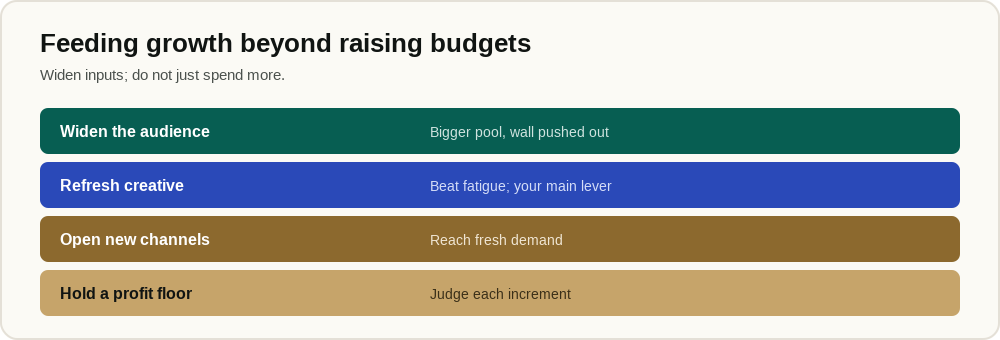
Simply raising the budget on existing campaigns runs into diminishing returns fastest, because you are asking the same setup to find ever more buyers in the same pool. Sustainable scaling comes from widening the inputs.
Widen the audience
Broaden targeting so the algorithm has a larger pool to find buyers in. Modern broad-targeting tools, used well, often scale better than tightly defined audiences because they give the system room to find demand you did not know to ask for. A bigger addressable pool pushes the diminishing-returns wall further out.
Refresh creative relentlessly
With targeting increasingly automated, creative is the main lever you still control, and creative fatigue is a real efficiency killer at scale. The more you spend, the faster audiences see your ads repeatedly and stop responding. A steady pipeline of fresh creative, new angles and formats, not just new colours, is often what lets you spend more at an acceptable cost. Scaling creative output is scaling spend.
Open new channels and placements
When one channel hits diminishing returns, adding another can be more efficient than pushing the first harder. New placements and platforms reach demand the saturated channel has already exhausted. Spreading spend across a sensible mix often beats concentrating it where efficiency is already falling.
Accept the trade-off deliberately
At some point, more volume is only available at lower efficiency, and that can still be the right choice if the incremental sales are profitable and you value the growth. The mistake is making that trade-off by accident. Decide deliberately how much efficiency you will trade for how much growth, hold a profit floor underneath it, and scaling becomes a controlled decision rather than a slow bleed.
FAQ
Frequently asked questions
Because platforms show your ads to the likeliest buyers first. As you spend more, those are already reached, so the system targets less likely, more expensive prospects. Average efficiency falls. This is diminishing returns, not a setup error.
There is no universal number, but modest incremental increases that let performance settle between steps are far safer than large sudden jumps, which push the algorithm back into a learning phase. Raise budgets gradually and watch efficiency at each step.
Raising budgets gradually is usually cleaner than duplicating, which can fragment learning and make campaigns compete with each other. More important than either is widening audiences and refreshing creative, which address the root cause of diminishing returns.
Break-even ROAS is the return at which your contribution margin exactly equals your ad spend. It matters because it tells you the floor below which additional spend loses money, so you can judge whether each increment of scaled spend is still profitable.
With targeting automated, creative is your main lever, and audiences fatigue faster the more you spend. A continuous pipeline of genuinely new creative angles keeps response rates up and is often what allows more spend at an acceptable cost. Running out of fresh creative caps how far you can scale.
Similar posts
Measurement
Break-Even ROAS: How to Calculate the Minimum Return Your Ecommerce Ads Need
Learn how to calculate break-even ROAS using contribution margin, understand its limitations, and set practical advertising targets for ecommerce profitability.
11 min read
Performance Marketing
Profit-First PPC: Managing Ads to Margin, Not Revenue
Two campaigns at the same ROAS can have opposite profitability. How to manage PPC to contribution margin, feed margin-aware values into bidding, and account for returns and discounts.
5 min read
Performance Marketing
AI Creative Testing at Scale
With targeting automated, creative is the main lever. AI lets you produce and test far more of it. How to combine volume with rigour, and avoid generic creative sludge.
4 min read
Related services