AI Search & GEO
Reviews and Reputation as AI Search Signals

When an AI assistant recommends a business or cites a source, it is making a reputational judgement on the user's behalf. Reviews and reputation are central to that judgement, because they are visible, widely referenced evidence of how real people regard you. This article explains why reputation feeds AI visibility and how to build it the right way, with a firm line against the fake-review shortcuts that ultimately backfire.
Quick answer
Reviews and reputation matter for AI search because engines favour sources and businesses that look credible and well regarded, and reviews are a strong, widely corroborated trust signal. Earning genuine reviews, maintaining a healthy rating, responding professionally and keeping your reputation consistent across the web all strengthen the trust that makes an engine comfortable recommending or citing you. Faking or buying reviews is both dishonest and self-defeating.
Key takeaways
- Reviews and reputation are strong trust signals for AI recommendations.
- Engines favour sources the wider web treats as credible.
- Earn genuine reviews steadily and respond professionally.
- Keep reputation consistent across platforms and the web.
- Never buy, fake or gate reviews; it is dishonest and self-defeating.
Why reputation feeds AI trust
Engines prefer to surface sources and businesses that the wider web treats as credible. Reviews are among the most referenced reputation signals online, so a consistent pattern of genuine, positive reviews supports the trust an engine needs before recommending you. Reputation is corroboration, exactly what engines look for when deciding whom to rely on.
Earn reviews the right way
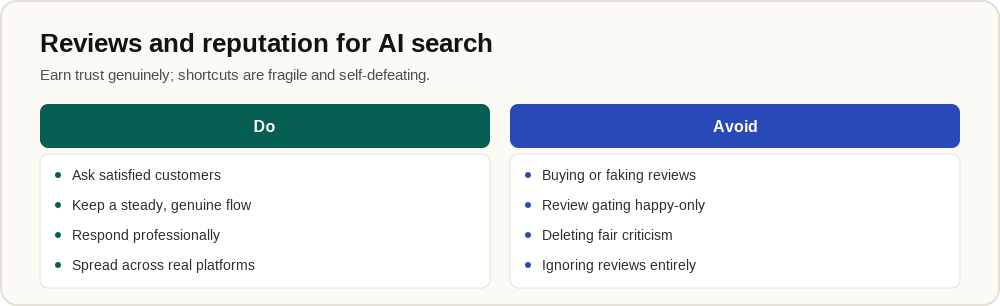
Ask satisfied customers at a natural moment, make leaving a review simple, and never incentivise or script them. Aim for a steady, genuine flow rather than a sudden spike, which looks unnatural. Spread reviews across the platforms your customers actually use rather than one only.
Respond and manage, do not manipulate
Respond to reviews professionally, both positive and negative. A thoughtful response to criticism shows accountability and often matters more to onlookers than the complaint itself. Resolve issues, learn from patterns, and let your genuine service drive your rating. Do not delete legitimate criticism or drown it with fakes.
Keep reputation consistent across the web
Reputation is not just star ratings. It includes mentions, coverage and how you are described across reputable sources. Keep your identity and messaging consistent, correct inaccuracies politely where you can, and build a coherent presence so the web tells one credible story about you.
What to avoid
- Buying, fabricating or incentivising reviews.
- Review gating that only invites happy customers to post publicly.
- Deleting or burying legitimate negative feedback.
- Ignoring reviews entirely, which signals neglect.
How reputation and content work together
Strong content earns citations; strong reputation earns the trust that makes those citations and recommendations more likely. Treat them as partners: publish genuinely helpful, accurate content, and back it with a real, well-managed reputation. Together they compound the credibility AI engines reward.
FAQ
Frequently asked questions
They rely on trusted data about your reputation, and reviews are a widely referenced part of that. A genuine, healthy review profile supports the trust engines need.
Not necessarily. A steady flow of genuine reviews with a strong but realistic rating looks more credible than a suspiciously perfect record.
Yes, professionally. A calm, accountable response reassures onlookers and often matters more than the original complaint.
Selectively routing only happy customers to public reviews is discouraged and can breach platform rules. Invite all customers and let genuine feedback stand.
It compounds over time as genuine reviews and consistent mentions accumulate. There is no instant switch; treat it as an ongoing discipline.
Similar posts
AI Search & GEO
Generative Engine Optimization (GEO): The Complete Playbook for Getting Cited by AI
A practitioner's guide to GEO: how to get your brand cited by ChatGPT, Google AI Overviews and Perplexity. What works, what you cannot control, and a 30-day plan.
6 min read
Local & International SEO
GEO for Local and Service Businesses
How local and service businesses get recommended by AI assistants: a consistent identity, genuine reviews, local-question content and local authority. No gimmicks.
3 min read
SEO
Entity SEO: Building a Brand Entity for AI Search
Entity SEO makes your brand, people and products recognisable and trusted by search and AI. Learn the signals that strengthen an entity and the mistakes that weaken it.
3 min read
Related services