Agentic Commerce
Perplexity and AI-Assistant Shopping for Brands

Answer engines like Perplexity occupy a distinct spot in the AI shopping landscape. Rather than hosting a storefront or a social feed, they answer questions by synthesising information from across the web and citing the sources they used. When those questions are about products, the engine is effectively doing a shopper's research for them and showing its working. For brands this is both an opportunity and a discipline. The opportunity is to be the source an answer engine draws on at the start of a purchase decision. The discipline is that you earn that position through verifiable credibility, not through spend. This piece explains how answer-engine shopping works and what a brand can actually do about it.
Quick answer
Perplexity and similar answer engines respond to shopping questions by synthesising information and citing sources, so being a cited, trusted source is how a brand appears. Unlike a social feed you can buy your way into, answer-engine shopping rewards credibility a machine can verify: consistent information, genuine reviews, clear expertise and clean data. For brands the response is to earn and maintain that verifiable trust, keep products machine-readable, and measure the referral and demand signals these engines produce.
Key takeaways
- Answer engines like Perplexity handle shopping by synthesising information and citing sources, so visibility means being a cited, trusted source.
- This rewards verifiable credibility, consistent information, genuine reviews, demonstrated expertise, rather than spend.
- Clear, factual product information and clean machine-readable data give the engine solid material to use and reduce the risk of being omitted or misrepresented.
- It resists shortcuts: you generally cannot buy your way into a synthesised answer, and thin gaming content tends not to survive.
- Respond with genuine reputation-building, consistency, machine-readable products and quality comparison content, treating it as a compounding investment.
- Measure with identifiable referrals, branded and direct demand, and customer surveys, backed by blended metrics.
How answer engines handle shopping questions
When someone asks an answer engine for a recommendation or comparison, it gathers relevant information, synthesises an answer, and cites the sources behind it. The products and brands that appear are those the engine found, understood and judged credible enough to include, with links back to where it found the supporting information.
This means visibility in answer-engine shopping is downstream of being a good, findable, trustworthy source. If reliable information about your products exists and is consistent across the web, the engine can use it. If your presence is thin, contradictory or hard to parse, the engine has little to go on and is likely to feature competitors it can corroborate instead.
What this rewards
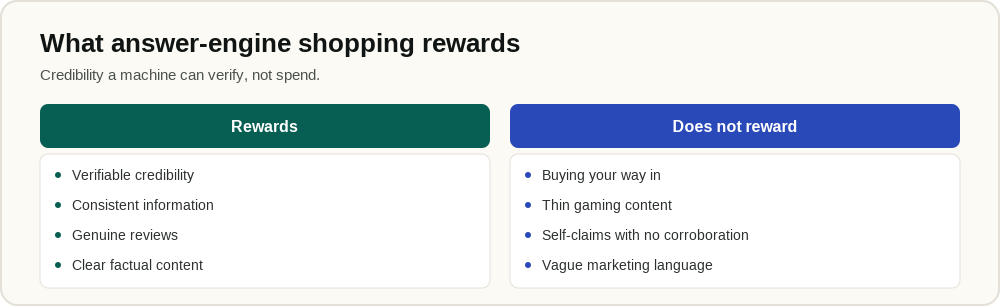
Verifiable credibility
Answer engines lean on signals of trust they can check: consistent information across multiple sources, genuine reviews, clear and demonstrated expertise, and authoritative mentions. A brand that is well-represented and consistent is a safe citation. A brand that only talks about itself, with little independent corroboration, is a riskier one. This is credibility a machine can verify, not credibility you assert.
Clear, factual information
Because the engine extracts and synthesises facts, clear and specific information about your products, what they are, who they suit, how they compare, gives it something solid to work with. Vague marketing language is hard to synthesise into a useful answer and tends to be passed over in favour of substance.
Machine-readable products
As with agents and AI search generally, clean structured data and feeds help answer engines understand your products accurately. The easier you are to read correctly, the less likely you are to be misrepresented or omitted.
What it does not reward
Answer-engine shopping is relatively resistant to the tactics that work elsewhere. You generally cannot simply buy your way to the top of a synthesised answer the way you can buy an ad placement, and thin content engineered to game rankings tends not to survive synthesis. The currency is genuine, corroborated credibility, which is slower to build but more durable. This is good news for brands willing to invest in substance and bad news for those hoping for a shortcut.
How brands should respond
The practical response mirrors generative engine optimisation applied to commerce. Build genuine reputation: real reviews, authoritative presence, expertise demonstrated in content. Keep your information consistent everywhere a machine might read it. Make your products machine-readable with clean data. Create clear, factual content that answers the comparison and suitability questions shoppers actually ask, so the engine has quality material to cite. And accept that this is a compounding, long-term investment rather than a switch you flip.
Measuring it
Answer engines sometimes send identifiable referral traffic, which is worth tracking where you can see it. Beyond that, treat growth in branded and direct demand as a partial signal that you are being surfaced in research you cannot directly observe, and ask customers how they found you. As with the rest of AI shopping, precise attribution is immature, so combine the visible signals with blended business metrics rather than expecting a clean count.
FAQ
Frequently asked questions
By being a findable, trustworthy source the engine can draw on. When it answers a shopping question, it cites the sources behind its answer, so brands with consistent, credible, machine-readable information get surfaced, while thin or contradictory ones are passed over for competitors the engine can corroborate.
Generally not in the way you buy an ad placement. Answer engines synthesise and cite credible information, so the main currency is genuine, corroborated trust rather than spend. That makes visibility slower to build but more durable, and resistant to the shortcuts that work on some other channels.
It overlaps but leans harder on being a credible, citable source than on ranking a single page. It is essentially generative engine optimisation for commerce: consistent information, genuine reputation, demonstrated expertise and clear factual content, so an engine can confidently cite and recommend you.
Clear, factual content that answers the suitability and comparison questions shoppers actually ask, who a product suits, how options differ, what to consider, gives the engine quality material to synthesise and cite. Vague marketing language is hard to use and tends to be skipped in favour of substance.
Track identifiable referral traffic where the engine provides it, watch branded and direct demand as a partial proxy for research you cannot see, and ask customers how they found you. Precise attribution is immature, so combine these signals with blended business metrics rather than relying on one exact figure.
Similar posts
Agentic Commerce
The Agentic Commerce Guide: Selling When AI Does the Shopping
A practitioner's guide to agentic commerce: what it is, what is real versus hype, and the no-regret work, structured data, feeds, trust and frictionless buying, that makes a store ready.
7 min read
Agentic Commerce
ChatGPT Shopping and In-Chat Checkout
People research products in AI assistants, and shopping features are emerging. What is real versus speculative, how to be legible and trusted, and why not to rebuild checkout on speculation.
5 min read
AI Search & GEO
How to Get Cited by Perplexity
Perplexity retrieves and cites live sources. Learn how to be discoverable, relevant, quotable and credible so it chooses your page, and how to audit your citations.
3 min read
Related services