Performance Marketing
How to Build a Performance Marketing Strategy

Learn how to build a performance marketing strategy with clear goals, unit economics, channel selection, tracking, creative testing, CRO and a practical optimization plan.
Quick answer
It is a plan that connects measurable business goals with audience research, channel selection, creative, conversion experience, tracking, budget decisions and ongoing optimization.
Key takeaways
- A performance marketing strategy is more than a media plan, a list of campaigns or a monthly advertising budget.
- Begin with the outcome, not the platform.
- Write down the metric, its definition, the data source, the reporting period and the person responsible.
- Marketing decisions should fit the economics of the product or service.
Introduction
Looking for outside help with this? See how to choose a performance marketing consultant in Karachi. A performance marketing strategy is more than a media plan, a list of campaigns or a monthly advertising budget. It is a structured way to connect business goals with customer demand, channel choices, measurement, creative, conversion experience and ongoing decisions.
Without a strategy, teams can become busy while results remain unclear. Budgets move between platforms without a shared objective. Reports celebrate platform-attributed revenue without checking profitability. Creative tests lack a clear hypothesis. Website issues are treated as advertising problems, and every performance dip triggers a new campaign structure.
A strong strategy creates a common operating system for the team. It answers five questions:
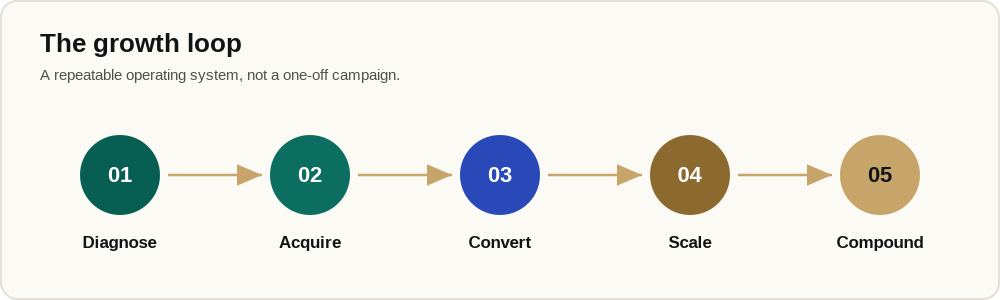
This guide follows the framework Diagnose → Acquire → Convert → Scale → Compound. It can be adapted for ecommerce, lead generation and other measurable growth programmes, while recognizing that each business model requires different conversion definitions and economics.
- 01What business outcome are we trying to improve?
- 02Which customers and needs should we prioritize?
- 03Which channels and messages are best suited to reach them?
- 04How will we measure performance reliably?
- 05What evidence will guide our next decision?
1. Start with the business objective
Begin with the outcome, not the platform. “Run Meta Ads” is an activity. “Increase profitable new-customer orders while keeping acquisition cost within an agreed limit” is a business objective.
Common objectives include:
Choose one primary objective and a small number of supporting indicators. Too many equal priorities make it difficult to decide what to optimize when metrics conflict.
- Increasing profitable ecommerce revenue.
- Acquiring qualified leads or sales opportunities.
- Improving the efficiency of customer acquisition.
- Growing demand for a specific product, category or service.
- Increasing repeat purchases or customer lifetime value.
- Improving the quality and consistency of conversion measurement.
Define success before launch
Write down the metric, its definition, the data source, the reporting period and the person responsible. For example, “qualified lead” should have a clear operational definition rather than meaning any form submission. Ecommerce revenue should be reconciled with the store or order system, with treatment of cancellations, refunds and taxes documented.
Separate business outcomes from platform metrics. Clicks, impressions, cost per click and platform-reported ROAS can help diagnose activity, but they do not automatically demonstrate incremental growth or profit.
2. Understand the economics
Marketing decisions should fit the economics of the product or service. Before setting a target ROAS or cost per lead, understand what the business can afford and what happens after the initial conversion.
For ecommerce, consider:
For lead generation, consider lead qualification rate, sales acceptance, close rate, average deal value, sales cycle, gross margin and the cost of serving the customer.
- Selling price and average order value.
- Cost of goods sold.
- Discounts and promotions.
- Payment processing fees.
- Fulfilment and shipping costs.
- Returns, cancellations and refunds.
- Other variable costs.
- Repeat purchase behaviour, if supported by reliable data.
Illustrative break-even ROAS calculation
Suppose an ecommerce order has a selling value of PKR 10,000 and the contribution available to cover advertising before ad spend is PKR 3,000. In this simplified example:
Break-even ROAS = Revenue ÷ allowable ad spend = 10,000 ÷ 3,000 = 3.33x
This is an illustrative calculation, not a universal benchmark. It assumes the PKR 3,000 is the relevant amount available to cover advertising after the costs included in the model. If costs are omitted, the calculation may overstate what the business can afford.
A target should leave room for profit and account for uncertainty. A campaign that reaches break-even is not necessarily a healthy growth engine.
3. Research the audience and the buying journey
A strategy should reflect customer needs, objections, triggers and decision processes. Build an evidence-based view from sources such as customer interviews, sales calls, support questions, product reviews, onsite search, CRM data and existing campaign results.
Document:
Avoid building audiences from stereotypes or assumptions alone. Use observed customer behaviour and research, while respecting privacy requirements and platform policies.
- Who is the priority customer?
- What problem are they trying to solve?
- What alternatives do they consider?
- What objections delay the purchase?
- What proof or information helps them decide?
- What is the likely buying cycle?
- What makes the offer relevant now?
Map messages to the journey
People at different stages need different information. Someone unfamiliar with a product may need education or a clear explanation of the problem it solves. Someone comparing options may need specifications, proof, pricing or a comparison. Someone ready to buy may need availability, delivery information, reassurance or a frictionless path to conversion.
The journey is not always linear. People move between channels, return later, ask others for advice and use multiple devices. Treat journey maps as a practical planning tool, not a claim that every customer follows the same path.
4. Choose channels by role, not trend
No channel is universally best. Channel selection depends on customer behaviour, market demand, product economics, creative capability, sales cycle, available data and operational resources.
This table describes possible roles, not guaranteed outcomes. A channel should earn its place through evidence and fit with the business.
| Channel | Potential role | Questions to answer |
|---|---|---|
| Google Search Ads | Capture existing search intent | Is there relevant demand, and can the offer compete? |
| Shopping and Performance Max | Support eligible product discovery across Google's inventory | Is product data accurate, tracking reliable and the feed maintained? |
| Meta Ads | Introduce products, create demand and test creative angles | Can the team produce relevant creative and measure outcomes responsibly? |
| SEO | Build long-term organic discovery | Are important pages useful, technically accessible and aligned with search intent? |
| Email and lifecycle marketing | Support onboarding, retention and repeat purchase | Are messages relevant, permissioned and measured against clear goals? |
| LinkedIn or other professional platforms | Reach selected business audiences where appropriate | Is the audience reachable and does the economics fit the deal value? |
| Affiliate, creator or partner activity | Access trusted audiences or specialist communities | Are partnerships authentic, trackable and commercially appropriate? |
Set a channel hypothesis
For every proposed channel, record the audience, objective, expected role, creative or offer requirement, conversion action, budget logic and evaluation criteria. If the hypothesis cannot be explained clearly, the campaign is not ready for a meaningful test.
5. Build a measurement plan before launching
Tracking is part of the strategy, not a task to postpone until campaigns are live. A platform can only optimize effectively against the signals it receives, and a business cannot evaluate results if its definitions change between reports.
Measurement checklist
Use the official documentation for the specific platforms and implementations. Consent, browser restrictions, server-side tracking and platform policies can affect what is observed. No setup guarantees that every conversion will be recorded or attributed identically across systems.
- Define primary and secondary conversions.
- Configure tags and events using the appropriate analytics and platform tools.
- Verify event names, values, currency and transaction identifiers.
- Prevent duplicate purchase or lead events where possible.
- Check consent and privacy requirements for the relevant markets.
- Test the complete user journey, including confirmation pages and server-side events where applicable.
- Document attribution windows and reporting definitions.
- Compare platform reporting with analytics, CRM or order data.
- Record known gaps, modelling and reconciliation differences.
Separate measurement from causality
Attribution assigns credit according to a model and its available signals. It does not automatically prove that an ad caused the conversion. For larger programmes, consider incrementality tests or other appropriate experimental methods when the business has sufficient scale and a suitable design.
For smaller accounts, a disciplined baseline, change log and consistent reporting can still improve decision quality. Be explicit about what the data can and cannot establish.
6. Align creative, offer and landing page
Campaign performance is shaped by more than targeting and bidding. The ad promise, creative, offer, landing page and checkout or lead form should work together.
Before launch, check:
If a campaign attracts clicks but few meaningful conversions, do not automatically blame the audience or platform. The issue may be the offer, the message, the page experience, product availability, pricing or tracking.
- Does the creative communicate the product or service clearly?
- Does the message reflect a real customer need?
- Is the offer understandable and commercially viable?
- Does the landing page match the ad's promise?
- Are pricing, availability and key terms clear?
- Is the next action obvious?
- Does the page work well on mobile?
- Are trust signals genuine and relevant?
- Are forms or checkout steps unnecessarily difficult?
- Does the page answer important objections?
Make creative testing deliberate
Every test should have a hypothesis. For example: “Showing the product in a real use context may help shoppers understand its size and function better than a studio-only image.” Define the audience, the change, the success metric and the conditions for making a decision.
Avoid changing the audience, offer, creative and landing page simultaneously if the goal is to understand which factor mattered. In real campaigns, perfect isolation is not always possible, but a clear testing plan improves interpretation.
7. Design a budget and testing plan
Budget allocation should reflect business priorities, channel role, demand, learning needs and the cost of obtaining a meaningful signal. Avoid splitting budget equally across every platform just to appear diversified.
A practical budget plan identifies:
Do not use a fixed budget split as a universal formula. For one business, high-intent search may be the main source of demand capture. For another, social creative may be needed to generate awareness and consideration. Budget decisions should be reviewed against the same business objective and the reliability of each channel's data.
- The total available media budget, separate from management and production fees.
- Minimum viable spend for each planned test, based on expected costs and conversion volume.
- The primary objective and evaluation window.
- The share reserved for proven activity versus new tests.
- Conditions for increasing, holding or reducing spend.
- Operational constraints such as stock, capacity, sales coverage or fulfilment.
Avoid premature conclusions
A few conversions may not be enough to establish a stable pattern, especially when order values vary or the sales cycle is long. Set evaluation rules before the test, account for conversion delay and avoid stopping a campaign solely because of a short-lived fluctuation.
At the same time, do not keep spending indefinitely because a campaign “needs more data.” Define a reasonable limit, identify what evidence would change the decision and escalate when tracking or the offer is clearly broken.
8. Create a repeatable optimization rhythm
Optimization is a decision process, not constant activity. A practical rhythm combines frequent checks for urgent issues with scheduled analysis for larger decisions.
Daily or frequent checks
- Tracking outages or unexpected conversion drops.
- Disapproved ads or feed errors.
- Budget pacing and unusual spend changes.
- Stock, price or landing-page problems.
- Lead delivery or sales follow-up failures.
Weekly review
- Performance by campaign, audience, creative, query or product group where relevant.
- Funnel drop-offs and conversion quality.
- Search terms, placements and creative fatigue indicators.
- Tests in progress and whether their evaluation conditions are met.
- Budget allocation and any changes requiring documentation.
Monthly review
Use a change log. Record what changed, why it changed, when it changed and what result would support or reject the hypothesis. This reduces reactive decisions and helps the team learn from both wins and losses.
- Overall business outcomes across channels.
- New-customer acquisition and retention where measurable.
- Revenue, margin or qualified pipeline rather than platform metrics alone.
- Creative and offer learnings.
- Tracking quality and attribution limitations.
- Next month's priorities, owners and expected evidence.
9. Diagnose problems by funnel stage
When performance declines, investigate the funnel instead of making random adjustments.
These are diagnostic possibilities, not automatic explanations. Confirm the cause before making major changes.
| Symptom | Possible causes to investigate | Useful first checks |
|---|---|---|
| Impressions or reach fall | Demand changes, budget limits, eligibility, competition or targeting constraints | Delivery status, demand trends, budgets and policy notices |
| Click-through rate falls | Message fatigue, weaker relevance, changed placement mix or competitive offers | Creative performance, query or audience mix, frequency where relevant |
| Clicks remain healthy but conversions fall | Landing-page issue, offer mismatch, price, stock, slow page or broken tracking | Test the journey, inspect site changes and validate events |
| Lead volume rises but quality falls | Broad targeting, weak qualification, form friction or misleading message | CRM outcomes, lead criteria, form questions and sales feedback |
| Platform ROAS rises but business profit does not | Attribution differences, discounts, returns, customer mix or unaccounted costs | Order-level data, margin assumptions and reporting definitions |
| Results fluctuate sharply | Low volume, conversion delays, tracking changes, seasonality or budget changes | Change log, event health, sample size and external factors |
10. Scale what works without losing control
Scaling should follow evidence that the programme can generate the desired outcome at acceptable economics and that the business can fulfil additional demand.
Before scaling, confirm:
Scaling may involve increasing budget, expanding product coverage, testing new creative concepts, improving the landing page, extending into a suitable audience or strengthening organic and lifecycle channels. It does not always mean increasing ad spend.
Do not promise that ROAS will remain constant as spend grows. Additional budget may reach less responsive audiences or capture demand with different economics. Evaluate incremental outcomes and the quality of the additional volume.
- Conversion tracking is sufficiently reliable for the decision.
- Performance has been assessed over an appropriate period.
- The result is not dependent on an unsustainable discount or temporary condition.
- Stock, delivery, customer support and sales capacity can handle growth.
- The business understands marginal economics, not just historical averages.
- The next budget increase has a defined review point.
- There is a plan if efficiency deteriorates.
11. Use the Diagnose → Acquire → Convert → Scale → Compound framework
The framework creates a practical connection between strategy and execution.
Diagnose
Understand the business objective, customer, unit economics, existing channel performance, tracking quality and main growth constraint.
Output: A baseline, problem statement and prioritized opportunity list.
Acquire
Choose channels and campaigns that fit customer intent and the business model. Build relevant messages and offers, then launch with a measurement plan.
Output: A clear acquisition plan with budget logic, audience hypotheses and conversion definitions.
Convert
Improve the landing page, product or service presentation, trust, forms and checkout. Ensure the promise made in the campaign is fulfilled on the page.
Output: A more coherent customer journey and a documented conversion test plan.
Scale
Expand the activity supported by evidence, while monitoring marginal economics, operational capacity and performance quality.
Output: A controlled growth plan with explicit scale and stop conditions.
Compound
Turn findings into better creative, clearer measurement, stronger landing pages, improved content, retention opportunities and more informed future decisions.
Output: A knowledge base and operating rhythm that improve future campaigns rather than resetting learning every month.
12. A practical 30-day launch plan
This is a planning template. The sequence should change when a business has an urgent tracking failure, technical blocker, major launch or limited operational capacity.
Week 1: Establish the truth
Deliverable: A baseline scorecard with definitions, assumptions and known limitations.
- Agree on the business outcome and how success is defined.
- Document relevant margin, lead-value or customer-economics assumptions.
- Audit conversion actions, event values, currency and duplicate events.
- Review current performance by channel and overall business outcome.
- Identify the largest data gaps.
Week 2: Identify the main constraint
Deliverable: A ranked list of opportunities with owners and validation steps.
- Review audience, search intent, creative, offer and campaign structure.
- Examine the landing page and conversion journey.
- Gather customer and sales feedback.
- Identify the most important funnel drop-off or measurement issue.
- Prioritize fixes by impact, confidence and effort.
Week 3: Launch focused improvements
Deliverable: A change log and a test plan with success criteria.
- Fix critical tracking or customer-journey problems first.
- Implement one or two high-confidence landing-page or offer improvements.
- Launch creative tests tied to clear hypotheses.
- Adjust budgets only where evidence supports the change.
- Record each major change.
Week 4: Evaluate and decide
Deliverable: A concise growth review with evidence, decisions, owners and next steps.
- Review performance over a suitable period, allowing for conversion delay.
- Compare platform metrics with business results and contribution where available.
- Separate observed changes from assumptions about causality.
- Decide what to continue, stop, test next or scale.
- Set the next month's priorities.
13. Common performance marketing strategy mistakes
Starting with a platform instead of an objective. A channel is a means, not the business outcome.
Optimizing to one metric. ROAS, cost per lead or click-through rate can be useful, but no single metric describes the whole business.
Launching before tracking is tested. Broken or duplicated events can undermine both reporting and automated optimization.
Treating all channels as interchangeable. Different platforms serve different roles and require different creative, timing and measurement assumptions.
Changing too many variables at once. This makes it harder to understand what caused the result.
Scaling before checking operations. More demand is not helpful if stock, fulfilment or sales follow-up cannot support it.
Ignoring the website. Paid media cannot compensate indefinitely for a confusing offer or broken conversion path.
Reporting attributed outcomes as proven incrementality. Attribution models assign credit; they do not alone prove causation.
Making unrecorded changes. Without a change log, the team can repeat failed tests and lose the reason behind successful ones.
Conclusion
A performance marketing strategy creates a disciplined link between business goals and daily execution. It clarifies what success means, identifies the customer and the economics, assigns a role to each channel, establishes measurement before launch, and makes optimization decisions based on evidence.
Use Diagnose → Acquire → Convert → Scale → Compound to build a repeatable process. Diagnose the real constraint before changing campaigns. Acquire through channels that fit the audience and offer. Convert by improving the full customer journey. Scale only when the evidence and operations support it. Compound the learning so each cycle improves the next.
The objective is not to run more campaigns. It is to make better decisions that create measurable, sustainable business value.
---
Schema and publication checklist
- Use Article or BlogPosting schema with accurate headline, description, author, publisher and genuine publication/modification dates.
- Link the author to the actual profile page and use only verifiable credentials.
- Confirm the final URL and canonical.
- Add a working table of contents if appropriate to the page design.
- Ensure the article is crawlable, indexable and linked from the existing /insights/ structure.
- Validate internal links, metadata, mobile layout and accessibility.
- Review platform-specific statements against official documentation before publication.
- Record substantive updates; do not backdate.
FAQ
Frequently asked questions
It is a plan that connects measurable business goals with audience research, channel selection, creative, conversion experience, tracking, budget decisions and ongoing optimization.
Define the business outcome, understand unit economics, research the audience, select channels by role, establish reliable conversion tracking, align creative and landing pages, set a testing budget, and document how decisions will be made.
Choose based on customer behaviour, demand, offer, business economics and operational capability. Search, paid social, SEO, lifecycle marketing and professional platforms can each play different roles. There is no universally best mix.
Track business outcomes alongside diagnostic metrics. Depending on the model, this may include revenue, orders, contribution margin, qualified leads, sales pipeline, CAC, ROAS, conversion rate, average order value and repeat purchase. Define each metric consistently.
There is no universal minimum that works for every business. Budget depends on expected costs, market demand, conversion volume, sales cycle and the amount of evidence needed to make a decision. Separate media spend from management and creative costs.
Check frequently for urgent delivery, tracking or website problems. Use a consistent weekly and monthly review for strategic decisions, allowing enough time for conversions and tests to mature. Avoid making large changes based on noise alone.
First verify tracking and business economics, then expand in controlled steps with clear review points. Monitor marginal performance and operational capacity. No strategy can guarantee that efficiency will remain unchanged as spend increases.
Digital marketing is the broader discipline covering online channels and activities. Performance marketing emphasizes measurable outcomes and optimization. They overlap; performance marketing can use multiple digital channels.
Similar posts
Performance Marketing
Performance Marketing for Ecommerce: What Actually Drives Profitable Growth
A profit-first guide to ecommerce performance marketing: how to connect paid media, SEO, conversion optimisation and measurement into one system that grows revenue without sacrificing margin.
11 min read
Measurement
ROAS vs CAC vs MER: Which Metrics Actually Measure Marketing Performance?
Understand ROAS, customer acquisition cost and marketing efficiency ratio, when each metric helps, and how to use them together for better growth decisions.
11 min read
Ecommerce Growth
How Much Should an Ecommerce Business Spend on Marketing? A Practical Budgeting Framework
Learn how to set an ecommerce marketing budget using margins, customer acquisition cost, channel performance, cash flow, and a practical 90-day planning framework.
13 min read
Related services
Related work