Performance Marketing
What Is Performance Marketing and How Does It Actually Work?

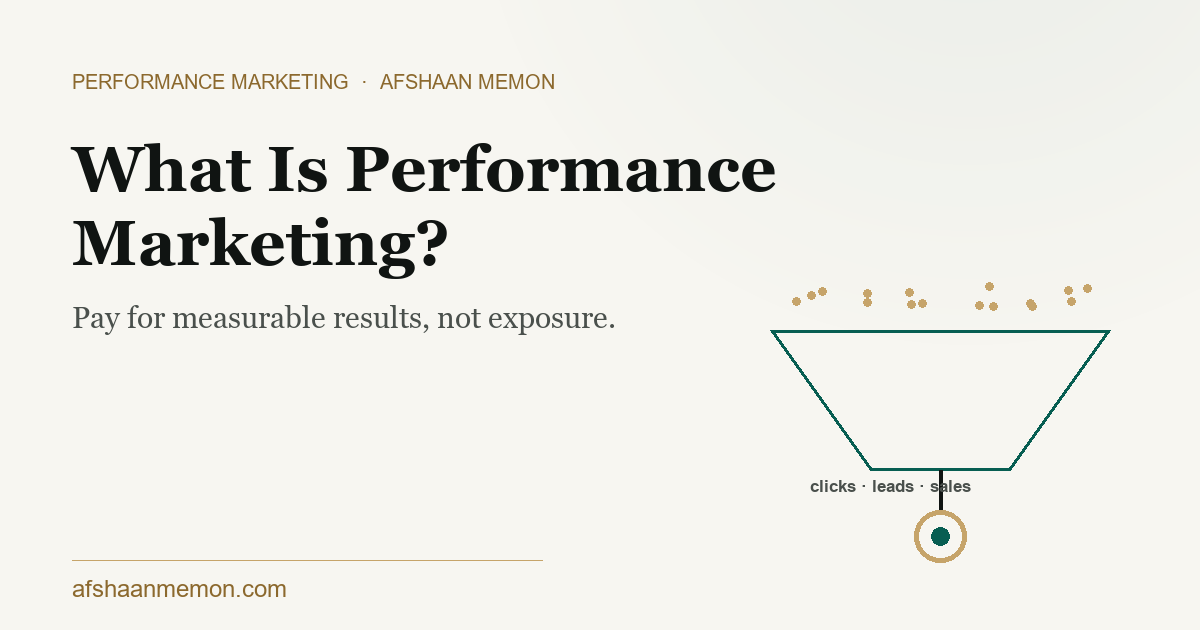
Performance marketing is one of the most overused terms in the industry. People use it to mean paid ads, or Facebook campaigns, or whatever an agency happens to be selling that month. The clearest way to understand it is by what it holds itself accountable to: a measurable business result, not attention. Over 12 years running paid media for fashion and eCommerce brands, I have found that the companies that actually grow are the ones that treat performance marketing as a system tied to revenue, not a set of campaigns judged on clicks.
Quick answer
Performance marketing is a form of digital advertising where you pay for and measure specific results, such as clicks, leads or sales, rather than paying for exposure. It usually runs on paid channels like Google Ads and Meta Ads, every action is tracked back to revenue, and success is judged on return metrics such as ROAS, CAC and MER rather than impressions.
Key takeaways
- Performance marketing is defined by accountability: you pay for measurable actions, not exposure.
- It runs mainly on paid channels like Google Ads, Meta Ads and TikTok, but the tracking and optimisation matter more than the platform.
- Success is measured in return (ROAS, CAC, MER), and a high ROAS does not automatically mean profit.
- Clean tracking comes first. Without trustworthy data, scaling decisions are built on sand.
- The brands that grow treat it as one system across acquisition, conversion and retention, not isolated campaigns.
What performance marketing actually means
Performance marketing is paid advertising where you are charged for a defined action and can measure whether it happened. A billboard charges you to be seen. Performance marketing charges you when someone clicks, submits a lead, installs an app or buys. That single shift, from paying for exposure to paying for outcomes, is the whole idea.
This is also why it is not the same as simply running online ads. You can spend money on Facebook and have no idea whether it worked. That is advertising. Performance marketing is advertising plus the discipline of tracking, attribution and optimisation that connects spend to a result the business cares about.
How performance marketing works
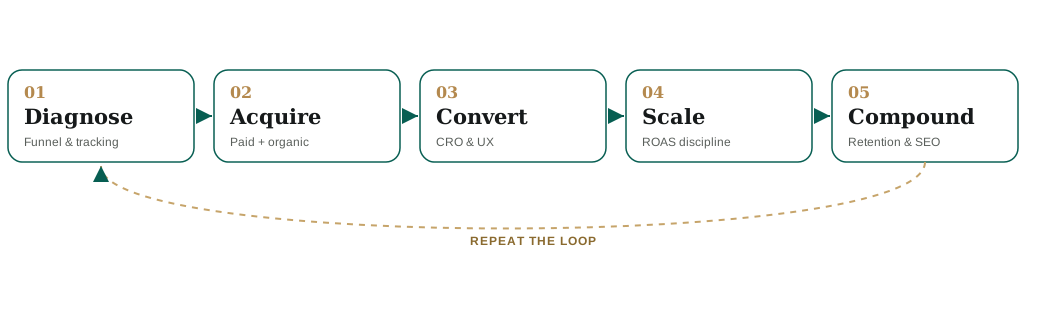
The process is a loop, not a launch. It starts with a business goal, usually a revenue target and an acceptable cost to acquire a customer, and then works outward from there.
You choose channels based on where the demand is, build tracking so every important action is captured, launch, and then read the numbers honestly. From there you optimise what is working, cut what is not, and scale spend only where the return holds. Then the loop repeats.
The main performance marketing channels
Different channels do different jobs. Some capture demand that already exists. Others create demand that was not there yet. The mistake is treating them as interchangeable.
| Channel | What it does | Best for |
|---|---|---|
| Google Search & Shopping | Captures existing intent | People already searching to buy |
| Google Performance Max | Captures intent across Google | Scaling product demand with strong feeds and tracking |
| Meta Ads (Facebook, Instagram) | Creates demand | Discovery, visual and considered products |
| TikTok Ads | Creates demand | Younger audiences and short-form video |
| Retargeting, email and CRM | Converts and retains | Bringing warm visitors and past buyers back |
How performance marketing is measured
Because performance marketing is accountable, it lives and dies by a few numbers. ROAS is revenue divided by ad spend. CAC is what it costs to acquire a customer. MER, the marketing efficiency ratio, is total revenue divided by total marketing spend, which gives a blended view across every channel.
Each is useful, and each can mislead on its own. The most common trap is treating ROAS as profit.
ROAS is not profit
A 4x ROAS can still lose money once you include product cost, shipping, returns and fees. Before setting targets, work back to the break-even ROAS for your actual margins, then judge the whole account on blended return.
Performance marketing vs digital marketing
Digital marketing is the umbrella. It includes SEO, content, organic social, email and paid ads. Performance marketing is the accountable, paid, measurable part of that umbrella.
Brand marketing and performance marketing are often set against each other, but they are not rivals. Brand builds demand over time. Performance captures and converts it. The strongest programmes use both, which is why I plan paid and organic as one system rather than competing budgets.
How I approach performance marketing
I start from economics, not channels. Before a single campaign goes live, the question is what a customer is worth, what the margin allows, and what break-even looks like. Channels come second.
The second rule is that measurement comes before scale. In my own work I have driven 20x returns on Google and 15x on Meta for fashion eCommerce, but the number that actually guided decisions was always contribution, not the platform's reported ROAS. If the tracking is wrong, scaling just loses money faster.
- Start from your margins and work out a break-even ROAS before setting targets.
- Fix tracking and attribution before you scale spend.
- Match channels to intent: capture demand on Google, create it on Meta.
- Judge the whole funnel on blended return (MER), not one platform's ROAS.
- Treat creative, offer and landing experience as part of performance, not separate from it.
FAQ
Frequently asked questions
No. Digital marketing is the umbrella that includes SEO, content, email, organic social and paid ads. Performance marketing is the paid, measurable part where you pay for specific actions and judge success on return.
Google Search and Shopping ads, Meta (Facebook and Instagram) ads, TikTok ads, retargeting and affiliate marketing are all performance marketing, because each is tracked to a measurable action like a click, lead or sale.
Yes. Google Ads is one of the core performance marketing channels. You pay per click or per conversion and can tie spend directly to sales, which is the defining feature of performance marketing.
Mainly through return metrics: ROAS (revenue divided by ad spend), CAC (cost to acquire a customer) and MER (total revenue divided by total marketing spend). Together they show whether spend is producing profitable growth, not just activity.
Often yes, because you can start small, measure what works and scale spend only where it returns. The key is getting tracking right and judging results against your margins rather than ROAS alone.
Related services
Related work