Performance Marketing
LTV-Based Acquisition: Bidding on Lifetime Value

Most ecommerce acquisition is managed on the first order. A customer costs this much to acquire, their first purchase yields that much margin, and if the margin beats the cost, the acquisition is deemed good. This is a reasonable starting point and a dangerous stopping point, because it ignores everything the customer does after order one. If a meaningful share of your customers come back, their real value is a stream of orders, not a single transaction. Judging acquisition on first-order economics alone means systematically underpaying for customers who would have been highly profitable over time. LTV-based acquisition corrects this by making lifetime value the yardstick. This piece explains how to do it without overcomplicating things.
Quick answer
LTV-based acquisition means deciding how much to pay for a customer based on their expected lifetime value, not just the profit on their first order. Because repeat-buying customers are worth far more over time, a store that only bids on first-order profit will underpay for its best customers and lose them to competitors who understand this. The method is to estimate LTV by segment, set acquisition targets against it, and feed value signals that steer bidding towards high-value customers.
Key takeaways
- Judging acquisition on first-order profit alone underprices customers who return, and lets competitors outbid you for your best buyers.
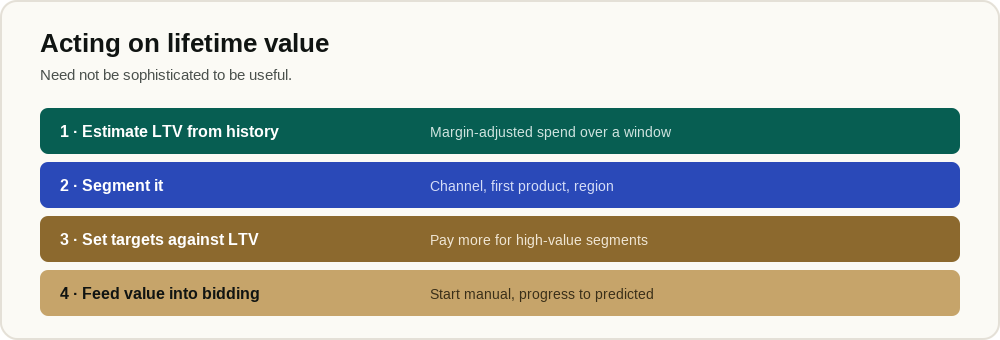
- Estimate LTV from your own order history as average margin-adjusted spend over a defined window; it need not be sophisticated to be useful.
- Segment LTV, because blended averages hide large differences by channel, first product and region.
- Set acquisition targets against LTV, allowing higher cost per acquisition for high-value segments and a tighter line on low-value ones.
- Start by setting targets manually by segment; move towards predicted-LTV value signals in bidding as your data matures.
- Remember LTV is earned over time but acquisition is paid today, so scale at a pace your cash flow supports.
Why first-order economics underprices good customers
Imagine two customers who both cost the same to acquire. One buys once and disappears. The other buys every two months for two years. On first-order maths they look identical, so you would pay the same for each and no more. But the second customer is worth many times the first, and your willingness to pay to acquire them should reflect that.
The competitor who understands this can afford to outbid you for exactly the customers you most want, because they are pricing in the full relationship while you are pricing in one order. Over time, they win the loyal customers and you are left fighting for one-time buyers. That is the strategic cost of first-order thinking.
Estimate lifetime value by segment
To act on LTV you need an estimate of it, and it does not need to be a sophisticated model to be useful. Start from your own order history: how much, on average, does a customer spend over a defined window, say the first twelve or twenty-four months, after their first order? That figure, adjusted for margin, is a workable LTV.
Segment, because averages hide the truth
A single blended LTV is better than nothing but hides enormous variation. Customers acquired through different channels, buying different first products, or in different regions often have very different repeat behaviour. Segment your LTV at least coarsely, because the whole point is to pay more for the segments that are worth more. A high first-product can predict a high-value customer; a deep-discount first order often predicts a low-value one.
Set acquisition targets against LTV
Once you have LTV by segment, you can set a target acquisition cost that reflects the full relationship rather than the first order. This usually means you can afford a higher cost per acquisition than first-order maths allows, sometimes much higher, for your high-value segments, while holding a tighter line on segments that rarely return.
The discipline is to spend the allowance on acquiring customers, not on subsidising unprofitable relationships. LTV justifies paying more to acquire a genuinely valuable customer. It does not justify acquiring customers who never become valuable in the hope that they might.
Feed value signals into bidding
The operational step is to get this into your bidding. Where first-order value-based bidding sends the profit on the first order as the conversion value, LTV-informed bidding sends a value that reflects expected lifetime worth, often by assigning predicted LTV to customers based on the signals available at purchase.
This is more advanced and depends on your data maturity, so most stores should start simpler: use LTV by segment to set different acquisition targets manually, and move towards predicted-LTV value signals as your tracking and data allow. Even the manual version captures most of the benefit.
Mind the cash-flow reality
One honest caveat: LTV is earned over time, but acquisition cost is paid today. Paying a high cost to acquire a customer whose value arrives over two years is sound on a lifetime basis but demanding on cash flow. Scale into LTV-based acquisition at a pace your cash position can support, and do not let a spreadsheet full of future value talk you into a present you cannot fund.
FAQ
Frequently asked questions
It is deciding how much to pay to acquire a customer based on their expected lifetime value across all future orders, rather than only the profit on their first purchase. It lets you justifiably pay more for customers who will return and be worth more.
Look at your order history and find the average margin-adjusted amount a customer spends over a defined window, such as the first twelve or twenty-four months after acquisition. Segment it by channel or first product rather than using a single blended figure. That is enough to act on.
Because repeat behaviour varies enormously by how customers were acquired and what they first bought. A blended average tells you to pay the same for everyone, which overpays for low-value segments and underpays for high-value ones. Segmenting is what makes the approach useful.
Yes, through value-based bidding, by sending a conversion value that reflects expected lifetime worth rather than first-order revenue. This is more advanced and depends on your data, so many stores start by setting acquisition targets manually by segment and progress to predicted-LTV signals over time.
The main risks are cash flow, since you pay acquisition costs now and earn LTV later, and the temptation to acquire unprofitable customers in the hope they become valuable. Scale at a pace your cash supports and reserve the higher allowance for segments that genuinely return.
Similar posts
Ecommerce Growth
Customer Lifetime Value (LTV) for Ecommerce: How to Measure and Use It
Learn how to calculate ecommerce customer lifetime value, distinguish revenue from contribution, compare LTV with CAC, and use cohorts to guide profitable growth.
11 min read
Ecommerce Growth
Ecommerce Retention Marketing: How to Turn First-Time Buyers into Repeat Customers
Learn how ecommerce retention marketing works, which customer journeys to build, and how to measure repeat purchases, retention, and customer value.
14 min read
Performance Marketing
A First-Party Data Strategy for Ecommerce
First-party data is your most valuable asset as cookies disappear. How to collect it with value and consent, unify it into one customer view, and activate it everywhere.
3 min read
Related services