AI Tools
How to Write Ad Copy with AI (Without Sounding Like AI)

AI makes producing ad copy fast, which is both its strength and its trap. Unedited AI ads tend to sound generic, overclaim, and blur into every other AI ad. The fix is not to avoid AI but to use it well: as a volume engine for angles you then sharpen. This guide shows how to brief AI for ad copy, how to strip out the tell-tale AI tone, and how to keep claims honest, so you get the speed without the sludge.
Quick answer
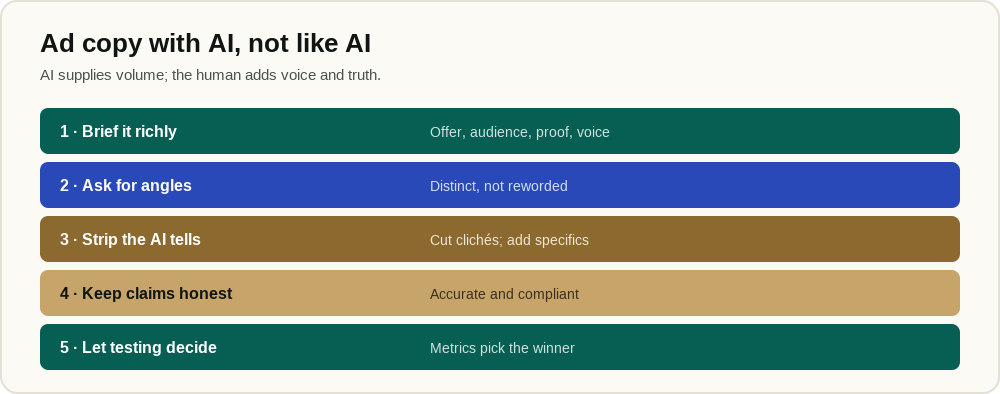
To write ad copy with AI that does not sound like AI, give it a rich brief (offer, audience, real benefit, proof, voice and words to avoid), ask for many distinct angles rather than polished "final" ads, then edit hard: cut clichés and filler, add specifics and a human hook, and make every claim honest. AI is excellent at producing volume to test; the human adds the voice, truth and judgement that make an ad land. Test the variations and let data pick the winner.
Key takeaways
- Brief AI richly: offer, audience, real benefit, proof, voice, words to avoid.
- Ask for many distinct angles, not finished or near-identical ads.
- Edit out AI tells: clichés, vague benefits, filler; add human specifics.
- Keep every claim honest and compliant.
- Use AI for volume; let disciplined testing pick the winner.
Brief it properly
Weak prompts produce weak, generic ads. Give the AI:
A rich brief is the difference between a usable batch and generic filler.
- The offer and the single main benefit.
- Who the audience is and what they actually care about.
- Real proof points and what makes you different.
- The brand voice and tone, with example lines.
- Words, claims and clichés to avoid.
Ask for angles, not finished ads
Request many distinct angles for the same offer: different hooks, emotions, objections addressed and framings, not ten rewordings of one idea. Variety is what makes testing worthwhile and what gives you something to sharpen. You are mining for raw material, not asking for a finished campaign.
Strip out the AI tells
AI copy has recognisable habits. In editing:
- Cut clichés and empty intensifiers ("unlock", "elevate", "game-changing").
- Replace vague benefits with concrete specifics.
- Add a real human hook or detail only you would know.
- Tighten: remove filler words and hedging.
- Read it aloud; if it sounds like a robot, rewrite the line.
Keep every claim honest
AI will happily write claims you cannot back. Check each ad for accuracy and compliance, remove anything exaggerated, and keep regulated categories under especially close review. Honest, specific copy outperforms inflated promises and protects your brand.
Let testing decide
AI gives you options; your testing gives you answers. Run disciplined experiments across your best variations, judge on real metrics (click-through, conversion, cost per result, return on spend), and scale winners. The combination of AI volume and rigorous testing beats both manual-only and ship-it-unedited approaches.
FAQ
Frequently asked questions
Usually because of a thin prompt and no editing. Give a rich brief, ask for distinct angles, and edit out clichés and vague benefits to make it sound human.
AI produces many options quickly, but conversion comes from testing those options against real audiences. Use AI for volume and let data find the winner.
Provide your voice with example lines and words to avoid, then edit every ad in that voice. Generic output means the brief lacked voice and the copy was not edited.
Only after human review for accuracy, claims and compliance. Never publish claims you cannot back, and keep regulated categories under close review.
Enough distinct angles to test meaningfully without spreading budget too thin. AI makes several strong variations easy; your testing framework sets the number.
Similar posts
AI Tools
The AI Marketing Tool Stack (2026): A Practical Buyer's Guide
A practitioner's guide to building an AI marketing tool stack around jobs to be done: general assistant, content, ads, email, analytics and AI visibility. Lean and honest.
4 min read
AI Tools
Best AI Tools for Ad Copy and Creatives
AI is genuinely useful for ad creative because it produces volume for testing. Tools for ad copy and visuals, how to feed strong inputs, and why data picks the winners.
3 min read
AI Tools
AI Prompts for Marketers: A Practical Library
Good marketing prompts share a structure: role, context, task, constraints, format. Learn the pattern, with adaptable examples for research, content, ads, email and analysis.
3 min read
Related services