AI Tools
How to Spot and Fix "AI Sludge" Content

As AI writing spread, the web filled with content that is technically fine and completely forgettable. Readers skim past it and search engines increasingly ignore it. This low-value output has a name: AI sludge. The problem is not AI itself but using it without expertise, editing or purpose. This guide helps you recognise sludge, in your own content and competitors', and fix it, so your AI-assisted work is genuinely good rather than generic filler.
Quick answer
"AI sludge" is low-value, generic content churned out with AI and little human input. You spot it by its tells: vague claims, padding, repetition, no real expertise or specifics, a bland uniform tone, and nothing a reader could not get elsewhere. You fix it by adding genuine expertise, concrete specifics and a real point of view, verifying facts, cutting filler, and rewriting in a human voice. The deeper fix is process: never publish unedited AI drafts, and hold every piece to a helpfulness standard.
Key takeaways
- AI sludge is generic, low-value content made with AI and little human input.
- Tells: vagueness, padding, no expertise, bland tone, surface coverage, errors.
- It performs poorly and erodes trust; volume is not a strategy.
- Fix it with real expertise, specifics, fact-checking, cuts and a human voice.
- The durable fix is a process that never ships unedited AI drafts.
What AI sludge looks like
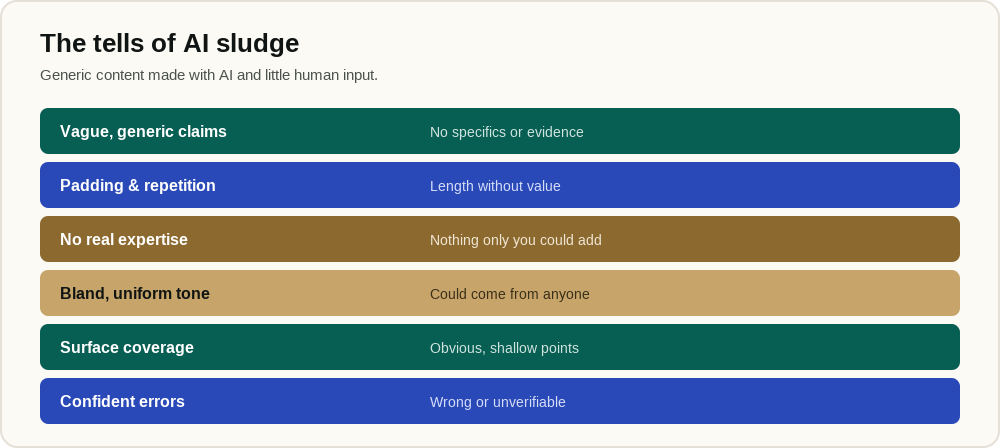
Common tells:
If a piece says nothing a reader could not get from any other result, it is sludge.
- Vague, generic claims with no specifics or evidence.
- Padding and repetition that add length but no value.
- No genuine expertise, experience or original insight.
- A bland, uniform tone that could come from anyone.
- Obvious, surface-level coverage of the topic.
- Confident statements that are wrong or unverifiable.
Why it is a problem
Sludge wastes readers' time, weakens trust, and performs poorly as search engines reward helpful, people-first content and discount mass-produced filler. It can also drag down a whole site's credibility. Producing more of it is not a content strategy; it is a liability.
How to fix sludge
Add genuine expertise
Insert real experience, data, examples and a point of view only you could provide. This is the single biggest upgrade from generic to valuable.
Get specific
Replace vague claims with concrete specifics: numbers, steps, examples, caveats. Specificity is the opposite of sludge.
Verify facts
Check every claim and figure. Confident errors are a hallmark of unedited AI content and destroy trust.
Cut the filler
Remove padding, repetition and empty intensifiers. Shorter and sharper beats longer and hollow.
Rewrite in a human voice
Edit so it sounds like a person with a perspective, not a template. Read it aloud; if it sounds generic, rewrite.
The real fix is process
One-off clean-ups help, but the durable fix is a workflow that never ships unedited AI drafts: use AI for speed, then require a human step that adds expertise, verifies facts and enforces a helpfulness bar. Ask of every piece, "would this genuinely help the reader more than what already exists?" If not, it is not ready.
FAQ
Frequently asked questions
Low-value, generic content produced with AI and little human input: vague, padded, expertise-free and forgettable. It performs poorly and erodes trust.
Ask whether it offers real expertise, specifics and a point of view, and whether it helps more than existing results. If it is generic and surface-level, it is sludge.
Google rewards helpful, people-first content however it is made, and discounts unhelpful, mass-produced content. Edited, expert, genuinely useful AI-assisted content is fine; sludge is not.
Often yes: add real expertise and specifics, verify facts, cut filler and rewrite the tone. If there is nothing genuine to add, the topic may not be worth publishing.
Use a workflow that never ships unedited AI drafts. Require a human step that adds expertise, verifies facts, and holds every piece to a clear helpfulness standard.
Similar posts
AI Tools
The AI Marketing Tool Stack (2026): A Practical Buyer's Guide
A practitioner's guide to building an AI marketing tool stack around jobs to be done: general assistant, content, ads, email, analytics and AI visibility. Lean and honest.
4 min read
AI Tools
How to Build a Content Workflow with AI
A practical end-to-end content workflow with AI: plan, research and brief, draft, then edit, fact-check and add expertise, add visuals, publish and measure. Humans stay in charge.
3 min read
AI Tools
Best AI Tools for Content Writing (and How to Use Them Well)
AI writing tools split into general assistants (ChatGPT, Claude, Gemini) and marketing writers (Jasper, Copy.ai). The quality comes from your brief, expertise and editing.
4 min read
Related services