Measurement
Attribution Models in 2026: What Still Works

Marketers have spent years arguing about attribution models: last click, first click, linear, time decay, data-driven. The arguments made sense when you could actually see most of a customer's journey. You mostly cannot any more. Tracking restrictions, cross-device behaviour and the rise of discovery inside AI answers and dark social mean a large share of the path to purchase is simply invisible. That does not make measurement hopeless. It makes it honest. This piece explains what the common attribution models still tell you, where they now mislead, and how to build a measurement approach that holds up when the underlying data does not.
Quick answer
Attribution in 2026 is less precise than the dashboards suggest, because cookies, cross-device journeys and AI-driven discovery break the click paths that models rely on. No single model is correct. The sensible approach is to treat platform attribution as a directional signal, lean on blended business metrics for the real picture, and use incrementality tests to settle big budget decisions. Pick models to answer specific questions, not to find one true number.
Key takeaways
- Attribution models assign credit by a rule; none is objectively correct, and all only see tracked touchpoints.
- The share of untracked discovery has grown, so models increasingly over-credit whatever touch was trackable, often a late branded click.
- Platform attribution double-counts across platforms because each claims the same orders; it is directional, not neutral.
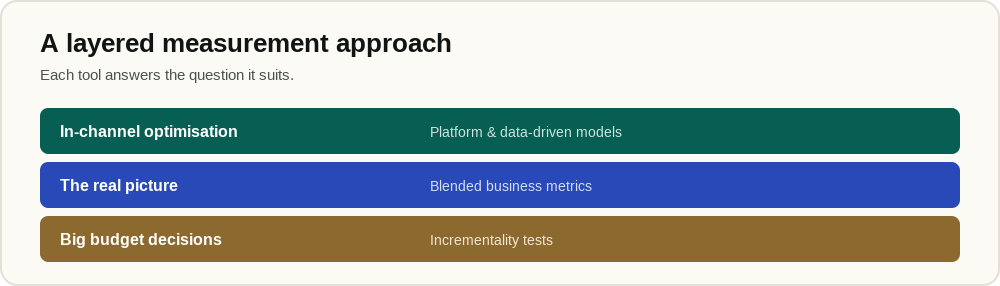
- Use platform and data-driven models for in-channel optimisation, blended business metrics for the real picture, and incrementality tests for big budget calls.
- Choose a model to answer a specific question rather than searching for one true number.
What attribution models actually are
An attribution model is a rule for assigning credit for a conversion across the touchpoints that preceded it. Last-click gives all credit to the final touch. First-click gives it to the first. Linear splits it evenly. Time-decay weights recent touches more heavily. Data-driven models use your own conversion patterns to distribute credit.
None of these is true. They are all conventions for dividing up credit, and they only see the touchpoints that were tracked. That second point is the one that matters most in 2026, because the share of untracked touchpoints has grown.
Why the models mislead now
The tracked path is shrinking
Models can only distribute credit among touches they can observe. When a growing portion of discovery happens where there is no click to record, in an AI answer, a private message, a podcast mention, a store someone remembered, the models quietly over-credit whatever touch happened to be trackable. Usually that is a branded search or a retargeting click near the end, which is why last-click so often flatters the channels that merely harvested existing demand.
Platforms mark their own homework
Google Ads and Meta each attribute conversions using their own view of the world, and each is incentivised to claim credit. Add them up and the total often exceeds your real sales, because both are counting the same orders. Platform attribution is useful for optimising within a platform. It is not a neutral referee between platforms.
What to use instead
The practical answer is not a better model. It is a layered approach where each tool answers the question it is suited to.
For day-to-day optimisation inside a channel, platform attribution and data-driven models are fine. They help the algorithm learn and help you compare campaigns like for like within one platform. Just do not treat the numbers as absolute truth.
For the real picture of whether marketing is working, watch blended business metrics: total revenue against total marketing spend, new customer cost, and contribution margin. These cannot be gamed by attribution, because they come from your bank account and your order data, not from a platform's self-report.
For the decisions that actually move money, which channel to scale, which to cut, use incrementality testing. A geo holdout or an audience holdout tells you what sales a channel genuinely caused, which no attribution model can. Reserve this for the big questions because it takes effort, but it is the only thing that settles them.
Pick a model to answer a question
Instead of hunting for one correct model, choose the model that fits the question in front of you. Want to understand which channels introduce new customers? First-click or a position-based model is informative. Want to optimise a bidding algorithm? Use the platform's data-driven model. Want to know if a channel is incremental? No model will tell you, so run a test.
Attribution becomes far less stressful once you stop expecting it to produce a single truth and start using it as a set of lenses.
FAQ
Frequently asked questions
There is no single best model. Data-driven attribution is a reasonable default inside a platform, but for cross-channel decisions you should lean on blended metrics and incrementality tests rather than any model. Match the tool to the question.
It is useful as one lens, especially for understanding what closes sales, but it systematically under-credits awareness and discovery channels and over-credits demand harvesting. Relying on it alone leads people to defund the very channels that create demand.
Each platform attributes conversions using its own tracking and its own window, and both can legitimately claim a touch in the same customer journey. Summed naively, their reported conversions exceed your real orders. This is why blended measurement matters.
No. Data-driven models distribute credit more intelligently among the touches they can see, but they cannot credit touches that were never tracked. They are better than last-click for in-platform work, not a solution to the underlying visibility problem.
Yes, for optimisation and for understanding journey patterns, but with lower expectations. Think of attribution as directional guidance that helps algorithms and informs hypotheses, backed by blended metrics for truth and incrementality tests for decisions.
Similar posts
Measurement
Ecommerce Marketing Attribution: How to Understand Which Channels Drive Growth
Learn how to interpret ecommerce attribution across Google Ads, Meta Ads and GA4 without confusing attributed revenue with incremental growth.
10 min read
Measurement
Incrementality Testing Explained
Incrementality testing measures the sales your marketing actually caused, not what a platform credits. Why it matters, the main test types, and how to run one simply.
3 min read
Measurement
Measuring ROAS in a Zero-Click World
Platform ROAS tells you less as click paths break. Use blended business metrics, incrementality tests and modelling to measure real return, not platform self-attribution.
3 min read
Related services