Ecommerce SEO
Ecommerce SEO for Seasonal Product Demand: Planning Inventory, Content, and Search Visibility

Seasonal ecommerce demand can rise and fall around holidays, weather, school calendars, gifting periods, and category-specific buying cycles. Organic visibility usually requires planning before the peak, not publishing a landing page after demand has already surged. A useful seasonal SEO process connects search research, inventory, page preparation, content, internal linking, and post-season maintenance.
Quick answer
Begin early enough to research, prepare pages, and resolve technical issues before demand peaks; the exact lead time varies by category and market.
Key takeaways
- Use historical sales and search data, campaign calendars, merchandising plans, and regional considerations to identify likely demand windows.
- If a seasonal page has continuing value and may be reused, maintaining a stable URL can preserve useful history and simplify future updates.
- Update titles, headings, copy, internal links, imagery, and relevant product selection before the peak.
- Gift guides, planning checklists, product comparisons, seasonal care advice, and use-case content can support discovery when they answer real questions.
Build a seasonality calendar
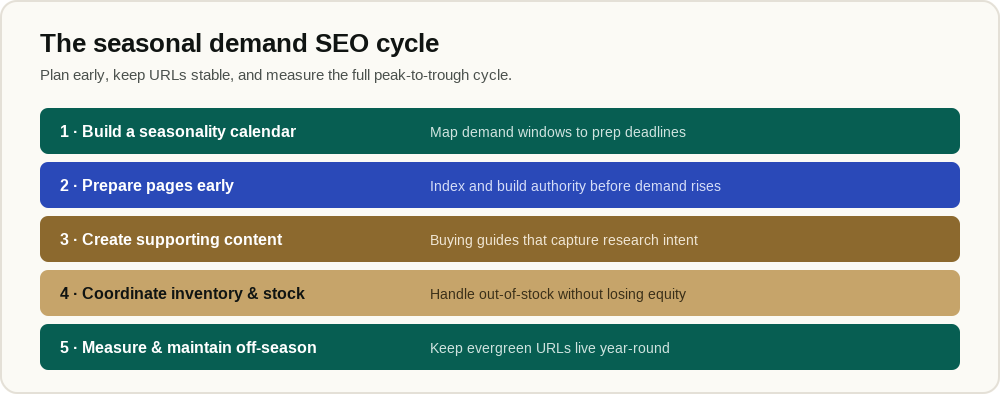
Use historical sales and search data, campaign calendars, merchandising plans, and regional considerations to identify likely demand windows. Search trends can inform timing but should not be treated as precise forecasts. Document the preparation deadline, expected product range, content owner, and inventory dependencies for each event.
Choose the right URL strategy
If a seasonal page has continuing value and may be reused, maintaining a stable URL can preserve useful history and simplify future updates. For temporary promotions, consider whether a campaign page is needed at all and how it will be handled afterward. Avoid creating near-identical URLs every year without a clear user or operational reason.
Prepare category and product pages early
Update titles, headings, copy, internal links, imagery, and relevant product selection before the peak. Confirm stock, delivery promises, returns, and regional availability. Do not advertise unavailable products as if they can be delivered on time. If a page is intended to remain useful year-round, avoid making all its content obsolete once the event ends.
Create helpful supporting content
Gift guides, planning checklists, product comparisons, seasonal care advice, and use-case content can support discovery when they answer real questions. Link them to appropriate categories and products. Keep recommendations accurate and disclose any commercial relationship where required. Do not create thin pages for every minor keyword permutation.
Coordinate inventory and out-of-stock handling
Review likely stock constraints and alternative products before demand peaks. When a product sells out, decide whether the page should remain with a clear availability message, point to a genuinely equivalent replacement, or return an appropriate status if discontinued. Do not redirect all unavailable products to a generic category automatically.
Measure the full cycle
Track search impressions, clicks, landing-page behaviour, conversions, and inventory status across preparation, peak, and post-season periods. Compare equivalent periods carefully and account for changes in assortment, pricing, and campaign support. Use the results to improve next year’s plan rather than relying on memory.
Post-season maintenance
Update content that remains useful, remove expired offers, correct dates and delivery promises, and decide whether the URL should remain available. Keep valuable evergreen resources live when they continue to serve users. Document what was learned about demand timing, stock, and content performance.
FAQ
Frequently asked questions
Begin early enough to research, prepare pages, and resolve technical issues before demand peaks; the exact lead time varies by category and market.
Not automatically. Consider ongoing user value, future reuse, links, and the availability of a relevant replacement.
It depends on whether the product is temporarily unavailable, permanently discontinued, or has a genuinely equivalent replacement.
No. Use it as one input alongside business history and inventory planning.
Similar posts
SEO
Ecommerce SEO for Seasonal Campaigns: Plan, Optimise, and Retain Search Visibility
11 min read

SEO
Ecommerce SEO for Out-of-Stock and Discontinued Products: Keep, Redirect, or Remove?
Learn how to handle out-of-stock and discontinued product pages without wasting SEO value. Use a practical framework for stock status, redirects, 404s, and internal links.
9 min read

SEO
Ecommerce Category Page SEO: How to Build Pages That Rank and Help Shoppers Choose
Learn how to optimise ecommerce category pages with better architecture, helpful copy, internal links, filters, and measurement.
15 min read
Related services
Related work