Ecommerce SEO
Ecommerce Product Reviews and Expert Content: Building Trust Without Inventing Authority

Customers often need evidence before buying. Genuine reviews, detailed specifications, expert explanations, comparison guidance, and clear policies can help them evaluate a product. But trust cannot be manufactured through fabricated testimonials, copied reviews, unsupported expertise claims, or structured data that exaggerates what the page contains. A strong review and content process is transparent about what is known, who contributed, and how information was gathered.
Quick answer
Honest criticism can provide useful context and make trade-offs clearer.
Key takeaways
- Ask for honest feedback using a consistent process.
- Compare products on attributes that matter to the intended buyer: dimensions, materials, compatibility, warranty, maintenance, use case, price, and limitations.
- Technical specialists, designers, product managers, or qualified reviewers may contribute valuable knowledge.
- Create rules for spam, abuse, personal data, irrelevant content, and genuine criticism.
Collect reviews responsibly
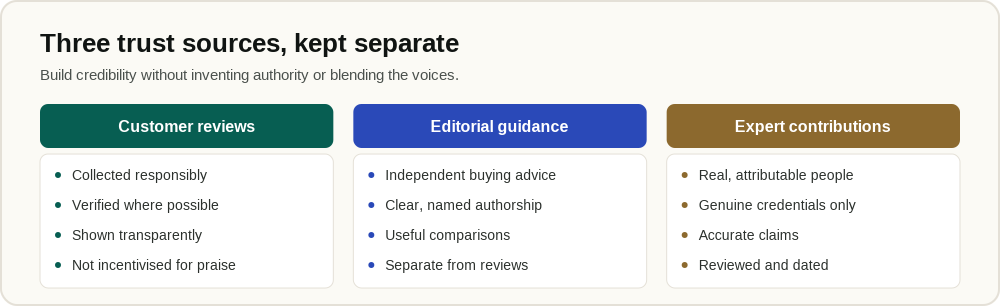
Ask for honest feedback using a consistent process. Do not condition incentives on positive sentiment or selectively suppress legitimate negative reviews. Follow applicable platform rules and legal requirements. Protect personal information and obtain permissions before reusing customer photographs or quotations in marketing materials.
Make product comparisons useful
Compare products on attributes that matter to the intended buyer: dimensions, materials, compatibility, warranty, maintenance, use case, price, and limitations. Explain how the products differ and which buyer needs each may suit. Avoid a comparison table that simply declares one product ‘best’ without transparent criteria.
Use expert contributions accurately
Technical specialists, designers, product managers, or qualified reviewers may contribute valuable knowledge. State their real role and scope. Provide author information that is accurate and avoid implying credentials that do not exist. A review process should be documented when technical, safety, health, or compliance claims are involved.
Moderation and maintenance
Create rules for spam, abuse, personal data, irrelevant content, and genuine criticism. Keep moderation decisions consistent. Review older expert guidance when products, specifications, or policies change. For products with safety implications, ensure claims and warnings receive appropriate review.
Measure quality, not just review count
Consider review coverage across priority products, usefulness of review detail, customer questions resolved, conversion behaviour where measurable, and support issues. A high review count alone does not prove trustworthiness. Treat correlation between reviews and sales cautiously because popular products may naturally receive more reviews.
FAQ
Frequently asked questions
Honest criticism can provide useful context and make trade-offs clearer.
Do not present synthetic text as a real customer experience. Use AI for internal assistance only where appropriate, with human review and clear boundaries.
No. Eligibility depends on current guidelines and search-engine decisions.
Add expert guidance where it genuinely helps buyers; do not create generic statements merely to appear authoritative.
Similar posts
CRO
Ecommerce Customer Reviews and UGC: Building Trust Without Manipulation
Learn how ecommerce brands can collect useful customer reviews, use user-generated content responsibly, and measure its role in product discovery and conversion.
12 min read

CRO
Ecommerce Product Page Optimisation: SEO, UX, and Conversion Checklist
Learn how to optimise ecommerce product pages for search visibility, customer confidence, and conversions with a practical product-page checklist.
17 min read

SEO
Ecommerce SEO Content Strategy: Build Useful Content That Supports Organic Growth
Build an ecommerce SEO content strategy with search-intent mapping, buying guides, category support, content quality checks, and measurement.
15 min read
Related services
Related work