Measurement
Ecommerce Customer Acquisition Cost (CAC): How to Calculate and Improve It

Learn how to calculate ecommerce CAC, distinguish paid and blended acquisition costs, evaluate profitability, and improve customer acquisition with a practical framework.
Quick answer
Ecommerce customer acquisition cost is the cost of acquiring a new customer, calculated by dividing the defined acquisition costs by the number of new customers gained over the same period.
Key takeaways
- Customer acquisition cost (CAC) estimates how much a business spends to acquire a customer.
- A basic formula is:
- A new customer is usually a person or account placing their first completed purchase with the business.
- These two views answer different questions.
Table of Contents
- 01What customer acquisition cost means
- 02The CAC formula
- 03Paid CAC vs blended CAC
- 04Which costs should you include?
- 05Why CAC is not the same as ROAS
- 06Connect CAC to contribution margin and customer lifetime value
- 07Segment CAC before making decisions
- 08How to improve ecommerce CAC
- 09Common CAC measurement mistakes
- 10A practical 30-day CAC improvement plan
- 11Frequently asked questions
- 12Recommended visuals and internal links
- 13SEO and publishing checklist
1. What customer acquisition cost means
Free tools: use the CAC calculator for CAC, LTV and payback, then work the other formulas with the marketing calculators and the eCommerce ad budget planner.
Customer acquisition cost (CAC) estimates how much a business spends to acquire a customer. For ecommerce, it helps connect marketing investment to the number of customers gained, not just clicks, sessions, or orders.
CAC is useful because growth can look strong while becoming less profitable. Revenue may increase as advertising spend rises, but if the business pays more to acquire each new customer than its economics can support, that growth may not be sustainable.
CAC is not a standalone verdict. Its meaning depends on what costs you include, which customers count as acquired, the time period, and whether you are measuring first-time customers or all purchasers. The goal is to define a consistent calculation and use it alongside contribution margin, retention, and cash flow.
2. The CAC formula
A basic formula is:
CAC = Acquisition costs ÷ Number of new customers acquired
For example, if a store spends PKR 600,000 on the acquisition costs included in its calculation and gains 300 new customers during the same period:
PKR 600,000 ÷ 300 = PKR 2,000 CAC
This is an illustrative calculation, not a market benchmark or a claim about any particular business.
The formula is simple; the measurement rules need care. Make sure the costs and new customers refer to the same period and business scope. If costs cover the full month but customer counts cover only part of it, the result will be misleading.
Define “new customer”
A new customer is usually a person or account placing their first completed purchase with the business. Decide how to handle:
For businesses with cash on delivery, it can be useful to distinguish first-time orders from first-time fulfilled customers. A placed order is not always a completed acquisition. Choose the measure that reflects the business question, and report it consistently.
- Cancelled and refunded orders.
- Cash-on-delivery orders that are refused or returned.
- Duplicate customer records across devices or checkout methods.
- Guest checkout and accounts created after purchase.
- Customers who purchased before the analytics system began recording history.
3. Paid CAC vs blended CAC
These two views answer different questions.
Paid CAC
Paid CAC measures the acquisition costs assigned to paid media divided by the new customers attributed to that media under a defined attribution method.
A simplified formula is:
Paid CAC = Paid media acquisition cost ÷ New customers attributed to paid media
Paid CAC is useful for campaign and channel decisions, but it depends on attribution settings and platform measurement. It may exclude creative production, agency fees, marketing staff, discounts, or other costs unless you deliberately include them.
Blended CAC
Blended CAC compares a broader set of acquisition costs with all new customers acquired in the period:
Blended CAC = Total included acquisition costs ÷ Total new customers acquired
The included cost scope might cover paid media, agency or contractor fees, creative production, relevant marketing tools, and allocated acquisition-team costs. Define the scope instead of assuming every company calculates it identically.
Blended CAC can help answer whether the overall acquisition system is becoming more or less efficient. It also captures customers who arrive through a mix of paid, organic, referral, direct, and other channels, though it does not by itself prove which channel caused each acquisition.
Use both, but label them clearly
A useful report may show:
Do not compare a narrow media-only CAC from one period with a fully loaded CAC from another and interpret the change as performance improvement.
- Platform-reported paid CAC.
- A business-calculated paid CAC using a consistent attribution rule.
- Blended CAC.
- New customers and fulfilled first-time customers.
- Contribution margin after acquisition costs, where available.
4. Which costs should you include?
There is no single scope that answers every management question. Create a definition that fits the decision and show the components.
Avoid mixing operating costs into CAC without a documented method. For many ecommerce decisions, it is clearer to report CAC separately from variable order costs, then calculate contribution after those costs.
The important rule is consistency: define the costs, document allocations, and do not change the formula silently between reports.
| Cost component | Include in media-only CAC? | Consider in broader CAC? |
|---|---|---|
| Advertising spend | Yes | Yes |
| Agency or freelance media fees | Usually no | Yes, if part of acquisition cost |
| Creative production | Usually no | Yes, if allocated consistently |
| Acquisition-team payroll | No | May be allocated |
| Marketing technology | No | May be allocated where material |
| Discounts and promotions | Not usually as acquisition spend | Track separately or include in a clearly defined economic view |
| Shipping, payment fees, fulfilment | Not acquisition spend in a narrow CAC calculation | Usually analyse in contribution economics rather than casually adding to CAC |
| Returns, refunds, COD refusals | Not media spend | Account for them when evaluating realised customer economics |
5. Why CAC is not the same as ROAS
ROAS measures attributed revenue relative to advertising spend:
ROAS = Attributed revenue ÷ Advertising spend
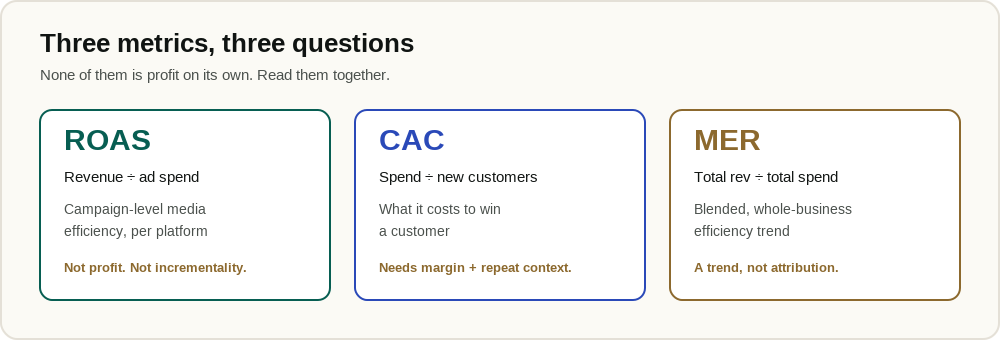
CAC measures acquisition cost relative to the number of customers acquired. ROAS can rise because existing customers place repeat orders, average order value increases, or attribution changes, even if the cost of acquiring new customers is worsening.
Likewise, a lower CAC does not automatically mean the business is more profitable. The customers may buy less, require heavier discounts, return more orders, or fail to make repeat purchases.
Use the metrics together:
Each metric has a different job. Avoid forcing one metric to answer every growth question.
- ROAS: How much attributed revenue is recorded per unit of ad spend?
- Paid CAC: How much paid-media cost is associated with each attributed new customer?
- Blended CAC: What does the broader acquisition system cost per new customer?
- Contribution margin: What remains after relevant variable costs?
- Retention and repeat purchase: Do acquired customers return and generate additional value over time?
6. Connect CAC to contribution margin and customer lifetime value
A sustainable acquisition decision depends on what a customer contributes, when that contribution arrives, and how reliably it can be measured.
Start with first-order contribution
A simplified first-order contribution calculation may begin with net sales and subtract cost of goods sold, discounts, payment fees, fulfilment and shipping costs borne by the business, and expected returns or other variable costs. The exact components depend on the company’s accounting and operating model.
If CAC is higher than first-order contribution, the first order does not cover acquisition cost under that model. That does not automatically make the customer unprofitable over their lifetime, but future repeat contribution must be supported by actual cohort evidence, not optimistic assumptions.
Use customer lifetime value carefully
Customer lifetime value (LTV or CLV) estimates the value a customer generates over a defined period. For decision-making, contribution-based lifetime value is generally more useful than revenue-only lifetime value because revenue does not account for product and servicing costs.
A simple conceptual comparison is:
Contribution-based LTV after acquisition = Expected customer contribution over the chosen period − CAC
This is a simplified framework, not a universal accounting formula. State the period, cost assumptions, and whether the estimate is observed or forecast.
Be cautious when a business has limited repeat-purchase history. Do not use an aspirational LTV:CAC ratio as permission to overspend. Track cohorts as they mature and compare forecast value with realised behaviour.
Consider cash-flow timing
Even if future repeat purchases eventually cover CAC, the business must fund inventory, fulfilment, refunds, and operating costs while waiting. A growth plan should consider payback timing and working capital, not only projected lifetime value.
7. Segment CAC before making decisions
An overall number can hide important differences. Where sample sizes are sufficient, analyse CAC by:
Attribution can assign credit differently across platforms and analytics tools. Treat channel-level CAC as a decision aid with known limitations, not a perfectly objective record of causation.
Do not over-segment tiny datasets. Small samples can swing sharply, and a highly detailed dashboard may create false certainty.
- Channel: Paid search, paid social, affiliates, email-assisted acquisition, organic search, and referrals.
- Campaign or objective: New-customer acquisition versus retention or remarketing.
- Product category: Different margins and repeat-purchase patterns can support different acquisition costs.
- Customer cohort: Acquisition month or quarter, then follow purchases and contribution over time.
- Geography: Delivery cost, payment behaviour, competition, and product demand may vary by market.
- Device and landing page: Differences may reveal friction, but validate the data before acting.
- Order outcome: Placed, confirmed, fulfilled, cancelled, returned, or refunded.
8. How to improve ecommerce CAC
The aim is not simply to lower CAC at any cost. The aim is to acquire appropriate customers at a cost the business can support while preserving customer quality and profitable growth.
8.1 Improve conversion before increasing spend
Review the journey from ad or search result to landing page, product page, cart, checkout, and fulfilled order. Check:
Improving conversion can reduce the cost required to generate an order, but only if the change improves real completed customers and does not reduce order quality.
- Message match between the ad and landing page.
- Product information, sizing, specifications, availability, and delivery expectations.
- Mobile speed and usability.
- Shipping fees, payment options, returns policy, and trust signals.
- Checkout errors and unnecessary steps.
- Whether the landing page serves the campaign’s intent.
8.2 Improve creative and audience-message fit
For paid social, test meaningful creative hypotheses: product benefit, use case, demonstration, comparison, proof, objection handling, and offer framing. Track new-customer outcomes and contribution where possible, not just low-cost clicks or engagement.
For search, review query intent, search terms, product availability, feed quality, landing-page relevance, and the distinction between branded demand and non-brand discovery.
Do not declare a winner from a handful of conversions. Set practical decision rules based on spend, conversion volume, business risk, and the likely size of the effect.
8.3 Fix measurement before optimising the number
Verify that purchase events, values, currency, refunds, and deduplication behave as intended. Compare platform reporting with order-management or ecommerce records. Investigate material discrepancies before using reported CAC to make budget decisions.
Separate new customers from returning customers where the data and platform capabilities permit. Otherwise, a campaign optimised for purchases may spend heavily on existing demand while the business interprets the result as new-customer acquisition.
8.4 Allocate budgets using economics, not a single dashboard metric
Give campaigns enough budget and time to produce interpretable data, but avoid protecting spend simply because a campaign has historically performed well. Evaluate marginal results: what happened to the next increment of spend?
A channel can show attractive average CAC while the latest budget increase acquires customers at a much higher cost. Scale in controlled steps, monitor lagging fulfilment and contribution data, and define conditions for holding or reversing an increase.
8.5 Strengthen organic and owned demand
SEO, useful content, email, lifecycle messaging, referrals, and customer experience can support acquisition efficiency over time. They are not free: they require people, tools, content, and operational effort. Include their costs where relevant in a broader view, and avoid claiming that every organic order was caused by a specific SEO activity.
The purpose is a more resilient acquisition mix, not to make one channel look artificially cheap by ignoring the work behind it.
8.6 Improve retention without confusing it with acquisition
Post-purchase communication, product quality, support, replenishment reminders, and relevant cross-sells can increase repeat contribution. Measure new-customer CAC separately from retention spend and repeat-purchase performance.
Retention may improve the economics of customers already acquired, but it does not retroactively lower the cost of acquiring them. Report acquisition and retention as connected, distinct parts of the growth system.
9. Common CAC measurement mistakes
- 01Counting orders instead of new customers. Multiple orders from one person can make acquisition look cheaper.
- 02Ignoring cancelled, refused, or refunded orders. A placed order may not become a real customer.
- 03Mixing cost scopes. Media-only and fully loaded calculations are not interchangeable.
- 04Comparing mismatched periods. Spend and customer counts must use aligned dates and appropriate conversion lag.
- 05Treating platform attribution as the whole truth. Platforms can overlap in credit for the same customer.
- 06Ignoring margin. Cheap acquisition is not necessarily profitable acquisition.
- 07Using projected LTV as a certainty. Forecasts need mature-cohort validation and transparent assumptions.
- 08Overreacting to small samples. Short windows and low volumes create volatility.
- 09Failing to separate new and returning customers. Purchase campaigns may not be dedicated acquisition campaigns.
- 10Changing definitions without documenting them. A new formula can look like a performance shift when only the measurement changed.
10. A practical 30-day CAC improvement plan
Week 1: Define and validate
Deliverable: A one-page CAC definition and measurement note.
- Write down the business definition of a new customer.
- Choose media-only, paid, and/or broader blended cost scopes.
- Confirm date ranges, currency, attribution windows, and reporting delays.
- Reconcile purchase counts against ecommerce or order-management records.
- Document how cancellations, returns, refunds, and COD outcomes are treated.
Week 2: Build a useful baseline
Deliverable: A baseline dashboard with definitions and data caveats.
- Calculate CAC for a consistent period.
- Separate new customers from returning customers where possible.
- Compare paid and blended CAC without mixing cost scopes.
- Add first-order contribution and order-quality indicators.
- Segment only where sample sizes support interpretation.
Week 3: Identify the main constraint
Deliverable: A prioritised test plan with owners and success criteria.
- Review the acquisition funnel and landing-page experience.
- Audit creative and search intent.
- Investigate tracking discrepancies and campaign attribution.
- Identify product, market, or fulfilment differences affecting contribution.
- Select one or two high-impact hypotheses rather than changing everything at once.
Week 4: Test and make a decision
Deliverable: A short decision log and next-month plan.
- Launch controlled creative, landing-page, or campaign changes.
- Set a review window appropriate to conversion volume and lag.
- Evaluate new-customer outcomes, contribution, and order quality.
- Record what changed and what the evidence supports.
- Decide whether to scale, continue testing, revert, or gather more data.
FAQ
Frequently asked questions
Ecommerce customer acquisition cost is the cost of acquiring a new customer, calculated by dividing the defined acquisition costs by the number of new customers gained over the same period.
Use CAC = included acquisition costs ÷ new customers acquired. Define which costs count, how a new customer is identified, and how cancellations or refunds are handled.
Paid CAC focuses on paid-media acquisition costs and customers attributed to paid channels under a chosen attribution method. Blended CAC uses a broader cost scope and total new customers across the business. The definitions must be documented to make comparisons meaningful.
No. A lower CAC is valuable only in context. Customer contribution, returns, retention, average order value, and cash-flow timing all affect whether acquisition is economically sound.
ROAS compares attributed revenue with advertising spend. CAC compares acquisition costs with the number of new customers acquired. A campaign can have strong ROAS without efficiently acquiring new customers, especially if returning-customer revenue is included.
For media-only CAC, these costs are usually excluded and should be labelled as such. A broader fully loaded calculation may allocate agency, creative, team, and technology costs using a consistent documented method.
Review it at a cadence that fits the business’s conversion volume and reporting lag. Monitor spend and leading indicators more frequently, but avoid making major decisions from incomplete cohorts or very small samples.
There is no universal good CAC. It depends on product margin, order value, fulfilment and return costs, repeat purchase behaviour, customer contribution, and cash flow. Calculate the acquisition cost the business can support instead of relying on a generic industry benchmark.
Similar posts
Measurement
ROAS vs CAC vs MER: Which Metrics Actually Measure Marketing Performance?
Understand ROAS, customer acquisition cost and marketing efficiency ratio, when each metric helps, and how to use them together for better growth decisions.
11 min read
Measurement
Break-Even ROAS: How to Calculate the Minimum Return Your Ecommerce Ads Need
Learn how to calculate break-even ROAS using contribution margin, understand its limitations, and set practical advertising targets for ecommerce profitability.
11 min read
Performance Marketing
Performance Marketing for Ecommerce: What Actually Drives Profitable Growth
A profit-first guide to ecommerce performance marketing: how to connect paid media, SEO, conversion optimisation and measurement into one system that grows revenue without sacrificing margin.
11 min read
Related services
Related work