AI Tools
AI Governance and Brand Safety for Marketers

As AI spreads through marketing teams, the risk is not dramatic failure but quiet, cumulative harm: a wrong fact published, an off-brand message, a privacy slip, an undisclosed synthetic asset. Governance is how you prevent that without slowing everyone down. It is not bureaucracy; it is a short, shared standard. This guide lays out a practical governance and brand-safety approach any marketing team can adopt quickly.
Quick answer
AI governance for marketing is a simple set of rules that keep AI use safe, accurate and on-brand: a human is always accountable for published output, facts are verified, brand voice and claims are checked, sensitive data is protected, disclosure rules are followed, and there is a clear list of what AI must never do alone. You do not need a huge policy document. You need a short, practical standard everyone follows, so AI makes your marketing faster without creating legal, factual or reputational risk.
Key takeaways
- AI governance is a short, practical standard, not a bureaucracy.
- Always keep a named human accountable for published output.
- Verify facts and claims, and protect brand voice and consistency.
- Protect sensitive data and follow disclosure rules.
- Define what AI must never do unsupervised, and keep the standard usable.
Why governance matters
Unmanaged AI use creates real exposure: inaccurate content that misleads customers, claims you cannot back, inconsistent or off-brand messaging, privacy breaches from pasting sensitive data, and undisclosed synthetic media. Any of these can cost trust, money or legal trouble. Light governance prevents most of it cheaply.
The core rules
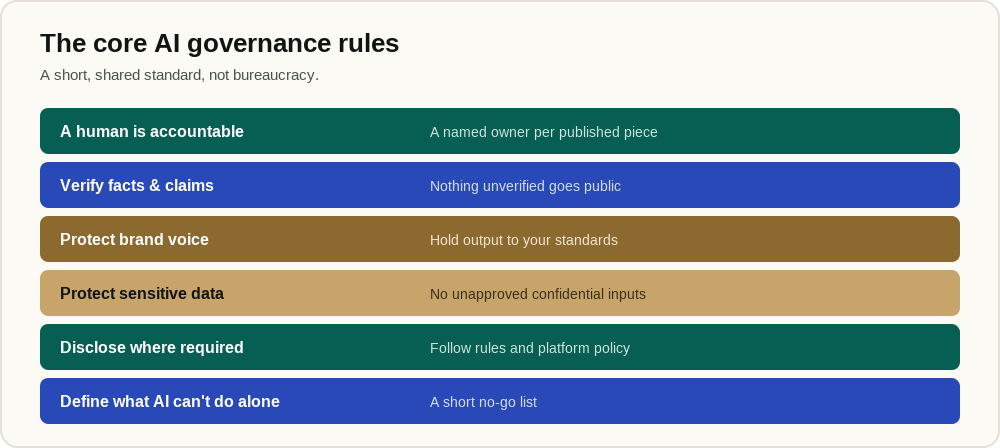
A human is always accountable
Every published piece has a named human responsible for it. AI assists; a person owns the result. This single rule prevents most problems.
Verify facts and claims
Check every fact, figure and claim before publishing. Never let unverified AI output become a public statement, especially anything comparative, regulated or quantified.
Protect brand voice and consistency
Hold AI output to your brand voice and messaging standards. Generic or off-brand content is a quality and safety issue, not just an aesthetic one.
Protect sensitive data
Do not paste confidential customer data, credentials or regulated information into tools without approval. Know what your tools do with inputs, and follow privacy law.
Disclose where required
Follow rules and platform policies on disclosing AI-generated or synthetic media, and never pass synthetic content off as something it is not.
Define what AI must not do alone
Keep a short list of actions AI never takes unsupervised: making claims, handling sensitive customer issues, publishing without review, or anything high-stakes.
Keep it light and usable
Governance fails when it is a document no one reads. Make it a one-page standard, build the checks into your existing workflow, train the team once, and review it periodically as tools change. The goal is safe speed, not red tape.
FAQ
Frequently asked questions
Yes, but keep it light: a one-page standard covering accountability, fact-checking, brand voice, data and disclosure. It prevents quiet, cumulative harm without slowing you down.
A named human is always accountable for published output. AI assists, but a person owns the result. This single rule prevents most AI-related problems.
Not without knowing what the tool does with it and whether it is approved. Protect confidential and regulated data, and follow privacy law. When in doubt, do not paste it.
Follow applicable rules and platform policies, and never present synthetic media as something it is not. Disclosure requirements vary, so check what applies to your channels.
Keep it to one page, build the checks into existing workflows, train once, and review as tools change. The aim is safe speed, not bureaucracy.
Similar posts
AI Tools
The AI Marketing Tool Stack (2026): A Practical Buyer's Guide
A practitioner's guide to building an AI marketing tool stack around jobs to be done: general assistant, content, ads, email, analytics and AI visibility. Lean and honest.
4 min read
AI Tools
How to Spot and Fix "AI Sludge" Content
AI sludge is generic, padded content made with little human input. How to recognise the tells, why it hurts, and how to fix it by adding expertise, specifics and a human voice.
3 min read
AI Tools
How to Build a Content Workflow with AI
A practical end-to-end content workflow with AI: plan, research and brief, draft, then edit, fact-check and add expertise, add visuals, publish and measure. Humans stay in charge.
3 min read
Related services