Performance Marketing
Agentic Ad Management: Hype vs Reality

"Let AI run your ads" is a growing pitch, and like most AI claims it mixes genuine capability with overreach. The platforms are already deeply automated, so some agentic behaviour is here. The question is how much to hand over, and where the line sits today between useful automation and risky autonomy. This guide separates what is real now from what is still marketing.
Quick answer
Agentic ad management is the idea of AI that runs campaigns with real autonomy: making changes, reallocating budget and optimising with little human input. Parts of this are real today, because platforms already automate bidding, targeting and placement. But full autonomy, an AI that strategises, spends and self-corrects with no oversight, is still hype. The sensible stance is to use the automation that works, keep humans accountable for goals, budgets and guardrails, and expand autonomy only as it proves reliable on your real account, not on a vendor's promise.
Key takeaways
- Agentic ad management is partly real: platforms already automate bidding, targeting and placement.
- Full, unsupervised autonomy over strategy and spend is still hype.
- Automation pursues the goals it is given; it does not understand your business.
- Humans must own goals, strategy, guardrails and oversight.
- Expand autonomy gradually, judged on real profit, not vendor claims.
What is already real
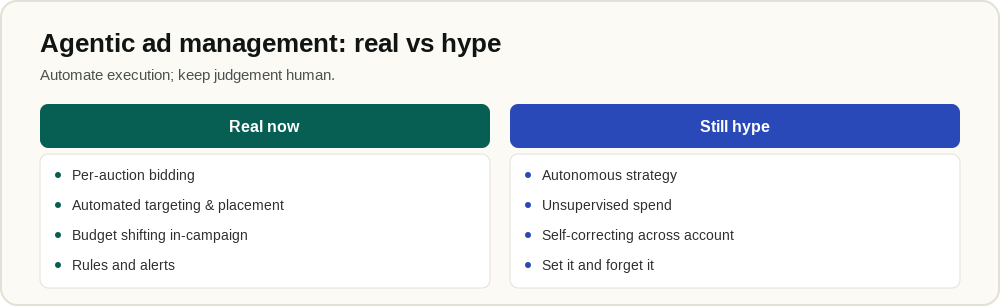
A lot of ad management is automated and works:
So "AI manages parts of your ads" is simply true. This is the real, useful core of agentic ad management.
- Bid management decided per auction by the platform.
- Targeting and placement handled by systems like Performance Max and Advantage+.
- Budget shifting within campaigns toward better performers.
- Automated rules and alerts you configure.
Where the hype outruns reality
The overclaim is full autonomy: an agent that sets strategy, judges what matters, spends freely and self-corrects across your whole account without human involvement. Today that is not reliable. Automation optimises toward the goals and signals it is given; it does not understand your business, margins or brand the way you do. Point it at the wrong goal and it will efficiently pursue the wrong thing. Unsupervised spending and strategy remain risky.
The human's irreplaceable role
Automation handles execution; judgement, context and accountability stay human.
- Set the right goal and value conversions by real profit, not vanity metrics.
- Decide strategy, positioning and what success actually means.
- Set guardrails: budgets, targets, exclusions, brand safety.
- Audit what the automation does and catch when it drifts.
How to adopt it sensibly
- Use the automation that demonstrably works, well fed and well bounded.
- Keep a human accountable for goals, budgets and oversight.
- Add autonomy incrementally, watching real results, not vendor claims.
- Never let an agent control strategy or unbounded spend unsupervised.
- Judge everything on profit, with validation like incrementality.
Where this is heading
Automation will keep getting more capable, and the band of what can be safely delegated will widen. The smart move is to learn the current tools deeply, build strong oversight habits, and expand autonomy as reliability earns it, rather than either rejecting automation or believing the set-and-forget promise.
FAQ
Frequently asked questions
Not reliably. Platforms already automate bidding, targeting and placement, so AI runs parts of campaigns well. But full autonomy over strategy and spend is still hype; it needs human goals, guardrails and oversight.
Per-auction bidding, targeting and placement through systems like Performance Max and Advantage+, budget shifting within campaigns, and rules you configure. This automation is real and useful when well fed and bounded.
Optimising toward the wrong goal. Automation efficiently pursues whatever goal and signals it is given, without understanding your margins or brand. Wrong goals or unsupervised spend can scale mistakes quickly.
Set the right profit-based goals, decide strategy and positioning, set budgets and guardrails, and audit what the automation actually does. Execution can be automated; judgement and accountability cannot.
Be sceptical. Use automation that proves itself on your real account, expand autonomy gradually on evidence, and never hand strategy or unbounded spend to an agent on a vendor's promise alone.
Similar posts
AI Search & GEO
Agentic AI for Marketing: What's Real and What's Hype
Agentic AI carries out multi-step tasks with some autonomy. The real near-term value is bounded, supervised workflows; fully autonomous marketing is still hype. How to adopt it sensibly.
3 min read
Google Ads
AI in Google Ads: Smart Bidding, Performance Max and Asset Generation
Google Ads is now AI-driven: Smart Bidding, Performance Max and generative assets. Where AI shows up, how to work with it, and the controls that keep automation honest.
4 min read
Meta Ads
AI in Meta Ads: A Practical Guide to Advantage+
Meta's Advantage+ automates targeting, placement and budget. Where it helps most, why strong creative is now your main lever, and how to measure on real profit.
3 min read
Related services