Local & International SEO
International Ecommerce SEO Operations: Localisation, Product Data, and Regional Governance

International ecommerce SEO is not simply translating a website and adding language tags. Regional storefronts may differ in language, assortment, price, currency, availability, shipping, legal information, and customer expectations. A reliable process aligns SEO architecture with the actual markets the business can serve, while keeping product data and technical signals consistent.
Quick answer
Not necessarily; choose a structure that fits the business and can be maintained reliably.
Key takeaways
- Decide how languages and regions will be represented in URLs and how users will move between them.
- Keyword research and category naming should reflect how customers in each market describe products.
- Regional pages should reflect actual availability, currency, pricing, taxes or charges where applicable, delivery terms, returns, and contact options.
- Where language or regional pages are equivalent alternatives, implement hreflang annotations according to current guidance and ensure references are consistent.
Choose the market and URL model deliberately
Free tool: build the tags with the hreflang tag generator, which checks codes, absolute URLs and the x-default fallback.
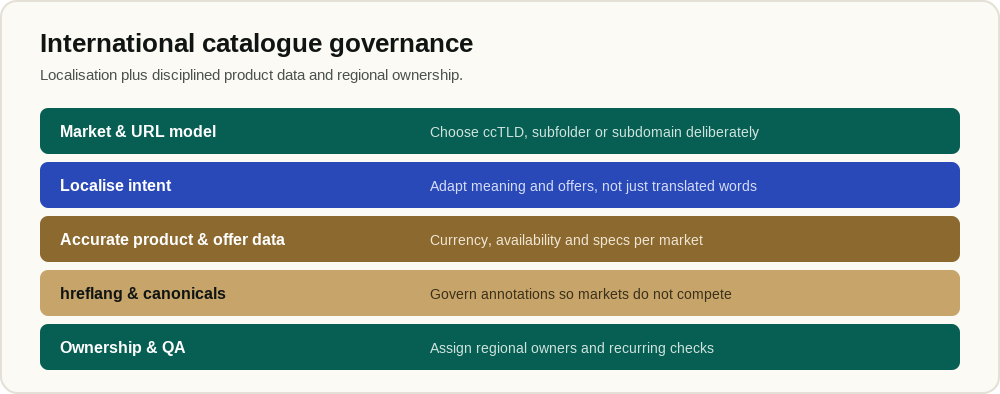
Decide how languages and regions will be represented in URLs and how users will move between them. Options may include country-code domains, subdomains, or subdirectories; each has operational trade-offs. Select a structure the organisation can maintain and localise. Avoid creating regional pages for markets where products, fulfilment, support, or relevant content are not genuinely available.
Localise intent, not only words
Keyword research and category naming should reflect how customers in each market describe products. A literal translation may not match local terminology or buying intent. Review measurements, sizing conventions, product names, spelling, imagery, and policy language. Use local reviewers for important claims and customer-facing details.
Keep product and offer data accurate
Regional pages should reflect actual availability, currency, pricing, taxes or charges where applicable, delivery terms, returns, and contact options. Ensure feeds and structured data match the local offer. Do not imply a product ships to a market if the business cannot fulfil it under the stated conditions.
Govern hreflang and canonicals
Where language or regional pages are equivalent alternatives, implement hreflang annotations according to current guidance and ensure references are consistent. Each page should use appropriate canonical signals; do not canonicalise all regional pages to one market if they are intended to be distinct indexable alternatives. Validate return references, language-region codes, and URL accessibility.
Assign ownership and QA
Define who approves translations, product data, market policies, hreflang, currency, feeds, and regional releases. Use a checklist for new market launches and recurring catalogue updates. Test representative URLs from every locale and check for mixed-language pages, missing translations, incorrect canonical tags, and broken regional links.
Measure by market
Segment Search Console and analytics data by country, language, URL group, and product category where useful. Compare like with like, accounting for different launch dates, assortment, seasonality, and market size. Do not assume that a successful strategy in one country will transfer unchanged to another.
FAQ
Frequently asked questions
Not necessarily; choose a structure that fits the business and can be maintained reliably.
No. Product content, terminology, policies, offer data, and user experience need appropriate localisation.
Not when they are genuinely distinct regional alternatives intended to be indexed; implement canonicals and hreflang according to the actual page relationship.
No. It helps communicate alternate versions but does not guarantee a specific result.
Similar posts
Local & International SEO
Ecommerce SEO for International Markets: A Practical Guide to Multilingual and Multiregional Sites
13 min read
Technical SEO
Ecommerce Product Data Quality: Connecting SEO, Merchant Feeds, and On-Site Experience
Connect SEO, merchant feeds and on-site experience with one source of truth. Consistent titles, identifiers, price, availability and images across every surface.
3 min read
SEO
Ecommerce SEO Audit: A Step-by-Step Technical, Content, and Indexation Checklist
13 min read
Related services
Related work