Measurement
Ecommerce SEO Reporting for Leadership: Turning Search Data into Decisions


SEO reporting becomes useful when it helps people make decisions. A dashboard filled with rankings, crawl counts, and traffic charts may describe activity without explaining what matters, what changed, or what the team needs next. Leadership reporting should connect search visibility to business priorities, explain uncertainty, identify risks, and make the next action clear.
Quick answer
Choose metrics tied to the business decision, often combining visibility, technical risk, delivery, and relevant commercial outcomes.
Key takeaways
- Before choosing metrics, ask what the report must help decide: whether to invest in a technical fix, prioritise a category, expand content, support a new market, or resolve a measurement problem.
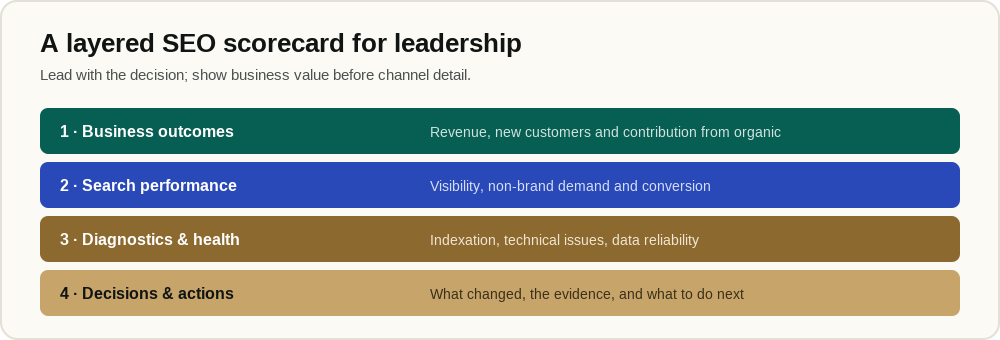
- A practical scorecard has four layers.
- State the comparison period, data source, definitions, known limitations, and material changes.
- A good report distinguishes what the data shows from what the team believes may explain it.
Start with the decision
Before choosing metrics, ask what the report must help decide: whether to invest in a technical fix, prioritise a category, expand content, support a new market, or resolve a measurement problem. Different decisions need different evidence. Avoid reporting every available metric simply because a tool provides it.
Use a layered scorecard
A practical scorecard has four layers. Visibility: clicks, impressions, query trends, and priority landing pages. Technical health: important defects, indexation patterns, redirects, and QA status. Delivery: completed work, blockers, and time to resolve critical issues. Business outcomes: organic landing behaviour, qualified leads, orders, or revenue where measurement is reliable.
Explain the context
State the comparison period, data source, definitions, known limitations, and material changes. Note seasonal effects, product availability, site releases, tracking changes, and market differences where relevant. Avoid comparing mismatched periods or mixing branded and non-branded performance without explanation.
Separate facts, hypotheses, and decisions
A good report distinguishes what the data shows from what the team believes may explain it. For example: fact, clicks fell on a particular category group; hypothesis, a recent template release may have contributed; next step, compare canonicals, rendering, and search query mix. This structure is more credible than presenting a correlation as a proven cause.
Build a useful narrative
Use a concise sequence: objective, result, explanation, risk, action. Highlight a small number of important changes and connect each to a decision or owner. Put detailed tables and URL-level exports in an appendix or linked tracker. Do not hide negative results; explain what was learned and how the plan will change.
Report business value responsibly
When connecting SEO work to revenue or leads, explain attribution limitations and avoid claiming that every organic conversion was caused by a specific SEO task. If reliable conversion data is unavailable, report the gap and the steps needed to improve measurement. Use illustrative calculations only when clearly labelled and never present them as actual client results.
Create an operating cadence
Use weekly reviews for delivery and technical risks, monthly reviews for performance and priorities, and quarterly reviews for investment and roadmap decisions. Assign owners to follow-up actions and track whether decisions were completed. A report without follow-through is an archive, not an operating tool.
FAQ
Frequently asked questions
Choose metrics tied to the business decision, often combining visibility, technical risk, delivery, and relevant commercial outcomes.
It can be a diagnostic signal, but it should not be used alone because query mix and search result layouts affect interpretation.
Explain the analytics model and its limits; avoid claiming perfect causal attribution.
Keep the main narrative concise and place detailed diagnostics in supporting material.
Similar posts

Measurement
Ecommerce SEO Reporting: KPIs, Dashboards, and Decisions That Drive Growth
12 min read

Measurement
Ecommerce Marketing Attribution: How to Understand Which Channels Drive Growth
Learn how to interpret ecommerce attribution across Google Ads, Meta Ads and GA4 without confusing attributed revenue with incremental growth.
10 min read

SEO
Ecommerce SEO Audit: A Step-by-Step Technical, Content, and Indexation Checklist
13 min read
Related services
Related work